Who is Jupiter?
Jupiter (Latin Iuppiter) was the supreme god of the Roman state and the central figure of the Capitoline Triad alongside Juno and Minerva. God of the sky, thunder, and lightning, he presided over oaths, treaties, and military victory. As Jupiter Optimus Maximus — “Best and Greatest” — he was not merely the Roman version of Greek Zeus but the divine guarantor of the Roman political order itself.
That civic weight is the key to understanding him. Where Greek myth dwells on Zeus's affairs and quarrels, Roman religion put Jupiter at the center of sovereignty: victory belonged ultimately to him, not to the general who won it.
Origins & history
Jupiter's great temple on the Capitoline Hill — traditionally linked with Rome's early kings and dedicated at the beginning of the Republic — made him inseparable from Roman power from the city's earliest recorded religion. His name descends from the same Indo-European sky-father root as Zeus (Dyeus-pater, “Sky Father”), but his Roman cult, offices, and political meaning are distinctly Roman rather than borrowed wholesale from Greece.
In Stoic theology he could be reinterpreted as the rational, providential principle running through the whole universe: Cicero's Stoic speaker Balbus, in De Natura Deorum, treats the world as governed by divine reason. Roman poets, meanwhile, freely preserved the older, passionate, anthropomorphic Jupiter of myth. A Roman could sacrifice to Jupiter publicly while philosophers debated what “Jupiter” ultimately meant.
Cult & worship
Jupiter was the highest recipient of Roman state cult. Oaths and treaties were sworn in his name; thunder and lightning were read as his signs. A victorious general celebrating a triumph processed through Rome to the Capitoline temple to lay his victory before the god — the ritual heart of the claim that Rome's success was divinely sanctioned. His chief priest, the Flamen Dialis, lived under an extraordinary web of ritual taboos that marked how sacred the god's service was. Under many titles — Optimus Maximus, Feretrius, Stator — he served the community at every level from the battlefield to the treaty table.
Greek equivalent
Jupiter was identified with Greek Zeus, and much of his narrative mythology — his loves, his disguises, his quarrels with Juno — is inherited from the Greek tradition through Latin poetry. But the identification is not the whole story. Zeus is king of the gods; Jupiter is that and the sacred guarantor of a specific political order. Reading the two side by side is the clearest way to see what was genuinely Roman about Roman religion.
Famous myths & stories
Empire without end
In Virgil's Aeneid, Jupiter delivers the great prophecy that fixes Rome's destiny — that he has given the Romans dominion without limit of space or time. The god of the sky becomes the author of history itself, underwriting the founding story of the Roman people.
The thunderer and the oath
Jupiter sends thunder and lightning as signs, sanctions victory, and stands behind every sworn oath. To break faith sworn in his name was not merely dishonest but an offense against the god who guaranteed the Roman order.
The moral tension
Jupiter's inherited myths — adulteries, disguises, coercion, dynastic violence — sit uneasily beside his civic role as guarantor of law. That contradiction was not lost on ancient readers; philosophers and, later, Christian critics used it to question the anthropomorphic gods of poetry.
Legacy & influence
Jupiter survives everywhere. The largest planet carries his name; the adjective “jovial” descends from the astrological character once assigned to it. Renaissance and Baroque painters returned again and again to his myths, and comparative religion still treats the sky-father as an archetype. Whenever a modern image reaches for a bearded, thunderbolt-wielding sky-king, it is reaching for Jupiter.
Symbolism
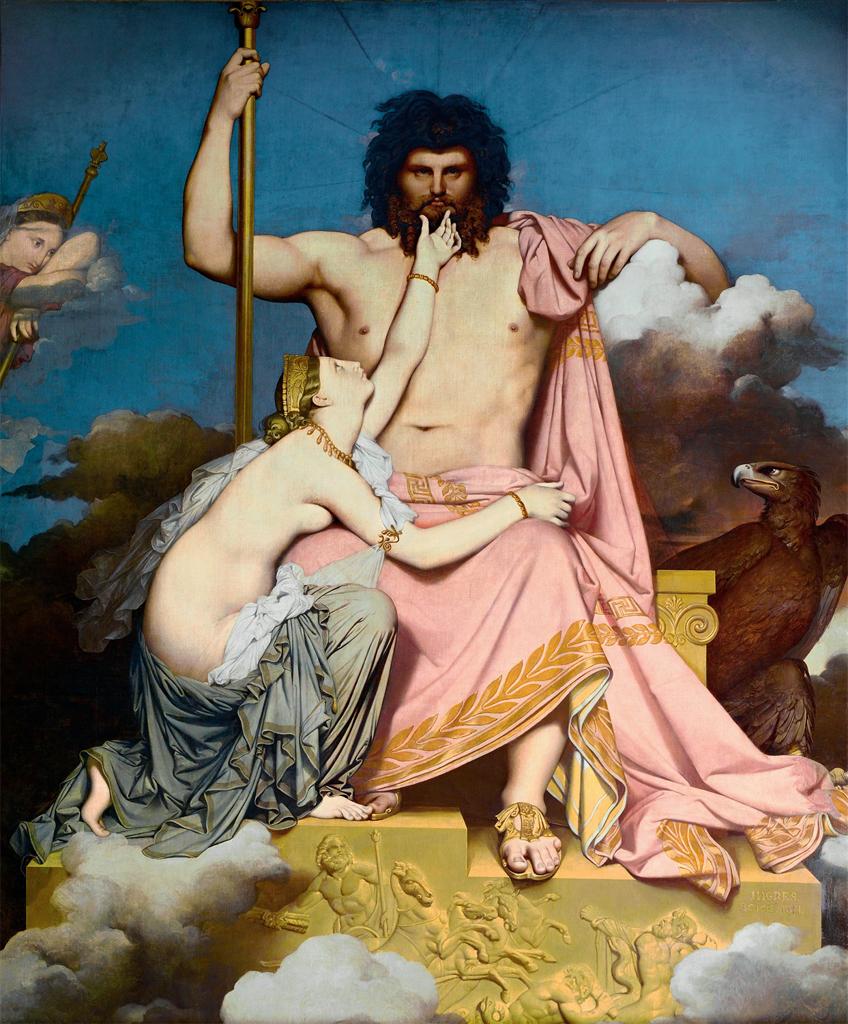
His symbols encode his nature: the thunderbolt is sanctioned force, the power to strike and to sanction; the eagle is sovereign height and far sight; the oak is endurance and the sacred tree associated with him; the sceptre is rule. Together they say what Roman religion meant by him — power that is also legitimacy, force that is also law.
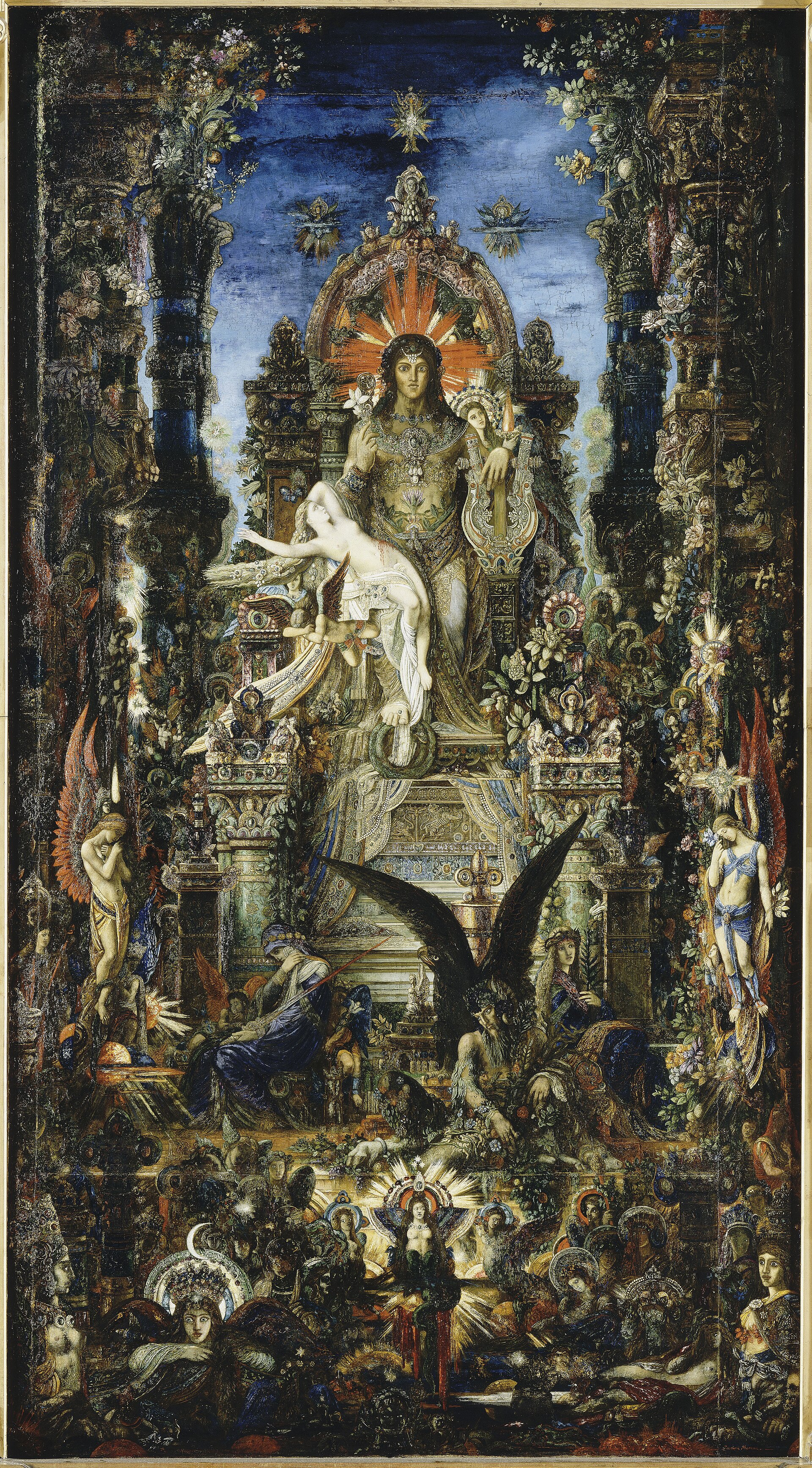
Famous public-domain depictions — click any image to view it full size.
Is Jupiter the same as Zeus?
They share the same sky-father mythology and were identified with each other, but Jupiter was not simply a Latin Zeus. As Jupiter Optimus Maximus he was the divine guarantor of the Roman state itself — of oaths, treaties, triumphs, and political order — a civic role that went well beyond Greek Zeus.
What was Jupiter the god of?
The sky, thunder and lightning, oaths, treaties, and military victory — the supreme god of the Roman state. With Juno and Minerva he formed the Capitoline Triad on the Capitoline Hill.
What does Jupiter Optimus Maximus mean?
“Jupiter Best and Greatest” (Iuppiter Optimus Maximus) — the title marking him as the highest recipient of state cult and the guarantor of Roman sovereignty.
How was Jupiter worshipped in Rome?
Through state cult at the Capitoline temple. Triumphal generals processed there to dedicate victories, oaths and treaties were sworn in his name, and his priest, the Flamen Dialis, lived under elaborate ritual restrictions.
 Michael Paycer