
Ruy Lopez Variations
After 3.Bb5 a6 4.Ba4 Nf6, Black stands at a crossroads. The reply to 5.0-0 defines the entire character of the game: a solid Berlin endgame, the rich positional Closed Lopez, an explosive Open Defense, or the sacrificial Marshall Attack. Each path leads somewhere completely different.
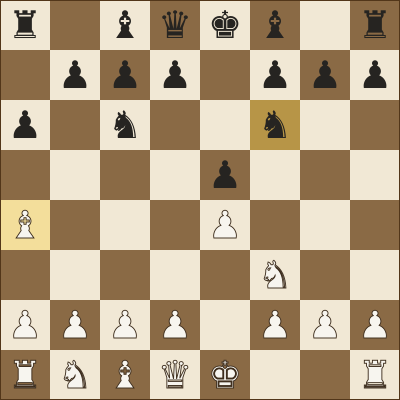
The Ruy Lopez branching point after 4.Ba4 Nf6 is one of the most studied positions in chess history. The choice of variation here defines White and Black's middlegame plan entirely.
Three-part deep dive on the Spanish Opening
ECO Codes
Berlin: C65–C67 · Closed/Morphy: C84–C99 · Open: C80–C83 · Marshall: C89
Branch Point
After 3...a6 4.Ba4 Nf6 5.0-0 — Black's fifth move determines which variation follows
Named For
Morphy Defense: Paul Morphy · Marshall Attack: Frank Marshall · Berlin: German school, 1840s
Complexity
Berlin: positional endgame · Closed: rich middlegame · Open & Marshall: sharp theory
After 4.Ba4 Nf6 — where theory branches
When White retreats the bishop to a4 after 3...a6, Black most commonly replies with 4...Nf6 — attacking the e4 pawn and forcing White to make a decision. White almost always castles with 5.0-0, and Black's response defines the entire game:
Black's options at move 5 (and earlier at move 3) are:
- 3...Nf6 — the Berlin Defense, immediately counterattacking e4
- 5...Be7 — the Morphy / Closed Defense, solid and classical
- 5...Nxe4 — the Open Ruy Lopez, winning a pawn immediately
- 5...Be7 → 8...d5 — the Marshall Attack, a deferred pawn sacrifice
Position after 1.e4 e5 2.Nf3 Nc6 3.Bb5 a6 4.Ba4 Nf6 — White has castled (5.0-0) and Black must now choose. The highlighted Ba4 has retreated from b5 after 3...a6, but remains pointed at the c6 knight.
The Berlin Defense — 3...Nf6
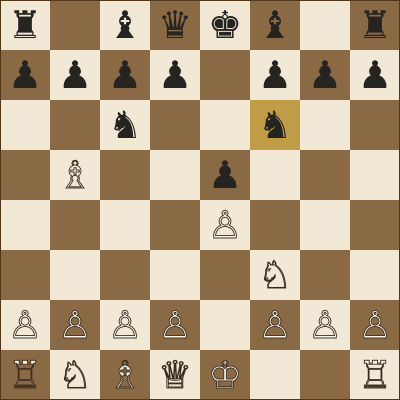
Black immediately attacks the e4 pawn, forcing White to make a decision before the bishop question on b5 is resolved.
The Berlin begins with 3...Nf6, attacking e4 at once. White most commonly plays 4.0-0, allowing Black to take with 4...Nxe4. After 5.d4 Nd6 6.Bxc6 dxc6 7.dxe5 Nf5, the game often reaches the famous Berlin Endgame after 8.Qxd8+ Kxd8.
Black pays a serious price for the pawn — losing the right to castle means the king must walk to safety manually. But Black gains the bishop pair and a solid, doubled-pawn structure that is notoriously difficult to crack. The resulting endgame positions are rich with subtle maneuvering.
Why the Berlin became elite's favorite
Vladimir Kramnik shocked the chess world at the 2000 World Championship by employing the Berlin against Garry Kasparov in every game where Kasparov played 1.e4. Kasparov — widely considered the greatest player in history — could not find a way to win any of those games. The Berlin became synonymous with "equalizing without risk." Magnus Carlsen and virtually every top-10 player in the world now has the Berlin in their repertoire.
Berlin Pros
- Bishop pair gives long-term compensation
- Extremely solid — hard for White to attack
- Well-suited to players who excel in endgames
- Forces White into a slow technical game
Berlin Cons
- Black loses castling rights early
- Doubled c-pawns are a long-term structural weakness
- Endgame demands high technical precision
- Not well-suited to attacking players
The Closed Ruy Lopez — 5...Be7
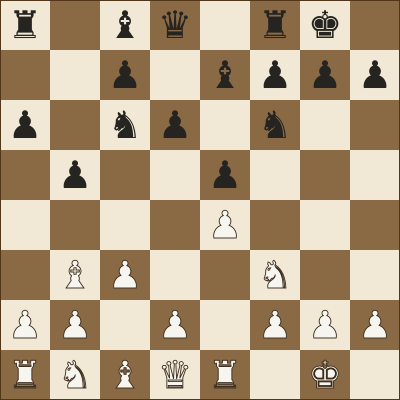
The Closed Lopez — also called the Morphy Defense — is the backbone of Ruy Lopez theory. After 3...a6 (the Morphy Defense move), Black expels the bishop to a4, then follows up with 4...Nf6 and 5...Be7. White castles, plays Re1, and the bishop retreats to b3 after 6...b5. Both sides castle and the stage is set for a long, strategically rich middlegame.
White's plan is straightforward: play c3 and d4, establishing a powerful pawn center. Black's response is to generate counterplay — typically with ...d6, ...Nb8-d7 rerouting the knight, and eventually ...d5 at the right moment to strike back. The tension can last for dozens of moves.
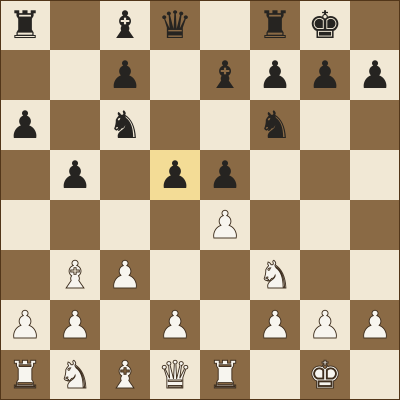
This position — after 11...Qc7 — is one of the most analyzed in chess history. Black has the knight on a5 pressuring the Bc2, and has established the c5 break. White fights for the center. Decades of grandmaster games have explored every subtlety of this position.
Champions of the Closed Lopez
Fischer's collected games in the Ruy Lopez — particularly in the Closed Defense — were almost exclusively in this line. Karpov's hyperaccurate technique thrived here. Anand and Carlsen both use the Closed Lopez as White regularly, citing its ability to generate pressure without overextending. As Black, players like Geller, Spassky, and Leko have found deep resources in the counterplay lines.
The Open Ruy Lopez — 5...Nxe4
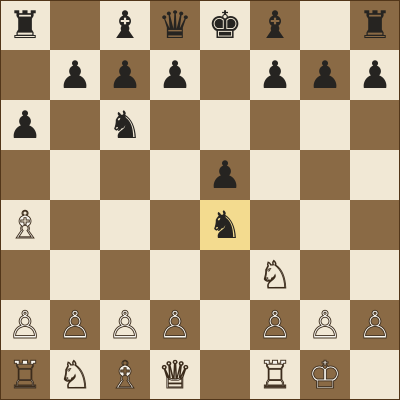
Instead of the solid 5...Be7, Black plays aggressively with 5...Nxe4, immediately capturing the e4 pawn. White cannot win the piece back immediately because 6.Re1 would be met by 6...Nc5. Instead, the main line runs 6.d4 b5 7.Bb3 d5 8.dxe5 Be6, and a tactical battle ensues over the center.
Material ends up level — Black captured e4, White captured e5 — but the resulting positions are unbalanced and dynamic: both sides have active pieces and real winning chances. The Open Lopez is fully theoretically sound and is a sharp alternative for players who want to fight for equality actively rather than accepting White's spatial pressure.
Key Ideas for Black
- Keep the d5 pawn and the e6 bishop solidly defended
- Keep the bishop on e6 or b3 diagonal active
- Use the d5 advance to contest the center
- Castle queenside in some lines for attack
Key Ideas for White
- Recover material quickly with c3-d4 and Nd2
- Use the e5 pawn as a space advantage
- Pressure the e4 knight before Black consolidates
- Play for the long-term bishop-pair advantage
The Marshall Attack — 8...d5
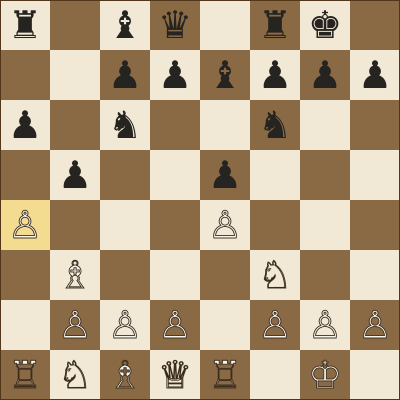
The Marshall Attack is one of the most daring and well-known pawn gambits in all of chess. After following the main-line Closed Lopez through move 7, Black ignores the standard 8...d6 and instead hurls the d-pawn forward with 8...d5. The pawn is almost always accepted with 9.exd5 Nxd5 10.Nxe5 Nxe5 11.Rxe5 c6, giving Black a powerful initiative and attacking chances against the White king in return for a pawn.
After 13...Qh4, Black has active piece play pointed at the White king and compensation for the pawn. This position has been analyzed to extraordinary depth — some lines are mapped out to move 30 or beyond. The Marshall is an opening where detailed theoretical preparation is essential for both sides.
Frank Marshall vs. José Capablanca, 1918
Frank Marshall had prepared the 8...d5 idea for years before finally springing it on José Raúl Capablanca in New York, 1918. Capablanca — facing the novelty for the first time over the board — found strong replies and won the game. But Marshall had demonstrated that the concept was sound, and subsequent analysis proved the Marshall Attack was a legitimate weapon. It remains in active use at the highest levels today.
The Anti-Marshall
White can sidestep the Marshall Attack entirely by playing 8.a4 instead of 8.c3. This "Anti-Marshall" avoids the well-prepared Black preparation by expanding on the queenside first. The Anti-Marshall remains popular at top level — Magnus Carlsen uses it regularly — as it forces Black out of the heavily-analyzed 8...d5 lines while keeping the initiative.
Which Ruy Lopez should you play?
The best variation depends on your playing style, preparation depth, and whether you're playing White or Black. Here is a brief comparison:
Berlin Defense
Best for: Endgame specialists, players who want solid draws, defenders who thrive in technical positions.
Avoid if: You prefer sharp, tactical middlegames or like to attack the opponent's king.
Open Ruy Lopez
Best for: Tactical players who like immediate complexity and are comfortable with material imbalances.
Avoid if: You prefer quieter positions — the Open forces sharp play from move 5 onwards.
Closed / Morphy Defense
Best for: Players who like long strategic battles, positional fighters, those who enjoy nuanced maneuvering.
Avoid if: You are impatient — the Closed Lopez can require 30+ moves of careful preparation before the position opens.
Marshall Attack
Best for: Theoretically well-prepared players with attacking instincts. The Marshall rewards home preparation.
Avoid if: You play without preparation — the Marshall requires knowing long forcing lines or risk losing material with nothing to show for it.
Ruy Lopez Variations — FAQ
What is the most popular Ruy Lopez variation?
The Closed Ruy Lopez (Morphy Defense) is the most frequently played variation at all levels, arising after 1.e4 e5 2.Nf3 Nc6 3.Bb5 a6 4.Ba4 Nf6 5.0-0 Be7 6.Re1 b5 7.Bb3. It leads to rich positional middlegames with opportunities for both sides. The Berlin Defense has surged in popularity at elite level since Kramnik used it to win the 2000 World Championship against Kasparov.
Is the Berlin Defense a draw?
Not necessarily. The Berlin leads to simplified endgames after 3...Nf6 4.0-0 Nxe4 5.d4 Nd6 6.Bxc6 dxc6 7.dxe5 Nf5 8.Qxd8+ Kxd8. Black loses castling rights but gains the bishop pair. Kramnik's famous neutralizations of Kasparov in 2000 gave the Berlin its "drawing" reputation, but modern theory shows many decisive games at all levels.
What is the Marshall Attack in chess?
The Marshall Attack is an aggressive pawn sacrifice by Black: after the main-line Closed Lopez through move 7, Black plays 8...d5 instead of the standard 8...d6. Black sacrifices a central pawn for a dangerous initiative against the White king. American master Frank Marshall invented the idea and debuted it against Capablanca in 1918 — losing the game but establishing a theoretically active weapon still used at the highest level today.
What is the Open Ruy Lopez?
The Open Ruy Lopez arises when Black plays 5...Nxe4 after 5.0-0, immediately winning White's e4 pawn. Black accepts sharp, unbalanced complications in return for material. After 6.d4 b5 7.Bb3 d5 8.dxe5 Be6, both sides have genuine winning chances. The Open Lopez is fully sound and suitable for players who prefer dynamic, double-edged positions over long positional battles.
Which Ruy Lopez variation is best for beginners?
The Closed Ruy Lopez is most accessible for beginners because the plans are clear and systematic: White plays c3-d4 to establish a center, Black fights back with ...d5 at the right moment. The Berlin requires precise endgame technique and the Marshall Attack requires memorizing extensive theoretical lines — both are better suited to more experienced players with a solid foundation.
What is the difference between the Open and Closed Ruy Lopez?
The defining difference is Black's response on move 5. In the Closed Lopez, Black plays 5...Be7, keeping material balanced and aiming to fight for counterplay later in the middlegame. In the Open Lopez, Black plays 5...Nxe4, immediately winning a pawn and accepting sharp, tactical complications. The Closed leads to slow maneuvering; the Open leads to immediate tactical battles.
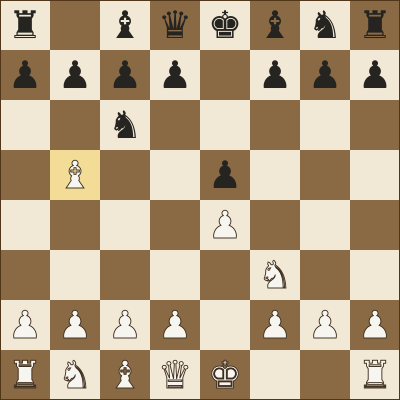
The early moves of the Ruy Lopez set the strategic direction — every variation begins with the same three moves before diverging.
The Closed Lopez middlegame is famous for its strategic depth — pawn structures built over the first 12-15 moves often decide games in the endgame 40 moves later.
The Marshall Attack and Open Lopez lead to tactical fireworks from the opening phase — both variations reward well-prepared, attacking players.
- Kasparov, G. (1995). My Great Predecessors, Part I. Everyman Chess.
- Nunn, J., Burgess, G., Emms, J., & Gallagher, J. (2010). Nunn's Chess Openings. Gambit Publications.
- Watson, J. (2003). Secrets of Modern Chess Strategy. Gambit Publications.
- Khalifman, A. (2000). Opening for White According to Anand 1.e4. Chess Stars.
- Chess Informant Database — Ruy Lopez theory files (ECO C65–C99).
- Kramnik, V. (2000). World Chess Championship press interviews on the Berlin Defense.
Three-part deep dive on the Spanish Opening
Every opening belongs to a family — browse the three theme clusters: Romantic & Attacking Gambits · Flank & Hypermodern Systems · Solid Defenses.
The Ruy Lopez is one of nine openings covered in depth on this site
From the Sicilian Defense to the Queen's Gambit, the chess opening guides on michaelpaycer.com cover the most important lines with the same depth — board diagrams, strategic ideas, history, and FAQ for each.