Ruy Lopez — Advanced
Breyer Variation, Zaitsev System, Marshall Attack, and the strategic structures that define grandmaster-level Ruy Lopez play.
Closed Ruy Lopez
main lines
Black: ...c5 or ...d5 counter-breaks.
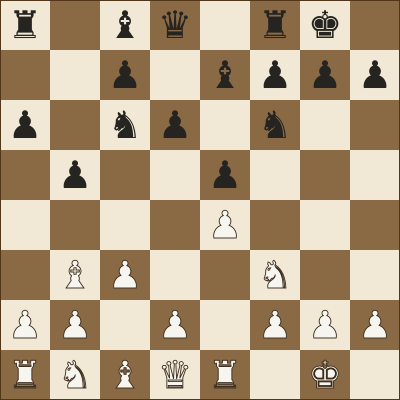
The Closed Lopez Tabiya: After 9.h3
The closed Ruy Lopez main line converges on one of the most theoretically rich positions in chess after just nine moves. Every serious player — from World Champions to ambitious club players — has to answer the question that arises here.
White's moves tell a story: the bishop went to b5, then retreated to a4 when Black played ...a6, then again to b3 when Black played ...b5. On b3 it sits like a coiled spring — exerting lasting pressure on the f7 square, the d5 outpost, and the entire dark-squared complex on the kingside. White's 9.h3 prevents ...Bg4 and prepares the d4 advance.
Without 9.h3, Black can play ...Bg4, pinning the Nf3 and reducing White's central control. The h3 move also prepares 10.d4 without allowing ...Bg4 after the d-pawn moves. It is not a luxury — it is the move that makes the entire closed Lopez system work.
The Breyer Variation: 9...Nb8!
The Breyer Variation stands as one of the great paradoxes of chess opening theory: the strongest response to White's setup is to retreat a knight to its starting square on move 9. Introduced by Hungarian master Gyula Breyer in the early 20th century and later refined by Karpov and Kramnik, the Breyer is today considered Black's most theoretically sound choice.
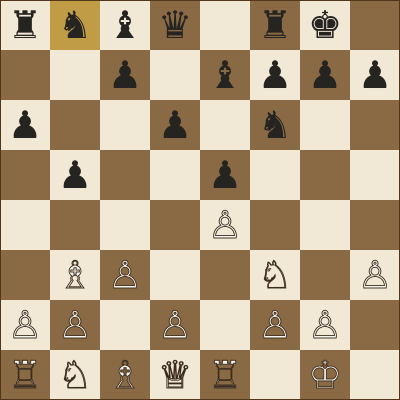
The logic behind 9...Nb8: the knight was misplaced on c6, blocking the ...c5 push and the queenside bishop. By retreating to b8, Black plans to redeploy it to d7, then f8 or e6 — positions where it actively supports the kingside and prevents White's d5 advance.
- c6 → b8 (the retreat)
- b8 → d7 (10...Nbd7)
- d7 → f8 (supports g6, covers e6)
- f8 → e6 or g6 (active in the center)
- ...c5 — challenge White's center
- ...Bb7 — activate the queenside bishop
- ...Re8 — support the e5 pawn
- ...g6, ...Bg7 — prepare the kingside
Anatoly Karpov used the Breyer as his primary weapon in the 1970s and 1980s, achieving landmark victories. Vladimir Kramnik further refined it and played it in his match against Kasparov in 2000. The variation demands extraordinary positional understanding — both sides maneuver for decades of opening theory.
The Zaitsev Variation: Kasparov's Weapon
While Karpov favored the Breyer, his great rival Garry Kasparov chose the Zaitsev Variation for the biggest moments of his career. The Zaitsev activates the bishop first — 9...Bb7 — before committing the knight, creating more immediate dynamic counterplay than the patient Breyer.
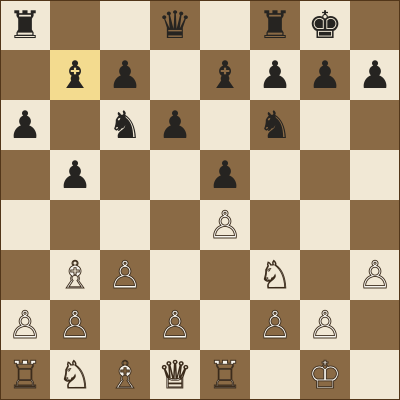
With 9...Bb7, the bishop activates along the a8-h1 diagonal, bearing down on White's king. After 10.d4 Re8, Black immediately increases pressure on e4. The tension typically breaks when Black captures on d4, after which the Nb4 maneuver hits the Bc2 and creates tactical complications that favor Black's dynamic piece play.
In their legendary World Championship matches, Kasparov and Karpov fought dozens of battles in the closed Ruy Lopez. Kasparov employed the Zaitsev in Game 16 of the 1986 match, producing one of the most famous games of the 20th century. The Zaitsev remains "Kasparov's opening" even today — a testament to how one player can define a variation through brilliant practical results.
- ...Bb7 activates the bishop immediately
- ...Re8 pressures the e5 pawn support
- ...exd4 opens the center at the right moment
- ...Nb4 creates tactical threats against Bc2
- ...d5 potential central break
- 13.Bc2 — the modern main line
- 13.Bb2 — fighting for the diagonal
- a4 expansion — typical queenside pressure
- Nf1-Ng3 — king attack preparation
- d5 advance — space grab in the center
The Chigorin Variation: Classical Solidity
The Chigorin Variation — 9...Na5 — takes a different approach: Black exchanges the bishop on b3, simplifying the position while establishing a knight on the strong c4 outpost. Named after the great 19th century Russian master Mikhail Chigorin, this was also heavily used by Anatoly Karpov.
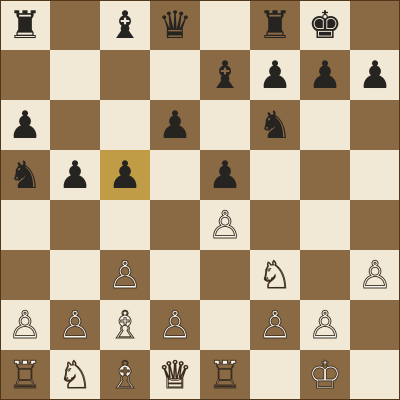
After 9...Na5 10.Bc2 c5, Black immediately challenges the center. The Na5 eyeing c4 combined with ...c5 pressuring d4 gives Black a clear, understandable plan. The position is slightly less sharp than the Zaitsev — Black accepts a slight inferiority in return for safer, more predictable play. Ideal for players who prefer concrete plans over dynamic complications.
The Marshall Attack: Pawn Sacrifice for the Ages
The Marshall Attack — 8...d5!? — is Black's most dangerous weapon in the Ruy Lopez. Named after Frank Marshall, who prepared it in secret before unleashing it against Capablanca at New York 1918, it sacrifices a pawn immediately for overwhelming piece activity. Modern theory, refined over a century of play, has established that White can survive with precise play — but one inaccuracy and the king is in immediate danger.
After 12...Bd6 13.Re1 Qh4, Black has three pieces aiming at the kingside, and the threat of ...Nf4 is devastating. White must find 14.g3 Qh3 15.Be3! (or similar precise defense) to survive. The Marshall's main line has been analyzed to near-theoretical exhaustion, but Black's piece activity makes it dangerous even against well-prepared opponents.
- 8.a4 — most popular sidestep; fights for a4-b5 space
- 8.h3 — delay ...d5 but still allow it later
- 8.d4 — immediate center confrontation
- 8.d3 — quiet, avoids theory entirely
- Highly effective if White doesn't know the theory
- Black gets immediate attacking chances
- White must find specific defensive moves
- Consider 8.a4 (Anti-Marshall) to sidestep it
- The gambit is objectively dubious but practically dangerous
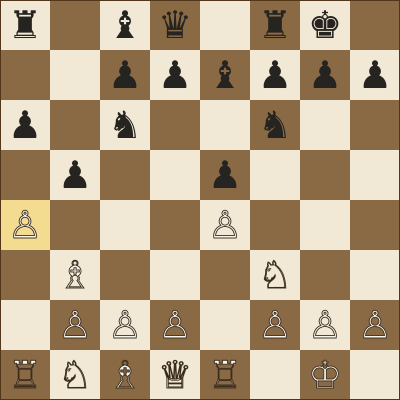
With 8.a4, White attacks the b5 pawn and sidesteps the Marshall entirely. After 8...Bb7 9.d3 d6, play transposes into a slow maneuvering battle where White's space advantage on the queenside matters more than tactical tricks. Most club players with White benefit from learning 8.a4 rather than the Marshall's defense.
Structural Themes: What Makes the Closed Lopez Tick
Beyond the specific variations, the closed Ruy Lopez teaches structural lessons that carry over to dozens of other openings. Understanding these themes is more valuable than memorizing twenty moves of theory.
The Lopez Bishop (Bb3)
The bishop retreated to b3 after 7.Bb3 looks passive but is one of the most powerful pieces on the board. It points at f7, controls d5, and cannot be easily challenged. White should avoid trading this bishop unless gaining something concrete in return. In many endgames, Bb3 versus Black's dark-squared bishop is a structural advantage that wins slowly.
The d5 Advance
White's strategic dream in the closed Lopez is to play d5, gaining space and fixing Black's pawn structure. Black must constantly prevent this by controlling d5 with ...Nc6, ...Nd7, and ...c6 if necessary. When White does achieve d5, the resulting position has similar themes to the Catalan or Botvinnik Semi-Slav — a queenside space advantage that Black must neutralize with active piece play.
Black's Queenside Counterplay
Black's counterplay in the closed Lopez almost always involves the ...c5 or ...d5 breaks. The ...c5 push (especially after ...Na5-c4) challenges White's center directly and creates queenside play. The ...d5 break (often in the Zaitsev) opens the position explosively. Black's b-pawn on b5 is also a long-term asset — it restricts White's a-file and supports queenside expansion.
Endgame Considerations
Closed Lopez endgames are typically won by whoever converts their structural advantages most efficiently. White usually has the bishop pair and slightly more space; Black has solid pawn structure and active pieces. Karpov was the supreme practitioner of closed Lopez endgames — converting minimal advantages through precise technique over 60+ moves. Study his games against Unzicker, Portisch, and Hübner for model Lopez endgame play.
Champions of the Ruy Lopez
Anatoly Karpov (White and Black)
Perhaps the greatest Ruy Lopez player in history, Karpov used the Breyer and Chigorin as Black and the closed Lopez as White to devastating effect throughout the 1970s and 80s. His understanding of long-term positional pressure in this opening was unmatched. Study his games for model queenside expansion themes and endgame technique.
Garry Kasparov (Zaitsev)
Kasparov's Zaitsev Variation games against Karpov represent the pinnacle of dynamic Lopez play. His treatment of the ...exd4, ...Nb4 ideas, and long-term piece activity produced some of the most brilliant games ever played. Game 16 of their 1986 match (Kasparov's Zaitsev win) is essential study material for any serious player.
Vladimir Kramnik (Breyer)
Kramnik refined the Breyer Variation to near-perfection in the 1990s and 2000s, using it as his main weapon in World Championship play. His solid positional handling of the Breyer setup — with precise piece coordination and endgame technique — showed how the variation could be used at the very highest level without risk.
Magnus Carlsen (Modern Interpretation)
Carlsen plays the Ruy Lopez with both colors and has introduced new move orders and ideas into the classical systems. His willingness to accept slightly inferior endgames and convert them through technique reflects the modern GM approach — less theory-reliant, more focused on creating imbalances that suit his play style.
Frequently Asked Questions
The closed Ruy Lopez tabiya arises after 1.e4 e5 2.Nf3 Nc6 3.Bb5 a6 4.Ba4 Nf6 5.0-0 Be7 6.Re1 b5 7.Bb3 d6 8.c3 0-0 9.h3. This position of enormous strategic complexity has been played in thousands of grandmaster games. From here, Black chooses between the Breyer (9...Nb8), Zaitsev (9...Bb7), Chigorin (9...Na5), and other systems. Mastering the tabiya is essential because most serious Ruy Lopez games converge here within 9 moves.
The Breyer Variation retreats the knight all the way back to b8. The idea is to reroute it to d7 and then f8 or e6, where it supports key squares without blocking the bishops. After 10.d4 Nbd7 11.Nbd2 Bb7, Black has a harmonious setup where all pieces work together. The Breyer is considered the most principled modern response, favored by Karpov, Kramnik, and current top players.
The Zaitsev — 9...Bb7 — immediately activates the queenside bishop before White can play d4. After 10.d4 Re8, Black prepares ...Bf8 and counterplay against White's center. The Zaitsev creates dynamic imbalances and excellent tactical counterplay. Kasparov used it extensively against Karpov in their World Championship matches, scoring stunning victories in their greatest games.
The Marshall Attack — 8...d5!? — sacrifices a pawn for massive piece activity. After 9.exd5 Nxd5 10.Nxe5 Nxe5 11.Rxe5 c6, Black gets enormous pressure against White's king. Most practical players use the Anti-Marshall (8.a4) to sidestep the gambit. At club level, accepting the Marshall requires memorizing many sharp lines; 8.a4 gives a normal positional battle without the theoretical burden.
The closed Lopez typically results in White having a broad center (d4-e4 pawns) and queenside space, while Black has a compact structure with a6-b5 pawns. White pursues the d5 advance or queenside expansion with a4. Black counters with ...c5 or ...d5 breaks. The Bb3 exerts long-range pressure on f7 and d5, making it the most important piece despite appearing passive.
Yes — the Ruy Lopez remains one of the most important openings at GM level and in World Championship play. Carlsen, Caruana, and other top players use it regularly. The Breyer Variation sees action even at 2800+ level. The opening is so rich that top players continue discovering new ideas after more than 150 years of theory. Club players benefit enormously from studying the Lopez — its structural themes apply across dozens of other openings.
Every opening belongs to a family — browse the three theme clusters: Romantic & Attacking Gambits · Flank & Hypermodern Systems · Solid Defenses.
Explore the Full Series
Covering seven major openings across multiple parts each — history, key ideas, major variations, and advanced structural themes for every level of player.