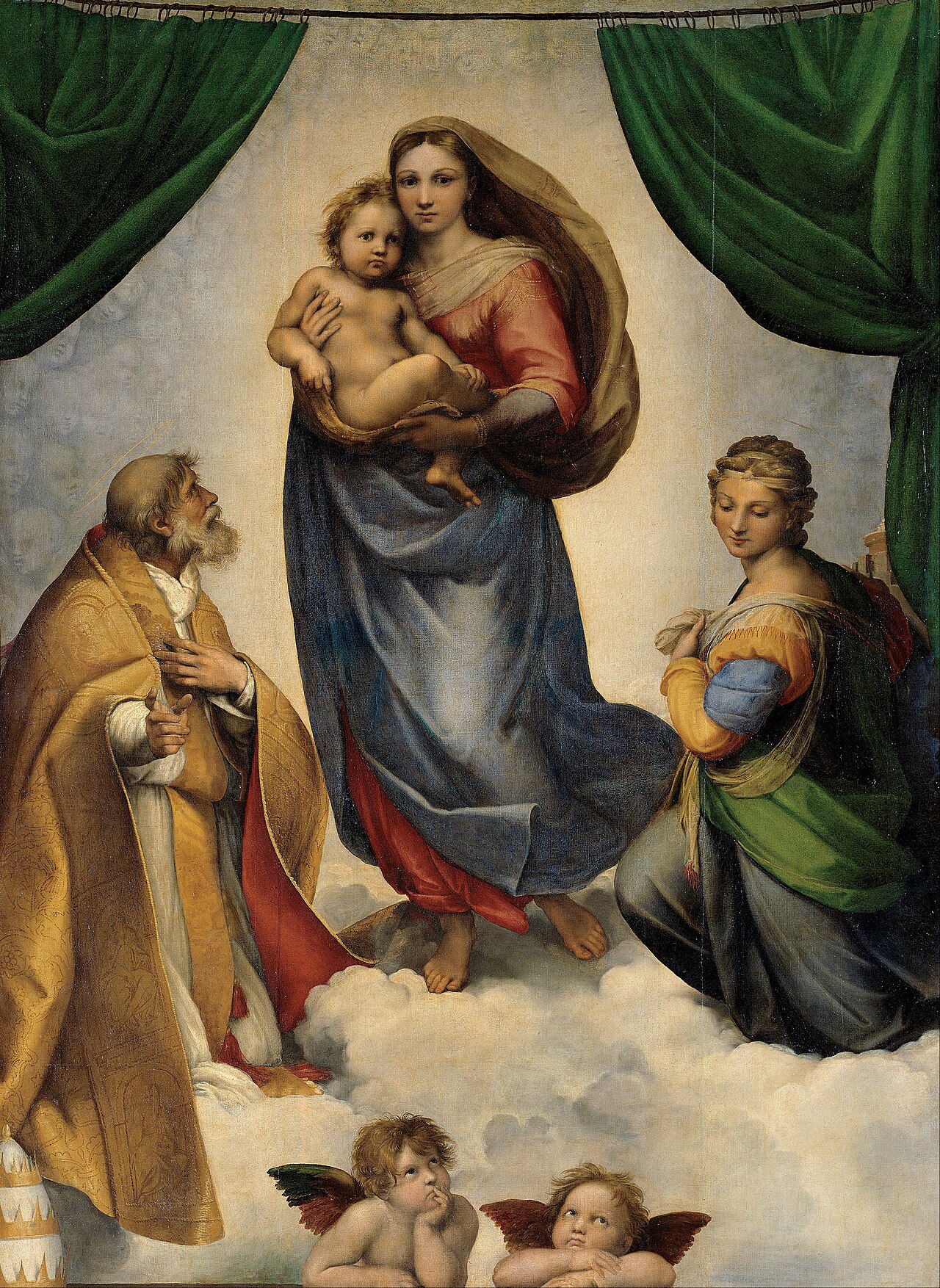
Before the manger, before the Cross, there is a teenage girl in a small town being asked to carry God, and answering that she will. Christianity has never stopped thinking about Mary since — honoring her, arguing about how far that honor should go, and painting her more than any other human being in history. Here's who she is, and why Christians disagree about her.
Michael Paycer
The mother of Jesus; the first to say yes
Theotokos — “God-bearer”
How far honor should go
Mary enters the Gospel at the Annunciation, when the angel Gabriel tells her she will bear the Son of God. Her answer — free, unforced, from a girl with everything to lose — is the hinge the whole Incarnation swings on:
“Behold the handmaid of the Lord; be it unto me according to thy word.”— Luke 1:38 (KJV)
Soon after, visiting her cousin Elizabeth, she breaks into the song the tradition calls the Magnificat — not a meek little prayer but a revolutionary hymn, in which God “hath put down the mighty from their seats, and exalted them of low degree” (Luke 1:52). This is the Mary the Gospels give us: humble but not passive, a poor young woman whose consent and whose song sit at the very start of the Christian story. The greeting that opens the Hail Mary — “blessed art thou among women” — is drawn directly from these chapters of Luke.
The early Church gave her the title Theotokos, “God-bearer” or “Mother of God,” at the Council of Ephesus in 431. It's worth understanding that this is really a claim about Jesus — that the child she carried was truly God, not merely a man God later adopted — more than a promotion of Mary. To defend who Christ was, the Church had to say something exact about his mother.

Over the centuries, Catholic teaching gathered four Marian dogmas: that she is Mother of God; that she remained ever-virgin; that she was conceived free of original sin (the Immaculate Conception); and that she was taken up body and soul into heaven (the Assumption). The Orthodox share much of this devotion; most Protestants accept only what stands explicit in Scripture, and regard the later dogmas as going beyond it.
Underneath the specifics is one honest question that divides Christians: how far should honor go before it becomes worship? Catholics and Orthodox draw a firm line — Mary is venerated, the highest of the saints, but never adored; prayers ask her to intercede, to pray for the believer, exactly as one might ask a friend to pray. Many Protestants worry the line blurs in practice and prefer to keep the focus squarely on Christ. It's a real disagreement, and this page's job is to state it clearly rather than resolve it. What all sides share is the recognition that the story could not have begun without her yes.
Christians argue about how high to lift Mary, but not about where she stands in the story: at the threshold, saying yes to something enormous, so that everything else could follow.
This page lays out who Mary is and why Christians honor — and debate — her. What she means to me, personally, belongs in its own space, and a reflection will live here soon. — Michael
Catholic teaching says no — it distinguishes veneration (honor) from worship (due to God alone). Prayers to Mary ask for her intercession, not treat her as divine. Whether that distinction convinces is a core Catholic–Protestant disagreement.
Greek for “God-bearer” or “Mother of God,” affirmed at Ephesus in 431. It's mainly a statement about Jesus — that the child Mary bore was truly God.
The Catholic dogma that Mary herself was conceived without original sin — often confused with the virgin birth of Jesus, but a different claim entirely, about Mary's own conception.
When I'm not reading the first chapters of Luke, I tune databases, design high-availability systems, and run cloud migrations.