Christianity · People

The holy dead,
treated as still family.

A saint isn't a plaster figure with a halo. In the oldest sense it just means a holy one — and behind the statues sits a bold claim: that death doesn't cut people out of the family of faith, so the great souls who went before can still be asked to pray for those left behind. Here's what the saints are, how one is made, and where Christians part ways over them.

Michael Paycer Michael Paycer
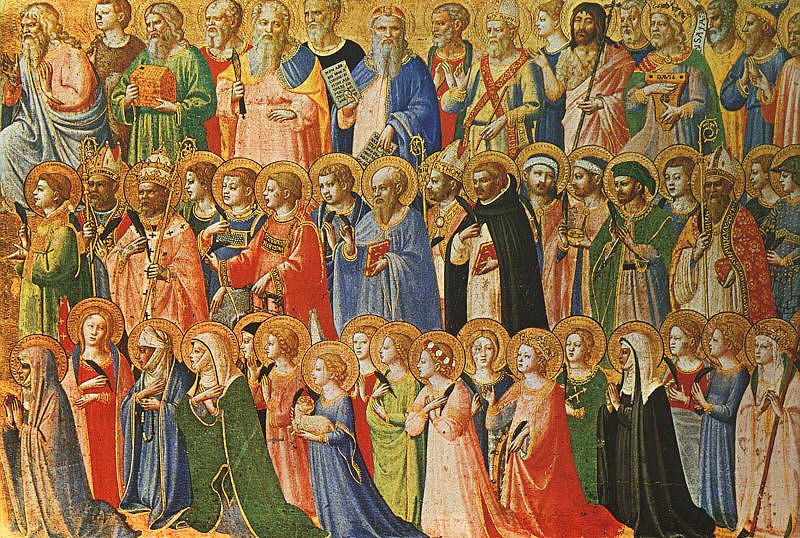
An All Saints painting: the company of the blessed gathered in heaven
All the saints together. The traditional image of the communion of saints — the whole company of the blessed gathered as one. Public domain via Wikimedia Commons
In brief

A saint is

A holy one — recognized as being with God

The bond

The communion of saints, living and dead

The ask

Intercession — that they pray for us

The idea

From “all believers” to “the recognized few”

The word travels. In the New Testament, Paul addresses whole congregations as “the saints” — the holy ones, meaning all believers. Over time the Church narrowed the public use of the title to those whose holiness was so evident it could be held up for everyone: the martyrs first, then confessors, teachers, and reformers.

To recognize such a life formally, the Catholic Church developed canonization — a careful, often centuries-long process. A person is first declared Venerable, then Blessed (beatification), then a saint (canonization), with miracles attributed to their intercession typically required as confirmation along the way. The result is not a claim that these people were flawless, but that grace worked in them so visibly that the rest of the Church can learn from and lean on them. Many saints become patrons — of trades, places, causes, and struggles — so that a traveler, a doctor, or someone facing a lost cause has a particular companion to turn to.

The belief, and the divide

A family that death didn't break

The engine underneath all of this is a line from the Apostles' Creed: the communion of saints — the conviction that every Christian, living or dead, belongs to one body in Christ, and that death does not sever the bond. If that's true, then asking a saint in heaven to pray for you is no stranger than asking a friend on earth. The letter to the Hebrews gives the image believers reach for:

“Wherefore seeing we also are compassed about with so great a cloud of witnesses…”— Hebrews 12:1 (KJV)

This is exactly where Christians divide, and the distinction matters. Catholics and Orthodox venerate the saints and ask their intercession — the saints pray with and for the believer; worship is reserved for God alone. Most Protestants reject the practice, holding that believers should approach God directly through Christ and that Scripture gives no warrant for praying to the dead. Both sides agree the saints are examples worth imitating; they disagree on whether the living should ask the dead to pray. As with Mary, the honest move is to name the line rather than pretend it isn't there.

The through-line

Strip away the debates and the saints answer a very human wish: that the people who lived faith well before us are not simply gone, but still, somehow, on our side.

My reflection — coming

This page explains what the saints are and why Christians honor — and debate — them. What they mean to me, personally, belongs in its own space, and a reflection will live here soon. — Michael

Common questions

People also ask

Do Catholics worship the saints?

No — Catholic teaching distinguishes veneration (honor) from worship (due to God alone). Prayers to saints ask for their intercession, not treat them as divine. Most Protestants reject the practice regardless; it's a genuine dividing line.

How does someone become a saint?

Through canonization: a long investigation leading from “Venerable” to “Blessed” (beatification) to sainthood, usually with miracles attributed to the person's intercession. It can take decades or centuries.

What is a patron saint?

A saint regarded as a special protector or advocate for a particular group, place, trade, or cause — a specific companion to turn to in a specific need.

Sources
The day job

Built by a SQL Server consultant

When I'm not reading the lives of the saints, I tune databases, design high-availability systems, and run cloud migrations.

See what I do →