Who are the Lares and Penates?
The Lares and Penates were the two great classes of Roman household gods — the divine powers that guarded the home from the inside. The Lares were protective spirits associated with household, place, neighborhood, roads, crossroads, fields, and eventually the imperial order itself. The Penates protected the household's provisions, well-being, and continuity. Together, the phrase “Lares and Penates” became a byword for home itself.
These were not distant Olympians but the gods of daily life. They lived where the family lived, received offerings at meals, and bound Roman religion to the ordinary rhythms of the house. The familiar “household Lares” are only one branch of a much wider category.
Origins & history
The Lares were never simply literary ghosts. They belonged to lived religion: meals, family continuity, neighborhood identity, and local sacred geography. Their exact origin was debated even in antiquity, and modern attempts to define them all as “ancestor spirits” are too rigid — “Lares” is a broad category whose local forms varied.
The Penates take their name from the interior store of the house. Ancient authors connected them with the penus — the inner larder or provision — and treated them as gods whose power concerned the household's food and sustenance. Rome also possessed public Penates, linking domestic protection to the larger Roman state, and tradition held that Aeneas had carried the Trojan Penates to Italy, making the household gods part of Rome's own sacred ancestry.
Cult & worship
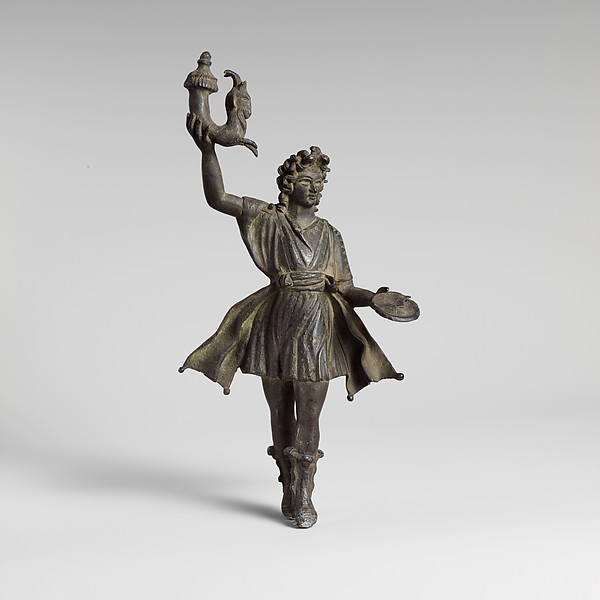
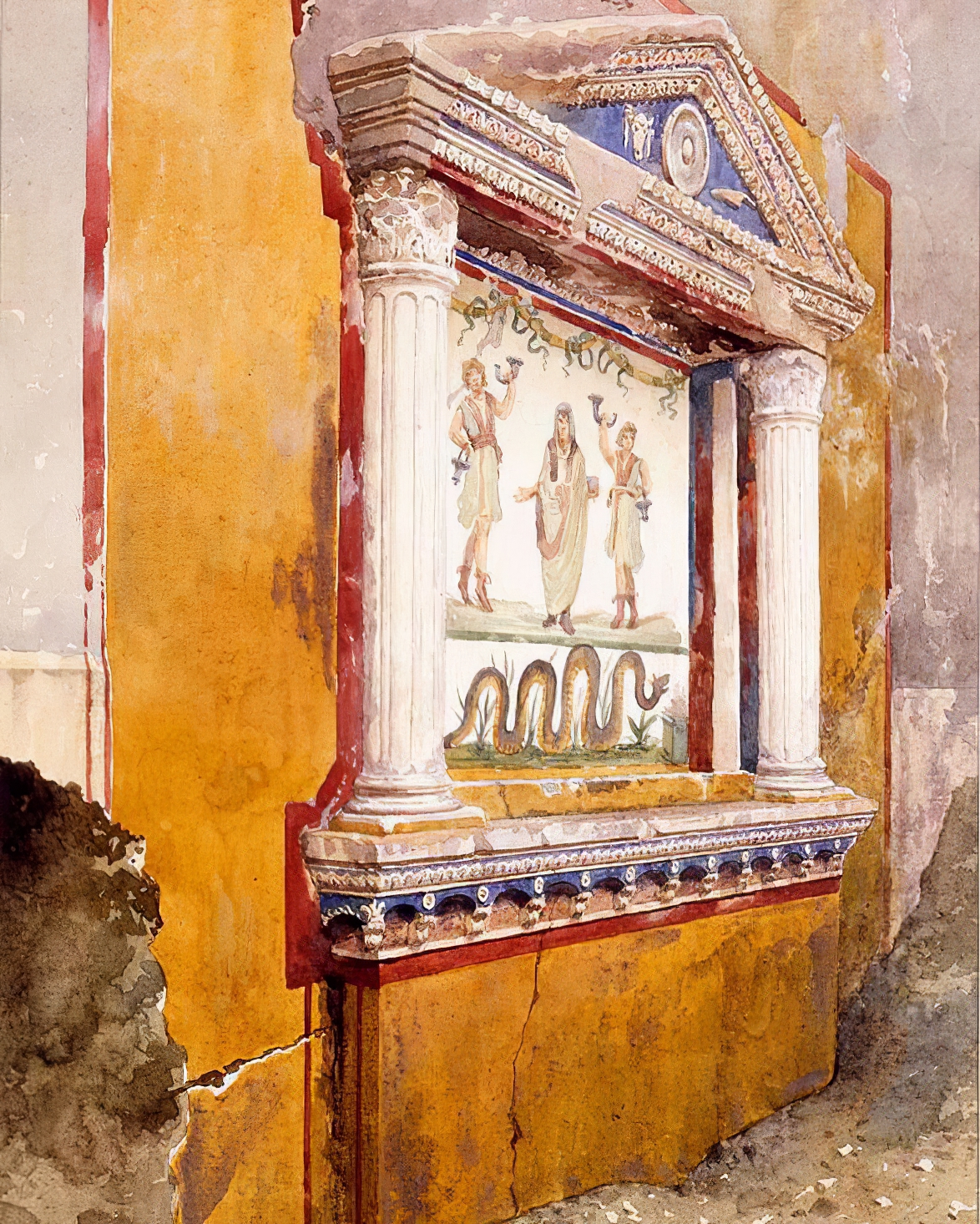
Household cult centered on the lararium, the family shrine where images of the Lares commonly stood and where members of the household made offerings — a little food, wine, incense, or flowers, given in the course of daily life. Well-preserved lararia, especially at Pompeii, are among our best evidence for Roman domestic religion, though the elite houses that survive should not be assumed to represent every household identically.
Beyond the home, the Lares Compitales were honored at the crossroads, giving neighborhoods their own protective cult and shared identity. Closely bound up with all this was the Genius — the generative, tutelary power of a person, place, or group. The Genius of the male head of household was honored domestically, places had their genius loci, and under the Empire the emperor's Genius became politically important. In lived practice, Lares, Penates, and Genius belonged to the same web of everyday devotion.
A distinctly Roman household religion
Unlike Jupiter or Venus, the Lares and Penates have no clean Greek equivalent to set beside them. They belong to a distinctly Roman domestic religion — a cult of home, hearth, storeroom, and neighborhood that grew from Roman social life rather than from imported myth. There is no single figure in the Greek pantheon to translate them into. Their nearest Roman kin lie in the same domestic and civic world: the public Penates tied to the state, the crossroads cult of the Lares Compitales, and the personal Genius. To understand them is to look not at mythology but at the Roman house itself.
Famous myths & stories
The Penates that Aeneas carried
Roman tradition held that Aeneas brought the Trojan Penates with him when he fled the burning city — carrying the household gods of Troy to Italy. Through that story, the humble gods of the storeroom became part of Rome's foundation legend and its claim to a sacred, inherited destiny.
Gods of the crossroads
The Lares Compitales were worshipped where roads met, giving each neighborhood its own guardians and its own festival. Here the household gods stepped out of doors: the same protective power that watched the family also bound a community together at the crossroads.
The shrine in every house
The real “story” of the Lares and Penates is told in the lararium — the shrine where a Roman family met its gods each day. Their cult integrated religion into domestic space so thoroughly that the home itself became a place of worship.
Legacy & influence
The phrase “Lares and Penates” outlived the cult and became literary shorthand for home and household — for one's own hearth and cherished domestic belongings. To speak of gathering up one's “Lares and Penates” is still to speak of home in its most personal sense. They survive as one of antiquity's most enduring images of what it means to have a place of one's own, and of a religion lived not in temples but at the family table. For the Roman dead who also shaped domestic memory, see the Manes and Lemures.
Symbolism
Their symbols are the emblems of home. The lararium is the sacred center of the house; the dancing Lar figures, cup and horn in hand, embody protection and plenty; the offerings of food, wine, and incense mark the daily bond between family and gods; and the storeroom — the penus — stands behind the very name of the Penates. Together they say what Roman religion meant by household cult: the sacredness of place, provision, and continuity, guarded from within.
Famous public-domain depictions — click any image to view it full size.
 Michael Paycer