The Divine Dead · Guardian Spirits · The Household · Night
The Roman Dead: Manes, Lemures & Larvae
The Romans made the dead divine. The Di Manes received offerings, the guardian Genius watched over the living, and each May the household drove off the restless dead with a fistful of beans.
Roman religion did not draw a hard line between gods and the dead. The spirits of the deceased were the Di Manes, the “divine Manes,” and countless tombstones open with the letters D.M. — Dis Manibus, “to the divine Manes.” Alongside them stood the Genius, a tutelary power that guarded a living person, place, or institution, and a darker family of night-spirits: the restless Lemures, appeased each May at the Lemuria, and the frankly frightening Larvae. Together these figures map how Rome kept the dead inside family life — honored, remembered, and, when necessary, warded off.
Here the evidence needs an honest caution, and it is a specific one: the terminology overlaps. Ancient authors do not maintain a single consistent distinction between Manes, Lemures, and Larvae; the same restless dead can be called different things by different writers. The Manes are well attested through funerary inscriptions and Ovid's calendar poetry (grade A), and the Genius is solidly documented (grade A/B), but the Lemures are thinner (grade B) and the Larvae thinner still (grade C), belonging more to Roman demonology and the fear of the unquiet dead than to any organized major cult. Where a Roman epitaph uses a set formula, it may record convention rather than one person's considered theology.
The Guardian Spirit
The tutelary power
Genius
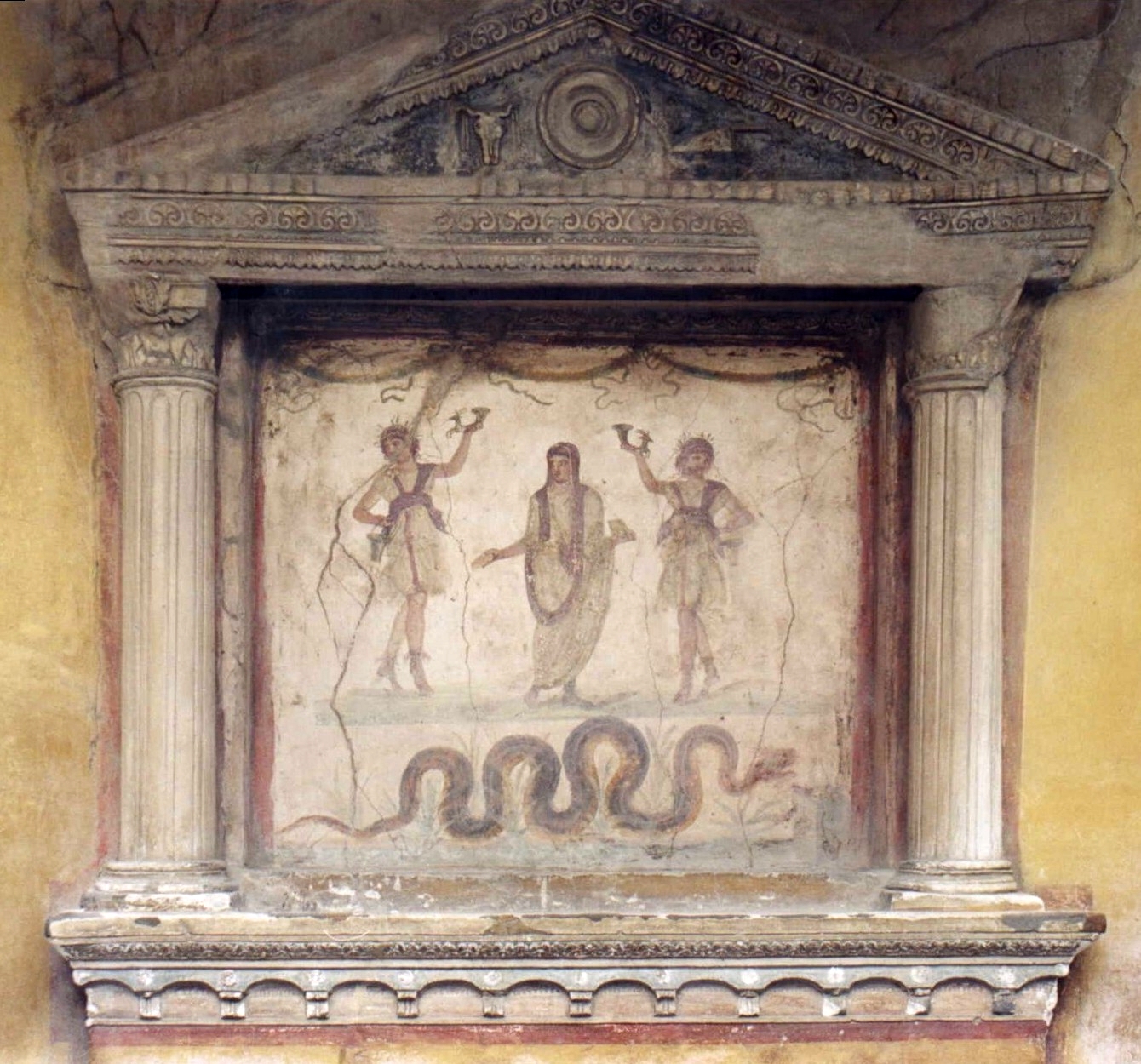
A genius was a generative or tutelary divine power attached to a person, place, group, or institution. The genius of the male head of household was honored in domestic cult; places had their own genius loci, the “spirit of the place”; and under the Empire the emperor's Genius took on real political weight. The Roman idea is not the modern one of extraordinary intelligence: it names a living, productive, protective identity or power rather than a talent. The category also varied a great deal, and mechanically equating it with a Christian guardian angel or a modern “soul” distorts its Roman setting. Its influence is everywhere in language — the word genius itself, and genius loci as it survives in architecture and landscape theory, the notion that a place has a distinctive spirit. Evidence grade: A/B.
The Divine Dead
The spirits of the dead
Manes
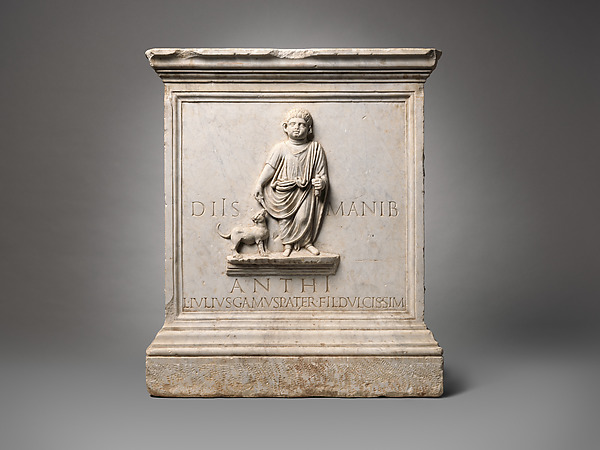
The Di Manes were the divine spirits of the dead, and they are the reason Roman funerary inscriptions so often begin D.M. — Dis Manibus, “to the divine Manes.” The dead did not simply depart; they remained part of Roman familial and ritual life, and the category reflects a religious continuum running from human ancestors to the divinized dead. Ovid's Fasti describes the Feralia and the parental rites for the dead, preserving the idea that the Manes expect modest offerings and remembrance rather than grand sacrifice. Two honest limits apply: “Manes” does not map neatly onto any single doctrine of the soul, since Roman views of the afterlife were diverse and sometimes inconsistent, and the tomb formulas can be conventional rather than proof of an individual's belief. The Manes remain central to Roman funerary archaeology, epigraphy, and the modern study of ancestor memory. Evidence grade: A.
Lemures
The Lemures were the restless, potentially dangerous spirits of the dead — the threatening counterpart to the orderly, commemorated ancestors. They were dealt with at the festival of the Lemuria in May, through household rites meant to expel or appease them. Ovid's Fasti 5 preserves the domestic ritual in vivid detail: rising at midnight, the head of the household tosses black beans behind him and repeats a redeeming formula, “With these beans I redeem me and mine.” The rite gave families a concrete method for managing the unquiet dead. As with the whole category, the terminology is slippery — lemures, larvae, and Manes are not consistently distinguished by every author. In a curious afterlife, the animal name lemur was later inspired by this Roman ghost-vocabulary, prompted by the creatures' nocturnal look. Evidence grade: B.
Larvae
The Larvae were generally understood as harmful or frightening ghosts, though ancient usage often blurs them into the lemures. They belong more to Roman demonology and the fear of the unquiet dead than to any organized major cult, and no secure direct speech or detailed unified theology survives for them; literary and antiquarian references establish the category but little more. Their defining feature is precisely that terminological uncertainty: the ancient sources do not hold one universally consistent line between larvae and lemures, and it is a mistake to impose a tidy taxonomy they never kept. The word had a strange second life — larva was later borrowed into zoology for an insect's immature stage, drawing on the old sense of a masked or ghostlike form. Evidence grade: C.
In Art
The Roman dead in art
Funerary and household imagery of the dead and their guardians — click any image to view it full size.
Marble funerary altar (of the child Anthus)Roman, marble, 1st half of 1st century CE (Early Imperial, Julio-Claudian).The Metropolitan Museum of Art, New York · CC0 (public domain)Lararium of the House of the VettiiThe household shrine of the Vettii brothers at Pompeii — the toga-clad genius flanked by dancing Lares, with the guardian serpent below. Roman wall-painting, 1st century AD.House of the Vettii, Pompeii · Photo: Patricio Lorente, CC BY-SA 2.5
In Their Words
Quotes & ancient voices
“With these beans I redeem me and mine.”
Ovid, Fasti 5 (the household formula of the Lemuria; translation approximate)
Roman religion angle
Nothing shows the domestic, functional character of Roman religion better than the dead. They were Di Manes, divine, yet cared for with modest household offerings rather than grand temple cult; and when they turned dangerous, the response was not doctrine but ritual — a father throwing beans in the dark to redeem his family. The categories stay deliberately fluid, because Roman religion cared far more about performing the right rite than about fixing a precise theology of the soul.
Questions
Common questions about the Roman dead
What does D.M. or Dis Manibus mean on Roman tombs?
D.M. stands for Dis Manibus, “to the divine Manes” — the divine spirits of the dead. Roman funerary inscriptions commonly open with this formula, dedicating the grave to the deceased's Manes. It reflects the Roman idea that the dead became Di Manes and remained part of the family's ritual life, though the phrase is often a conventional formula rather than proof of an individual's precise beliefs about the afterlife.
What was the Lemuria and the bean ritual?
The Lemuria was a festival held in May to appease or expel the Lemures, the restless and potentially dangerous spirits of the dead. In the household rite described by Ovid's Fasti, the head of the house rose at night, threw black beans over his shoulder, and repeated a redeeming formula: “With these beans I redeem me and mine.” It is a domestic apotropaic ritual for managing the unquiet dead.
What is a Roman genius?
A genius was a generative or tutelary divine power tied to a person, place, group, or institution — not the modern idea of extraordinary intelligence. The genius of the male head of household was honored at home, places had a genius loci, and under the Empire the emperor's Genius became politically important. It expresses a living, protective identity rather than a soul in the Christian sense.
What is the difference between Manes, Lemures, and Larvae?
Broadly, the Manes are the collective divine dead who receive respectful commemoration, the Lemures are restless or dangerous spirits appeased at the Lemuria, and the Larvae are frightening, malevolent ghosts. But the terms overlap: ancient authors do not maintain one consistent distinction between lemures, larvae, and Manes, so these categories should be treated as fluid rather than a fixed taxonomy.
Sources
Ovid, Fasti (the Feralia and parental rites in relation to the Manes; the Lemuria and its bean formula in Book 5).
Roman funerary inscriptions and epigraphy (the D.M. / Dis Manibus formula) and household shrine evidence for the Genius.
Literary and antiquarian references for the Lemures and Larvae, with attention to their overlapping terminology.
Evidence grades: A for the Manes, A/B for the Genius, B for the Lemures, and C for the Larvae — the terminological overlap among the dead-spirits is a real limit, not a detail to be smoothed over.
 Michael Paycer