Who was Aeneas?
Aeneas was a Trojan hero — son of the goddess Venus and the mortal Anchises — adopted as the great ancestor of the Roman people. Earlier Greek traditions already knew him as a warrior at Troy, but Roman authors, above all Virgil in the Aeneid, made his journey from the fallen city to Italy the sacred prehistory of Rome and of Augustus. He is remembered above all as the embodiment of pietas: duty to the gods, to family, and to the destiny he is bound to serve.
He is not a philosopher, but the poem built around him forces philosophical questions — about fate and free will, empire and suffering, and whether duty can justify personal sacrifice. Aeneas is the man who does what he must, and Virgil never lets us forget its cost.
Origins & history
Aeneas belongs first to Greek epic: he appears in the Iliad as a Trojan prince of divine parentage, fated to survive the war. Over centuries that survival was elaborated into a westward voyage, and Roman tradition seized on it to give the city a Trojan origin. Virgil's Aeneid, written under Augustus, gave the story its definitive shape — twelve books carrying Aeneas from the ruins of Troy through the tragedy of Carthage to war and victory in Italy.
The result knit two foundation legends together. Aeneas supplies Rome's deep Trojan ancestry; centuries later his descendants Romulus and Remus found the city itself. Rome could thus claim both a fallen Troy and a wolf-nursed founder, and the Julian family could trace its blood back through Aeneas to Venus.
Cult, honors & legend
Aeneas's honor is dynastic and literary as much as cultic. Through his son Iulus (Ascanius) the Julian family claimed him as ancestor, so that Julius Caesar and Augustus stood in a line running back to a Trojan hero and, through Venus, to the gods themselves. The Aeneid made that descent the sacred charter of the Augustan age. In legend Aeneas is credited with rescuing the Penates, Troy's household gods, and carrying them to Italy — an act that transfers Troy's sacred continuity to Rome and models the piety the Romans prized.
Greek connection
Aeneas is the clearest case of a hero who is Greek by origin but Roman by meaning. He was already known in earlier Greek tradition — a Trojan of the Iliad, destined to survive — but it was Virgil who made him Roman, turning a minor epic survivor into the founding ancestor of an empire. Where Jupiter is a Roman god identified with a Greek one, Aeneas is a Greek-tradition figure claimed and remade for a Roman purpose. Reading the Iliad's Aeneas beside Virgil's is the sharpest way to see how Rome took inherited myth and bent it toward its own destiny.
Famous myths & stories
Out of the fire
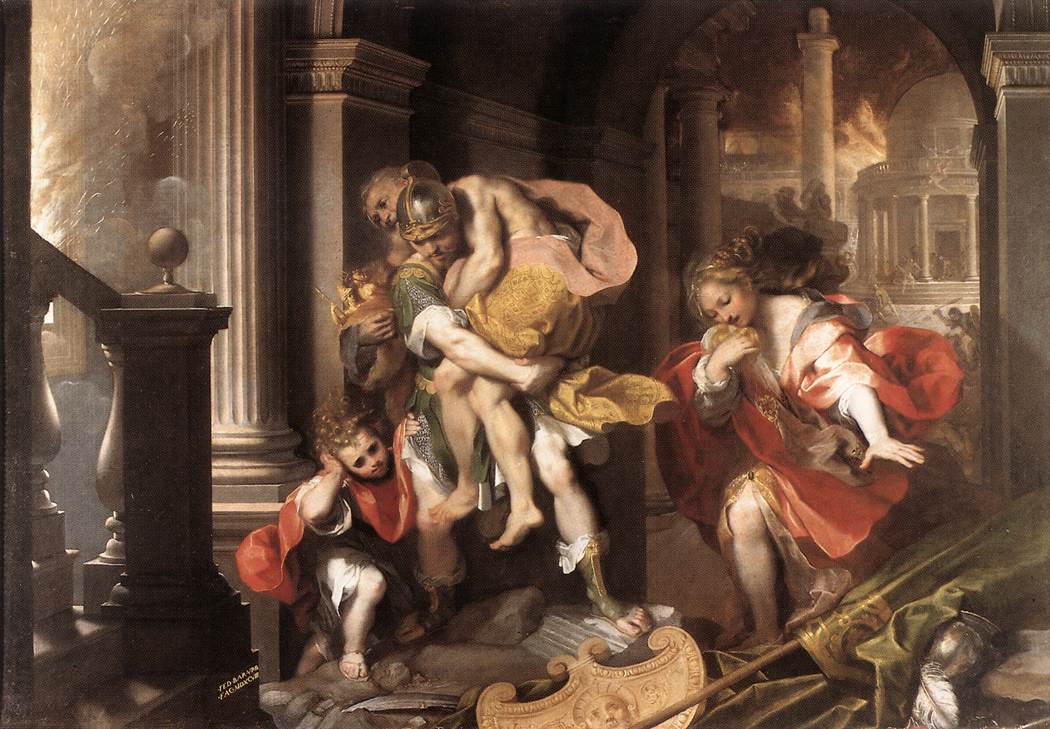
On the night Troy falls, Aeneas gathers his household: he lifts his aged father Anchises onto his shoulders, takes the sacred Penates, and leads his son by the hand out of the burning city. The image — the son carrying the father and the gods — became the defining picture of pietas, duty made visible.
Dido and the cost of duty
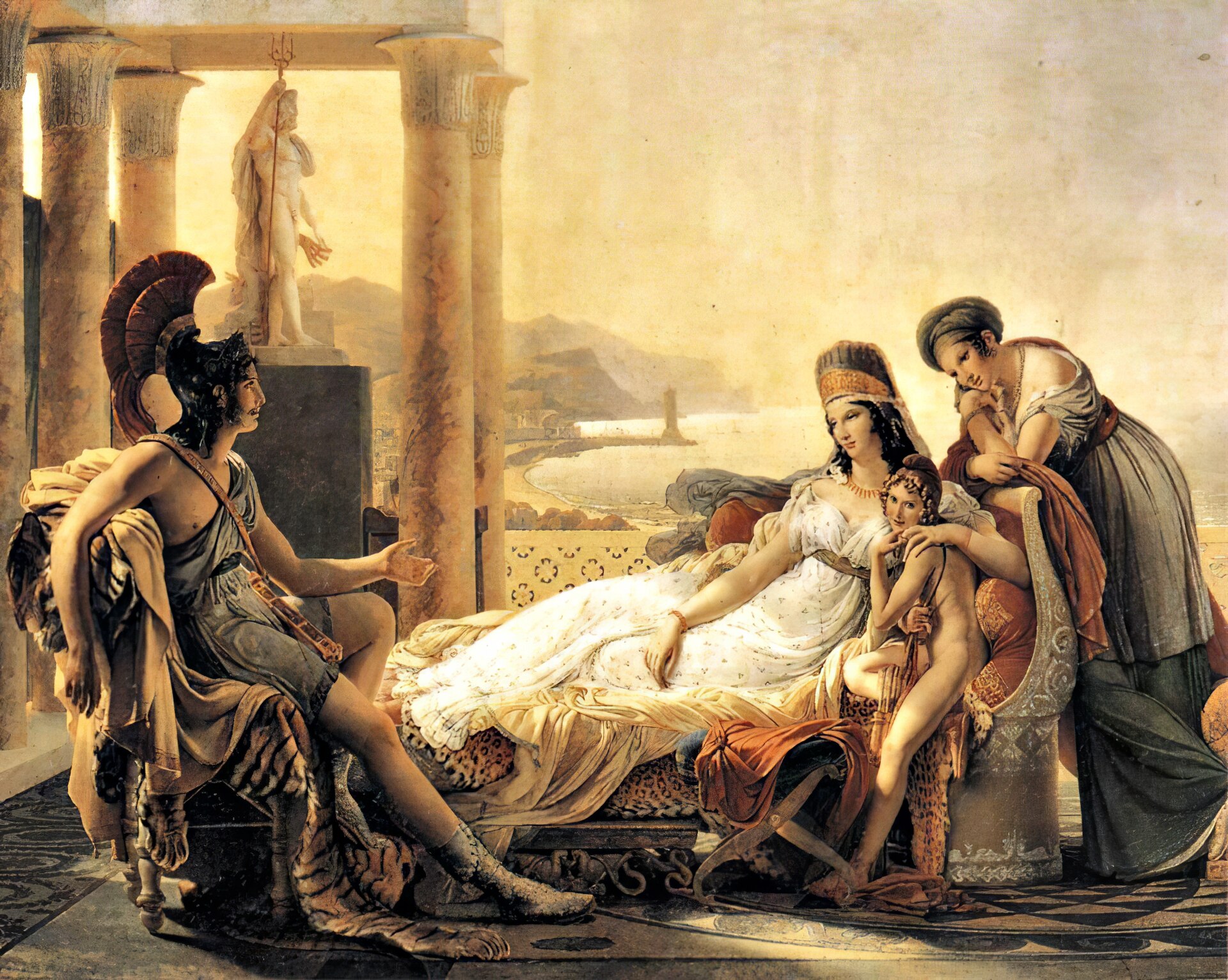
Shipwrecked at Carthage, Aeneas loves and is loved by Queen Dido — but the gods command him onward to Italy. He leaves; Dido, betrayed, takes her own life. Virgil refuses easy comfort here: the mission that will make Rome also destroys a queen who did nothing but love the man destiny would not let stay.
The killing of Turnus
In Italy Aeneas is drawn into a brutal war for a homeland and a marriage. At the poem's shocking end he stands over the defeated Turnus, ready to spare him — until he sees the belt of the young Pallas, whom Turnus had killed, and strikes in grief and rage. The Aeneid closes not in triumph but in violence, leaving the reader to weigh what the founding of Rome has cost.
Legacy & influence
Aeneas is one of Western literature's central epic heroes. The Aeneid became the core text of Roman identity and, later, of European education; medieval and Renaissance readers learned Latin on it, painters returned to Aeneas and Anchises and to Dido's pyre, and opera gave Dido her most famous laments. The questions the poem raises — about empire, duty, and the suffering that greatness leaves behind — still frame how the West argues about power and its price.
Symbolism
The symbols tell his story. Anchises borne on his shoulder is filial duty and continuity with the past; the Penates, the rescued household gods, are sacred obligation carried into the future; the ship is exile, endurance, and the long voyage toward a destiny not yet seen. Together they define pietas — the founding Roman virtue of the man who serves gods, family, and city before himself.
Famous public-domain depictions — click any image to view it full size.
Who was Aeneas?
A Trojan hero adopted as the great ancestor of the Roman people. Earlier Greek traditions knew him, but Virgil's Aeneid made his journey from fallen Troy to Italy the sacred prehistory of Rome and Augustus. He is remembered above all as the embodiment of pietas.
What is pietas and why does Aeneas embody it?
Pietas is Roman dutifulness — devotion to the gods, one's family, and the community and destiny one serves. Aeneas embodies it by carrying his father Anchises and the household gods out of burning Troy, obeying the gods' call to Italy, and subordinating his own happiness, including his love for Dido, to his mission.
Why did Aeneas leave Dido?
He loves the Carthaginian queen Dido but is commanded by the gods to leave and continue to Italy to found the Roman line. His departure drives Dido to suicide. Virgil frames it as the collision of duty and desire — pietas set against personal happiness.
How is Aeneas connected to Rome and the Julian line?
He leads the Trojan survivors to Italy and becomes the mythic ancestor of the Roman people. Through his son the Julian family — and so Julius Caesar and Augustus — claimed descent from him and, through his mother Venus, from the gods.
 Michael Paycer