
King's Gambit Variations
The King's Gambit is not one opening — it is a branching tree of sharp, forcing lines that diverge immediately after Black's second move. Accepting leads to entirely different chess than declining; within the Accepted lines alone, 3...g5, 3...d5, and 3...Nf6 produce radically different positions. This guide walks through the main branches with board diagrams.
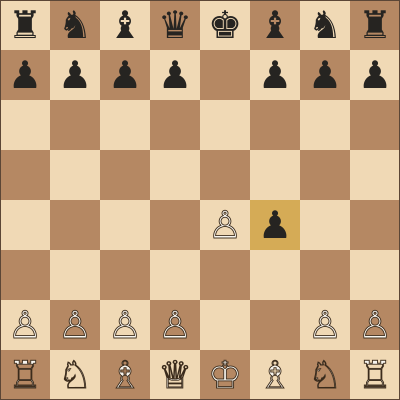
The branching begins here, in the Accepted: 2...exf4 (the black pawn on f4). From this point White's choice between 3.Nf3 and 3.Bc4 — and Black's choice of how to hold the pawn — fans out into the Kieseritzky, the Muzio, and the Bishop's Gambit.
After 2...exf4 3.Nf3
After 3.Nf3 — controlling d4 and preparing the central advance — Black's main question is how to hold the f4 pawn (or what to get for returning it). The most ambitious try is 3...g5, covering f4 with the g-pawn, which leads to the sharpest lines including the Kieseritzky and the Muzio. Quieter tries like 3...d5, 3...d6 (the Fischer Defense), and 3...Nf6 are more positional.
The Accepted: Black has captured on f4 (highlighted). White plays 3.Nf3, controlling d4 and preparing d4 — and Black must decide how to defend the extra pawn or hand it back for activity.
3...g5 defends f4 and grabs kingside space, but weakens the h5–e8 diagonal and opens Black's king. After 4.h4 White challenges the g-pawn; if 4...g4 the knight must move, reaching the critical fork: 5.Ne5 (Kieseritzky) or 5.Ng5 (Allgaier, a piece sacrifice). Both were analyzed exhaustively in the 1800s and remain unresolved today.
3.Nf3 g5 4.h4 g4 5.Ne5
The classical mainline against the aggressive 3...g5. After 4.h4 g4 5.Ne5, White's knight leaps to an active central post while Black's g4 pawn has created weaknesses; White threatens rapid d4 and Bc4 with tempo. Black's main replies are 5...Nf6 — the Berlin Defense, hitting e4 and preparing to return the pawn for development — and 5...d6 (kicking the knight: 6.Nxg4 Nf6 returns the pawn for development). The Berlin is a fully viable, deeply analyzed defense: after 6.Bc4 d5 7.exd5 Bd6 Black gives the pawn back to complete development and blunt White's initiative.
3.Nf3 g5 4.Bc4 g4 5.0-0 — a whole piece for the attack
One of the most spectacular ideas in chess. After 3.Nf3 g5 4.Bc4 g4 5.0-0, White lets Black capture the knight on f3 with 5...gxf3 6.Qxf3, sacrificing a piece for tremendous activity down the f-file and toward f7. It is objectively questionable — Black survives with precise play — but devastating in practice: after the knight goes, White's pieces all point at the Black king, which cannot castle safely, while Black's extra material is undeveloped. Winning combinations appear on nearly every move.
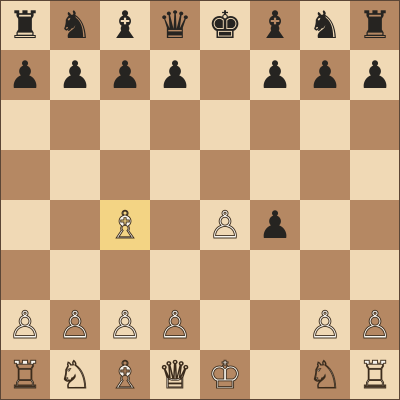
The bishop on c4 (highlighted) targets f7 — the geometry behind both the Bishop's Gambit (3.Bc4) and the Muzio (3.Nf3 g5 4.Bc4 g4 5.0-0), where castling sets up the famous knight sacrifice on f3.
Why the Muzio still wins
A piece sacrifice that leads to a queen checkmate fifteen moves later is not "refuted" by theory alone — it demands concrete, accurate defense under attacking pressure. The Muzio works at all levels below grandmaster simply because Black must find exact moves while White makes threats naturally. Anderssen played it brilliantly, and it remains a study in attacking principles.
2...d5 — Black counterattacks
Black's most aggressive response: rather than defend, Black creates counter-pressure at once. After 3.exd5 e4, Black sacrifices a pawn to activate the position — White's d5 pawn is advanced but the e4 pawn congests White's camp while Black's pieces develop toward the king. First analyzed by Ernst Falkbeer in the 1850s, it is fully viable: after 4.d3 Nf6 5.dxe4 Nxe4 Black has a centralized knight and open lines — ample compensation. The Falkbeer suits players who want to fight from the Black side rather than merely defend.
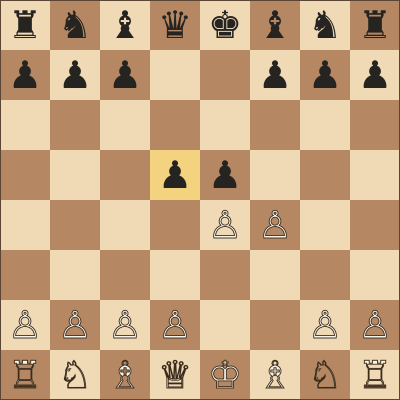
The Falkbeer: 2...d5 (highlighted) turns the tables — Black ignores the f-pawn and challenges the centre, taking the initiative White hoped to keep.
Other principled paths
Bishop's Gambit — 3.Bc4
Instead of 3.Nf3, White plays 3.Bc4, training the bishop on f7 and keeping options for a later Nf3-g5 or a direct attack. A Spassky favorite. Black's best is usually 3...Nf6, 3...Nc6, or 3...d5; after 3.Bc4 Nf6 4.Nc3 the position is complex and double-edged.
King's Gambit Declined
The Classical Declined 2...Bc5 is the most principled: Black develops actively, eyes f2, keeps the centre, and avoids the forced tactics. After 3.Nf3 d6 4.c3 Nf6 it resembles a structured Italian. The Modern Decline 2...d6 and 2...Nc6 often transpose, and are chosen by players wanting less memorization.
King's Gambit Variations — FAQ
Which KGA variation should I learn first?
Start with the Kieseritzky (3.Nf3 g5 4.h4 g4 5.Ne5). It is the mainline of the Accepted gambit, teaches the opening's ideas deeply, and has the most theory and history. Once you understand it, the Bishop's Gambit and Muzio make structural sense as related ideas.
Is the Muzio objectively sound?
At grandmaster level, no — precise defense gives Black sufficient compensation and eventually a material edge. In practical play below the very top it is extremely dangerous, because the defense required is enormous under attacking pressure. "Objectively unsound" and "practically effective" are not contradictions in aggressive chess.
What is the Fischer Defense?
It is 3.Nf3 d6 in the Accepted. Fischer recommended it in 1961 as a reliable way to a safe advantage: after 4.d4 g5 or 4.Bc4 h6, Black's position is solid and the f4 pawn well supported — the best practical results while avoiding the most complex 3...g5 lines.
How should White respond to the Falkbeer?
The most robust try is 3.exd5 e4 4.d3 — accept the counter-gambit and develop. After 4...Nf6 5.dxe4 Nxe4 6.Nf3 play is complex but White has returned material with active pieces. White should not try to hold all the material; accepting some imbalance while developing quickly is the principled approach.
The branching point — every response to 2.f4 leads to different chess. The KGA's tactical complexity is the gateway to the Kieseritzky and Muzio.
The Muzio attack — White sacrifices a knight to open lines against the Black king. Romantic-era chess at its most extreme.
The counter-gambit — the Falkbeer refuses to defend and attacks instead, producing games as sharp as any in the Accepted.
- Gallagher, J. Winning with the King's Gambit. Batsford.
- Kieseritzky's original analysis (1840s); Falkbeer's publications (1850s).
- Modern Chess Openings (MCO-15), King's Gambit sections.
- ECO Volume C, C30–C39.
Every opening belongs to a family — browse the three theme clusters: Romantic & Attacking Gambits · Flank & Hypermodern Systems · Solid Defenses.
King's Gambit — Part 2 of 3
Part 3 brings it to the present: how the modern elite handle the King's Gambit, the computer-age verdict on the Bishop's Gambit, and the practical wisdom for playing it today.