King's Gambit: Modern Theory & GM Mastery
The 20th and 21st centuries changed how we understand the King's Gambit. Computers mapped defensive resources humans had missed for 400 years — yet the opening stayed playable, sometimes brilliantly so, at grandmaster level. Spassky, Bronstein, and Tal showed that preparation, tactical vision, and nerve matter as much as objective evaluation. This part covers the modern theory, the legendary games, and the gambit through contemporary eyes.
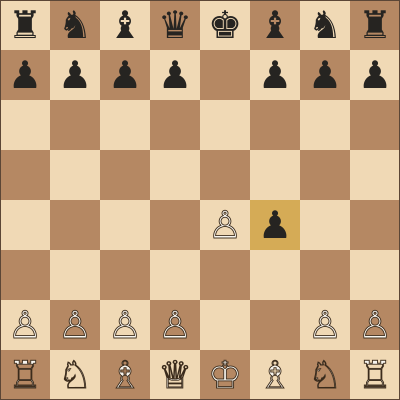
The Accepted (2...exf4) is where modern theory has been fought hardest — engines have mapped the critical Kieseritzky and Bishop's Gambit positions 30+ moves deep, yet the practical burden on the defender keeps the opening dangerous below the very top.
Computer Verdict
Engines suggest Black holds with precise defense in most main lines — "dynamically equal to slightly better for Black" at best play
Practical Verdict
Below super-GM level it stays genuinely dangerous — the defensive burden is immense and one slip can be fatal
GM Champions
Spassky, Bronstein, Tal, Shirov, and Short have played it at world-class level
Famous Games
Spassky–Bronstein (1960), Spassky–Fischer (1960), Bronstein–Spassky (1961)
Boris Spassky and the 20th-century King's Gambit
Spassky's relationship with the King's Gambit was the single most important factor in keeping it a serious weapon through the mid-20th century. A top player from the mid-1950s through the 1970s and World Champion from 1969 to 1972, he brought the gambit to championship-level competition and won stunning games with it.
Spassky vs. Bronstein, Leningrad 1960
The most celebrated King's Gambit game of the 20th century. Spassky met the gambit accepted with 3.Nf3 (Bronstein answered with the Modern Defense, 3...d5) and used the f-file to devastating effect — clean attacking lines, no gimmicks, just relentless pressure that Bronstein, one of the world's best, could not escape. It is regularly named one of the finest King's Gambit games ever played.
Spassky's play combined deep preparation with psychological precision. He didn't play the opening speculatively — he had analyzed it deeply and understood the exact defensive resources opponents would deploy. His games showed the King's Gambit wasn't merely romantic attacking chess; at the right level of preparation it was a precisely engineered weapon.
Spassky vs. Fischer, Mar del Plata 1960
Bobby Fischer, one of the best-prepared players in history, lost to Spassky's King's Gambit in this famous game — months before Fischer's own "Bust" essay. Spassky demonstrated that White could still generate enormous pressure with accurate play, and the loss fed directly into Fischer's deep study of Black's defenses in the years that followed.
The attack of the imagination
David Bronstein
Bronstein approached the King's Gambit as art rather than science. His games feature unexpected quiet moves in the middle of attacks, maneuvers that only make sense ten moves later, and sacrifices that look obvious only in hindsight. He also studied the opening as a theoretical object, publishing analyses (notably around Zurich 1953) that influenced a generation of Soviet analysts.
Mikhail Tal
The 8th World Champion and most feared attacker of the century was a natural fit for the gambit's spirit. "There are two kinds of sacrifices: correct ones, and mine" captures the King's Gambit at its most extreme. In rapid and blitz he was devastating with it — blurring through the opening to reach attacking positions before opponents could recall their preparation.
How engines changed the King's Gambit
Strong engines in the 1990s and 2000s changed how every opening was evaluated, and the King's Gambit was no exception. Computers revealed defensive resources in previously "unclear" positions; lines Spassky relied on were shown to give Black adequate play, and the Muzio — which Romantic-era players considered nearly winning — was shown to be defensible with precision.
The Accepted is where engines have worked hardest. From this position the Kieseritzky (3.Nf3 g5 4.h4 g4 5.Ne5) and the Bishop's Gambit have been mapped 30+ moves deep — clarifying exactly where the initiative is, and isn't, decisive.
The computer verdict — that Black holds with precise defense — had two effects: it reduced the gambit's frequency at the very top, and it paradoxically made human preparation more important. If the opening is a preparation battle, the side with deeper analysis has a real edge, and modern grandmasters who play it bring extensive engine-generated novelties.
The practical vs. theoretical gap
The most important lesson computers taught about the King's Gambit is the gap between theoretical evaluation and practical results. An opening that is "theoretically suspect" can still score well, because the defensive moves are precise, non-obvious, and psychologically demanding. The King's Gambit scores above average at every level below 2500 — precisely because the defense it demands is genuinely hard to achieve, even with preparation.
How to play the King's Gambit today
The Accepted lines
Begin with 1.e4 e5 2.f4 exf4 3.Nf3. Learn the Kieseritzky (3...g5 4.h4 g4 5.Ne5) deeply, including the Berlin Defense (5...Nf6) and 5...d6. Study the Fischer Defense (3...d6) since any prepared opponent may use it, and understand the Bishop's Gambit (3.Bc4) as a move order that bypasses certain defenses.
The Declined & the Falkbeer
The Classical Declined (2...Bc5) needs its own plan: after 3.Nf3 d6 4.c3 or 3.Nf3 Nc6 4.Bc4 the game turns Italian-like — push d4 when you can, develop the bishop to c4, and look for f-file pressure. Against the Falkbeer, know the 4.d3 line and be comfortable with the resulting positions.
The surprise-weapon mentality
One effective modern approach is to deploy the King's Gambit as a prepared surprise — in rapid games, must-win situations, or against opponents booked up on your usual openings. As an occasional weapon rather than a main system, the psychological jolt of the unexpected gambit can outweigh any small objective disadvantage.
Advanced King's Gambit — FAQ
What did Bobby Fischer's 1961 essay actually claim?
Fischer's "A Bust to the King's Gambit" argued that 2...exf4 3.Nf3 d6! gives Black a safe, lasting advantage, with a specific annotated line. The chess world took it seriously. Later computer analysis showed White retains adequate compensation in the Fischer Defense with precise play, so the "bust" was not definitive — and when Fischer himself later played the King's Gambit, he chose 3.Bc4, the Bishop's Gambit, sidestepping his own recommended defense.
Has the King's Gambit been played in recent world championship matches?
Not in the main classical World Championship since Spassky's era. Its rarity at the top reflects modern preparation cycles, where both sides prepare specific lines for months. Surprising an opponent with it is possible in rapid and blitz tiebreaks, but even there it is rare because top players prepare for faster games nearly as thoroughly.
Is there a modern book recommendation for learning the King's Gambit?
Joe Gallagher's Winning with the King's Gambit (Batsford, 1992) remains the gold standard. For computer-checked analysis, recent GM magazine articles help, and online databases let you study modern high-level games. Supplement any text with engine analysis at the critical branch points.
Can the King's Gambit be revived at the super-grandmaster level?
Possibly — it would take a major theoretical novelty in a critical position that engines haven't yet found or opponents haven't prepared. History shows "refuted" openings can be revived by new ideas, so whether the King's Gambit hides a sufficient novelty at 2700+ remains an open question for ambitious attacking theorists.
Computer analysis — engines evaluate KGA positions 30+ moves deep, revealing resources humans missed for centuries and clarifying where the initiative is truly decisive.
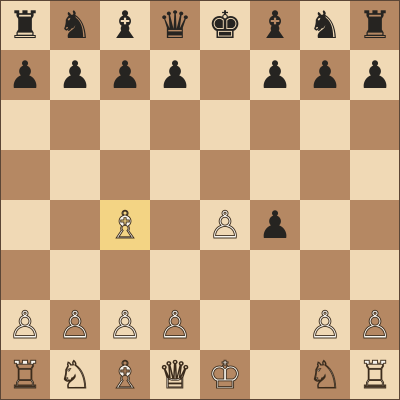
Preparation depth — Spassky's favorite Bishop's Gambit is a preparation battle; the side with deeper novelties in the critical lines gains the edge.
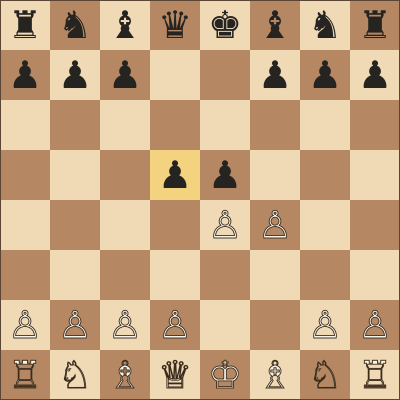
Alive at every level — below 2500 the King's Gambit scores above neutral, because the defense it demands is precision few players consistently achieve.
- Gallagher, J. (1992). Winning with the King's Gambit. Batsford.
- Kasparov, G. My Great Predecessors, Vol. IV (Spassky chapter).
- Bronstein, D. Zurich International Chess Tournament 1953; The Sorcerer's Apprentice.
- Fischer, R. "A Bust to the King's Gambit" (American Chess Quarterly, 1961).
- Tal, M. The Life and Games of Mikhail Tal; ECO Volume C (C30–C39).
Every opening belongs to a family — browse the three theme clusters: Romantic & Attacking Gambits · Flank & Hypermodern Systems · Solid Defenses.
King's Gambit — Part 3 of 3
That completes the King's Gambit guide — from 2.f4 and four centuries of history, through the Accepted, Falkbeer, and Bishop's Gambit, to the modern engine-age verdict. Explore the rest of the chess library next.