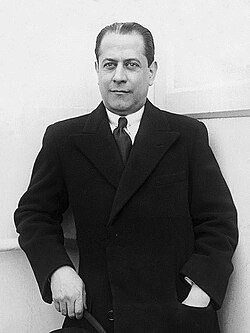
José Raúl Capablanca
The chess machine. World Champion from 1921 to 1927, the Cuban prodigy played with a clarity that has never been surpassed — moves so simple and so exact that he seemed incapable of error. His endgame technique set the standard for every champion who followed, and for years he barely lost a game at all.
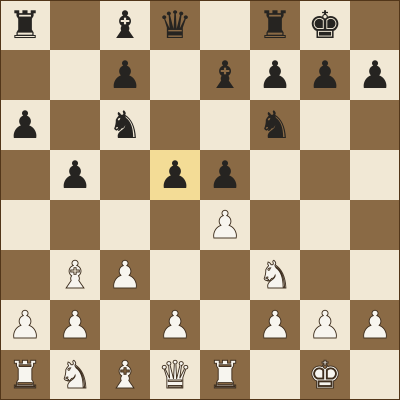
The Marshall Attack of the Ruy Lopez — the gambit Frank Marshall unveiled against Capablanca in 1918. Facing a deeply prepared homemade attack he had never seen, Capablanca defended with machine-like precision, gave back material at the perfect moment, and won. The line is respected theory today; his defence is a classic.
Lived
1888–1942 · born Havana, Cuba
World Champion
1921–1927 — won the title from Lasker without a single loss
Style
Crystalline clarity, flawless endgames, near-zero mistakes
Famous Game
Capablanca–Marshall 1918 — refuting the Marshall Attack over the board
Chess without mistakes
Where other masters dazzled with complications, Capablanca won by removing them. He simplified toward clear positions, then converted tiny advantages with a technique so smooth that the wins looked easy — and were anything but. He claimed he did not study openings deeply; he relied on understanding. For a stretch of eight years (1916–1924) he lost only a single tournament game, an almost unimaginable record at the top level.
He took the crown from Emanuel Lasker in 1921 without losing a game, and his clear, logical style made him one of the most admired players in history. The modern emphasis on endgame technique and clean conversion of advantages traces directly back to him.
Where his games live in this library
The Ruy Lopez
Capablanca's 1918 defence against the Marshall is a chapter of the Ruy Lopez story — and the Marshall Attack he refuted remains one of Black's sharpest tries against the Spanish today.
Clarity over complication
His handling of classical 1.d4 structures like the Queen's Gambit is a model of how a small edge becomes a won endgame — the heart of positional chess.
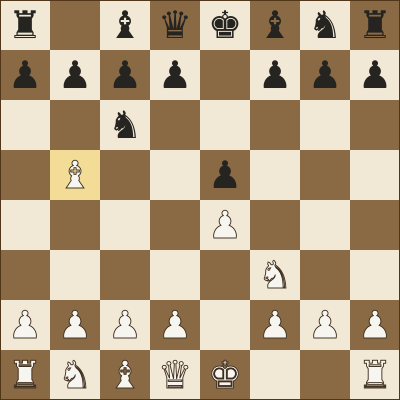
The Ruy Lopez (1.e4 e5 2.Nf3 Nc6 3.Bb5) — the classical battleground where Capablanca's clarity shone, and the opening from which the Marshall Attack he faced in 1918 branches.
Capablanca — FAQ
Why was Capablanca called the chess machine?
He played with such clarity and accuracy that he seemed to make almost no mistakes. His moves looked simple and inevitable, his endgame technique was flawless, and for long stretches he barely lost a game. Writers compared him to a machine because errors seemed absent from his play.
What is the Capablanca–Marshall 1918 game?
Frank Marshall sprang a deeply prepared new gambit — the Marshall Attack of the Ruy Lopez — on Capablanca, who had never seen it. Defending over the board, Capablanca found the precise moves, returned material at the right moment, and won. The Marshall Attack survives as respected theory; his defence is a classic.
When was Capablanca world champion?
From 1921 to 1927. He won the title from Emanuel Lasker without losing a game and held it until 1927, when Alexander Alekhine beat him in one of the longest title matches ever played.
The Marshall Attack — the homemade gambit Capablanca refuted at the board in 1918.
The Ruy Lopez — the classical opening that rewarded Capablanca's effortless clarity.
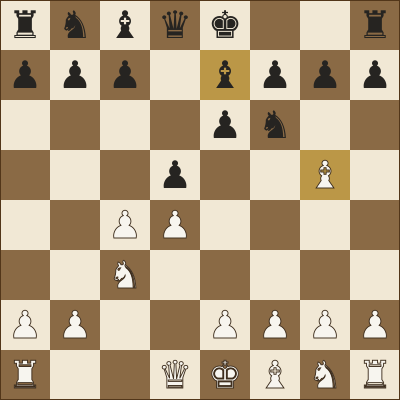
Classical 1.d4 structures — where Capablanca turned the smallest edge into a flawless endgame.
- Capablanca, J.R. Chess Fundamentals and My Chess Career.
- Capablanca–Marshall, New York 1918 (Marshall Attack, game record).
- Kasparov, G. My Great Predecessors, Vol. I (Capablanca).
- World Championship 1921 (Lasker–Capablanca) records.
Capablanca — Part 1 of 2
His legend rests on technique as much as talent. Part 2 looks at how Capablanca actually won — the endgame mastery that turned "simple" positions into points, and that every player can learn from.
Continue to Part 2: Endgame Technique → · Alexander Alekhine →