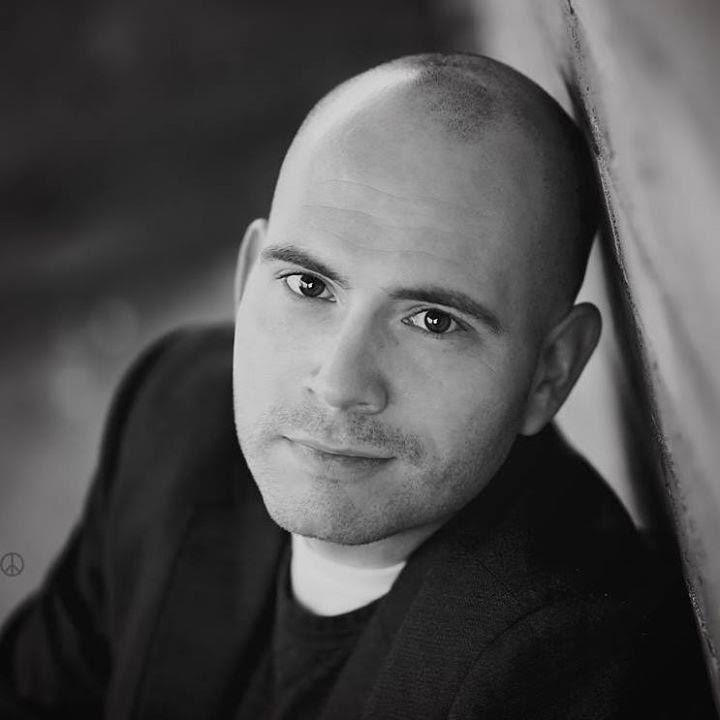
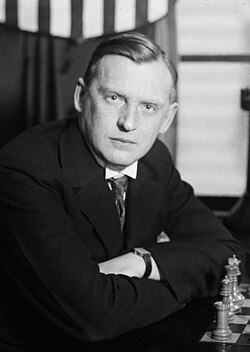
Alexander Alekhine
The attacking genius. World Champion from 1927 to 1935 and again from 1937 until his death in 1946, Alexander Alekhine fused the romantic love of the attack with rigorous modern calculation. His combinations — deep, original, and beautiful — set a new standard for dynamic chess, and he remains the only champion ever to die holding the title.
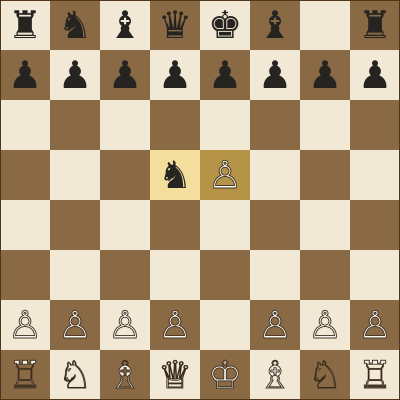
Alekhine's Defence — the provocative opening 1.e4 Nf6 2.e5 Nd5 (the knight on d5 and the advanced e5-pawn highlighted). Black deliberately lets White build a big centre, then sets out to prove it overextended. It bears Alekhine's name because he pioneered exactly this kind of dynamic, counterattacking idea.
Lived
1892–1946 · born Moscow, Russia; later French citizen
World Champion
1927–1935 and 1937–1946 — the only champion to die holding the title
Style
Deep combinations, dynamic attack, original opening preparation
Namesake
Alekhine's Defence (1.e4 Nf6); the Alekhine–Chatard Attack
Calculation as art
Alekhine's games are textbooks of attacking chess. He had a gift for steering games into rich, complicated positions where his superior calculation could find combinations no one else saw — often involving several pieces working together across the whole board. His best games are studied not just for their results but for their beauty, and his own deeply annotated game collections are among the finest chess books ever written.
In 1927 he did what many thought impossible: he defeated the seemingly invincible Capablanca in a marathon title match. He lost the crown to Max Euwe in 1935 — a result he reversed in a 1937 rematch — and held it until he died in 1946, still champion.
Where his games live in this library
Alekhine's Defence
His provocative 1.e4 Nf6 is the hypermodern idea in miniature: cede the centre, then attack it. It is a cousin of the counterattacking systems covered across the opening guides here.
Classical mastery
Against 1.d4 he was a master of the Queen's Gambit structures — the openings in which he ground down Capablanca in 1927 with relentless precision.
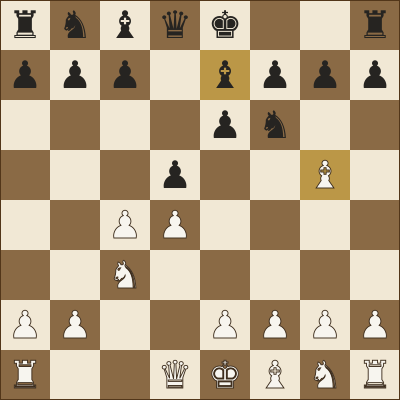
The Queen's Gambit Declined — the classical battleground of the 1927 Alekhine–Capablanca match, where Alekhine's preparation and endgame resolve wore down the "chess machine" over 34 games.
Alexander Alekhine — FAQ
What was Alekhine's playing style?
He was the supreme combinational attacker of his era — building complex, dynamic positions and then unleashing deep, multi-piece combinations opponents could not foresee. He backed his attacks with rigorous calculation and original preparation, making him the first great attacking theorist among the champions.
What is Alekhine's Defence?
The provocative opening 1.e4 Nf6, inviting 2.e5 Nd5 and a big white centre that Black then attacks as overextended. Named after Alekhine, who pioneered it in the 1920s, it remains a respected hypermodern surprise weapon at every level.
How did Alekhine become world champion?
He beat Capablanca in 1927 in one of the longest title matches ever played. He held the title from 1927 to 1935, lost it to Max Euwe in 1935, regained it in 1937, and held it until his death in 1946 — the only champion to die holding the crown.
Alekhine's Defence (1.e4 Nf6 2.e5 Nd5) — the provocative counterattack that bears his name.
The Queen's Gambit Declined — the classical territory of his 1927 triumph over Capablanca.
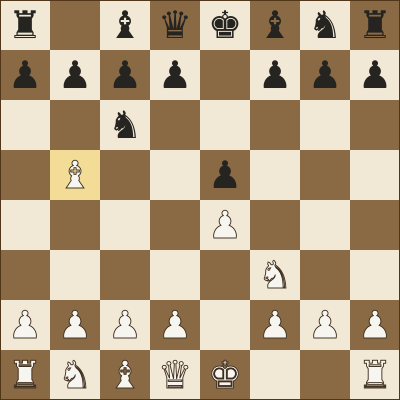
The open games — where Alekhine's combinational eye produced some of chess's most beautiful attacks.
- Alekhine, A. My Best Games of Chess (annotated collections).
- World Championship 1927 (Capablanca–Alekhine) records.
- Kasparov, G. My Great Predecessors, Vol. I (Alekhine).
- Alekhine's Defence theory (ECO B02–B05).
The lineage continues
Alekhine took the crown from Capablanca in 1927; after his death the title passed to Mikhail Botvinnik and the Soviet era. Explore the rest of the lineage.
José Raúl Capablanca → · Mikhail Botvinnik → · All Champions →