Capablanca's Endgame Technique
Capablanca's genius was clearest where the board was emptiest. With a handful of pieces left, he converted advantages so small that other masters saw nothing — and he did it so smoothly the wins looked inevitable. This is how he actually won: the endgame principles behind the legend, explained so any player can use them.
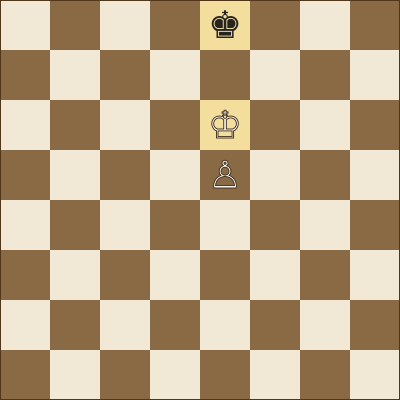
The foundation: a king-and-pawn ending. White's king has reached the sixth rank in front of its pawn (e6) with Black to move — White holds the opposition, Black must give way, and the pawn promotes. Capablanca's whole technique grows from mastering simple positions like this one perfectly.
The king becomes a fighting piece
The single biggest idea in Capablanca's endgames is also the simplest: in the endgame, the king is strong. With the queens off and few pieces left, the king is no longer a target to be hidden but a powerful attacker to be marched into the centre and forward. Capablanca activated his king earlier and more confidently than his contemporaries, and again and again that extra activity proved decisive. The opposition shown above is just the purest example — the king fighting for the key squares it needs to win.
Trading into a won position
When Capablanca held an advantage, he simplified toward it. Rather than keep tension and risk complications, he exchanged pieces to reach clear endings whose outcome he could calculate and trust — turning a small middlegame edge into a technically winning endgame. It sounds obvious; the skill is in knowing which ending is winning, and Capablanca's understanding of that was without equal.
The old proverb says rook-and-pawn endgames tend to be drawn even a pawn down — and it is largely true. Capablanca's mastery showed in how often he won them anyway. His famous 1924 game against Savielly Tartakower in New York is the model: down material in a rook ending, he ignored his own pawns, marched his king deep into Black's position, and used his active rook and king to win — activity beating material, exactly as the principles predict.
Why one weakness is not enough
A defender can usually guard a single weak point forever. Capablanca's method — later codified as the principle of two weaknesses — was to create a second problem on the other side of the board. Now the defending king and pieces cannot cover both; stretched between two fronts, something has to fall. Watch a Capablanca endgame and you will see him provoke a weakness, fix it, then calmly open a second one and shuttle his pieces between them until the position collapses.
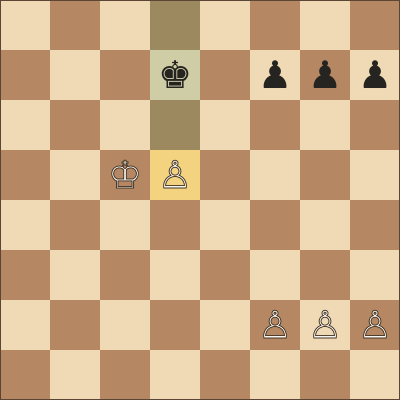
A passed pawn — one of the endgame's decisive assets and often the "second weakness" itself. The defender must spend a piece to stop it, freeing the attacker's forces elsewhere. Capablanca created and exploited passed pawns with unmatched clarity.
Capablanca's lessons for your own games
You do not need Capablanca's talent to use his method. Three habits will improve any player's results: activate the king once the queens come off; simplify toward endings you understand when you are ahead; and create a second weakness when one is not enough to win. These are the bones of his technique, and they are learnable. For the building blocks, see the pawn structures and passed pawn guides; for the tactics that finish endings, the tactics guide.
Capablanca's Endgames — FAQ
Why is Capablanca's endgame technique so admired?
He converted tiny advantages into wins with a simplicity that looked effortless and was nearly impossible to match. His moves seemed obvious in hindsight, yet few could find them. His handling of king-and-pawn and rook endings is still a model taught today.
What is the opposition in chess?
A king-and-pawn technique where the kings face each other with one square between them and the player NOT to move holds the edge, because the opponent must give way. Seizing it lets the stronger king reach the key squares in front of its pawn and promote.
What can I learn from Capablanca's endgames?
Three things: activate your king in the endgame, simplify into endings you understand when ahead, and create a second weakness so the defender can't guard everything. His games are the clearest demonstration of these principles.
The opposition — the foundational king-and-pawn technique at the root of Capablanca's mastery.
The passed pawn — a decisive endgame asset and a classic "second weakness."
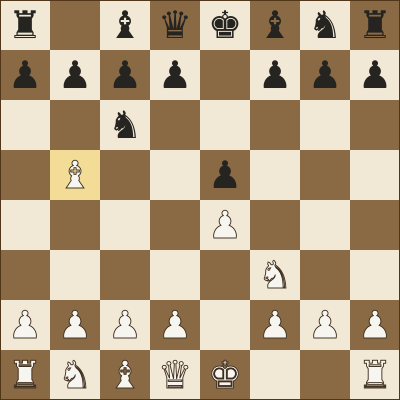
The openings (Part 1) that fed into the long, clear endgames where Capablanca did his finest work.
- Capablanca, J.R. Chess Fundamentals (his own primer on technique).
- Capablanca–Tartakower, New York 1924 (rook endgame, game record).
- Kasparov, G. My Great Predecessors, Vol. I (Capablanca).
- Standard endgame texts on the opposition and the principle of two weaknesses.
Capablanca — Part 2 of 2
That completes the Capablanca guide — the chess machine and his 1918 masterpiece, and the endgame technique that made him the model of clarity for every champion since.