Theme · Pride · Limits
Hubris
Excessive pride that oversteps human limits — and the downfall the Greeks believed it always invites.
 Michael Paycer
Excessive pride that oversteps human limits — and the downfall the Greeks believed it always invites.
Michael PaycerThe question
Where do human limits lie?
Greek figures
Icarus, Arachne, Niobe, Ajax
Philosophers
Socrates, Aristotle
Antidote
Self-knowledge, humility
Hubris means more than pride. To the Greeks it was a dangerous arrogance — overstepping the boundaries set for mortals, challenging the gods, or treating others with contempt. It was so serious that in Athens it was an actual crime.
Hubris almost always summons nemesis: the corrective downfall that restores the proper order. The pattern is one of Greek culture's deepest moral lessons — and it points straight to the philosophical virtues of humility, self-knowledge, and knowing one's limits.
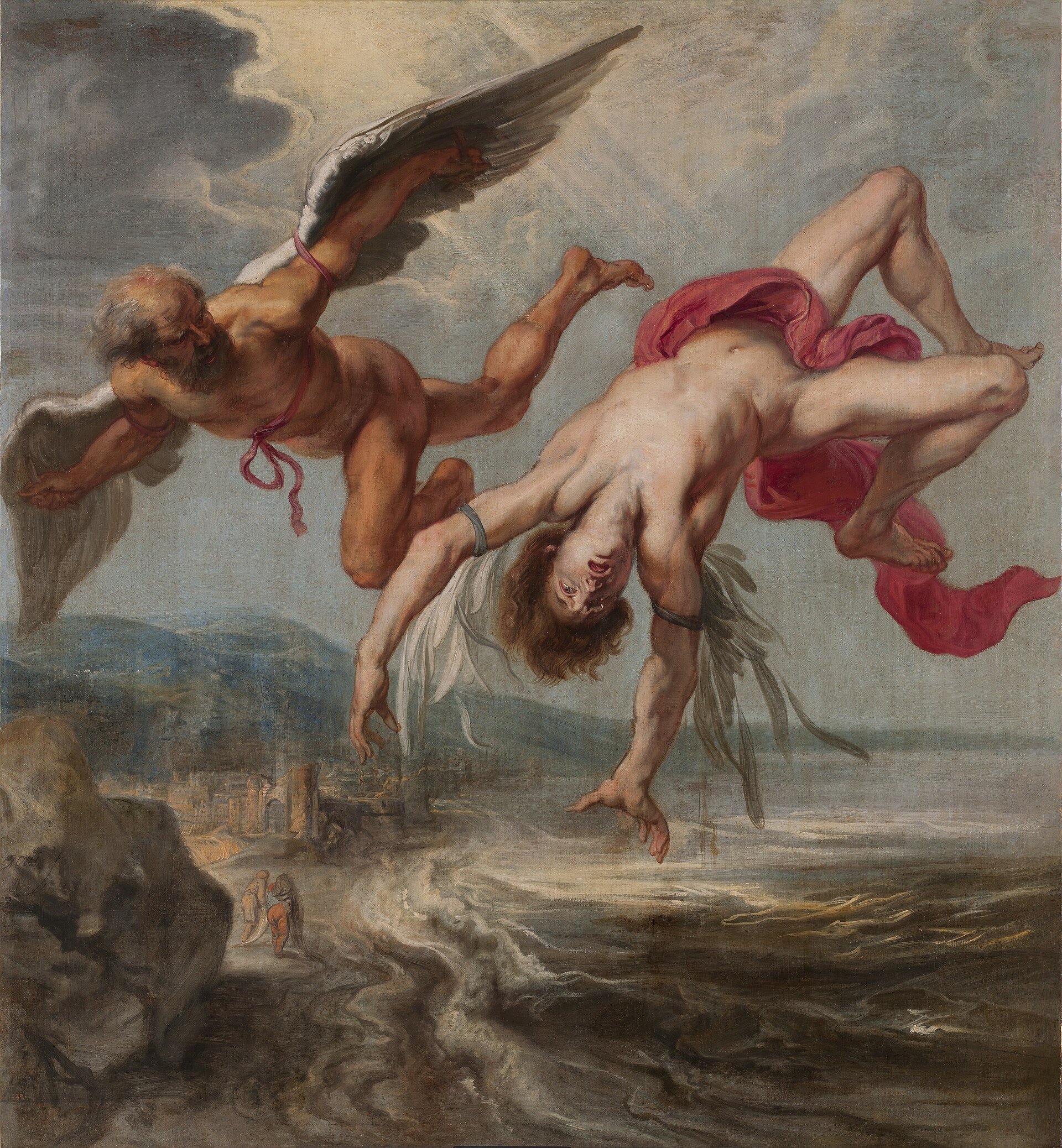
Given wings of wax and feathers, Icarus is warned not to fly too high. Intoxicated by flight, he soars toward the sun, the wax melts, and he falls into the sea. The single most famous image of ambition overreaching its limits.
The mortal weaver Arachne boasts she can out-weave Athena herself, and challenges the goddess. Even though her work is flawless, her arrogance is punished: Athena turns her into a spider, weaving forever.
Socrates built his entire philosophy on the Delphic warning against hubris: know thyself. Wisdom begins with honestly recognizing the limits of your own knowledge — the exact opposite of arrogant overreach.
For Aristotle, virtue is a balance between extremes. Proper self-respect sits between servility and vanity; courage between cowardice and recklessness. Hubris is excess — the vice of going too far.
Greek tragedy is, in large part, a sustained meditation on hubris: the great figure brought low by a fatal overstepping. The genre taught audiences, again and again, the wisdom of limits and the danger of pride.
Public-domain depictions — click any image to view it full size.
“Nothing in excess.”
Delphic maxim, Temple of Apollo
“Call no man happy until he is dead.”
Solon, in Herodotus — on the danger of pride in fortune
Excessive pride or arrogance, especially the kind that oversteps human limits or challenges the gods. In Greek thought it almost always invites a corrective downfall, called nemesis.
Icarus flying too close to the sun against his father's warning is the classic example. Others include Arachne challenging Athena and Niobe boasting against the goddess Leto.
Humility and self-knowledge — captured in the Delphic maxims 'know thyself' and 'nothing in excess,' which Socrates made central to philosophy.
When I am not reading Homer or Nietzsche, I tune databases, design high-availability systems, and run cloud migrations.