
How It Formed
The Sun and all its planets, moons, belts, and comets condensed from a single cloud of gas and dust some 4.6 billion years ago. One idea — the nebular hypothesis — explains the whole family in a single motion: a cloud collapses, a disk spins up, and out of the swirling grains, worlds are built.
From cloud to worlds, in four steps
Everything in the Solar System traces back to one collapsing cloud. Gravity pulled it inward; spin flattened it into a disk; and within that disk, dust stuck to dust until whole planets had grown. This diagram sketches the sequence.
Schematic by Michael Paycer — not to scale. The whole process, from collapsing cloud to formed planets, took only a few tens of millions of years.
Age
~4.6 billion years
Formed from
A collapsing cloud — the solar nebula
The Sun took
~99.86% of the cloud's mass
The split
Rock inside the "frost line," ice & gas outside
Gravity, spin, and a line drawn by cold
About 4.6 billion years ago, a vast cloud of gas and dust — the solar nebula — began to collapse under its own gravity, perhaps nudged by the shockwave of a nearby exploding star. As it fell inward it spun faster and flattened, the way a figure skater speeds up by pulling in their arms, until it became a swirling protoplanetary disk with a hot, dense center. That center became the Sun, which eventually grew hot enough to ignite nuclear fusion and switch on as a star, gathering up the vast majority of the cloud's material.
In the leftover disk, the planets were built from the bottom up. Tiny dust grains collided and stuck, growing into pebbles, then boulders, then kilometer-sized planetesimals, which swept up more material and merged into planets — a process called accretion. The reason the family split into rocky worlds and giants comes down to one boundary: the frost line. Close to the young Sun it was too hot for ices to survive, so only rock and metal could condense — building the small terrestrial planets. Beyond the frost line, water, ammonia, and methane froze into abundant ice, giving the outer planets far more raw material; they grew huge and pulled in gas, becoming the gas and ice giants. The scraps that never became planets are still with us — the Asteroid Belt, the Kuiper Belt, and the comets.
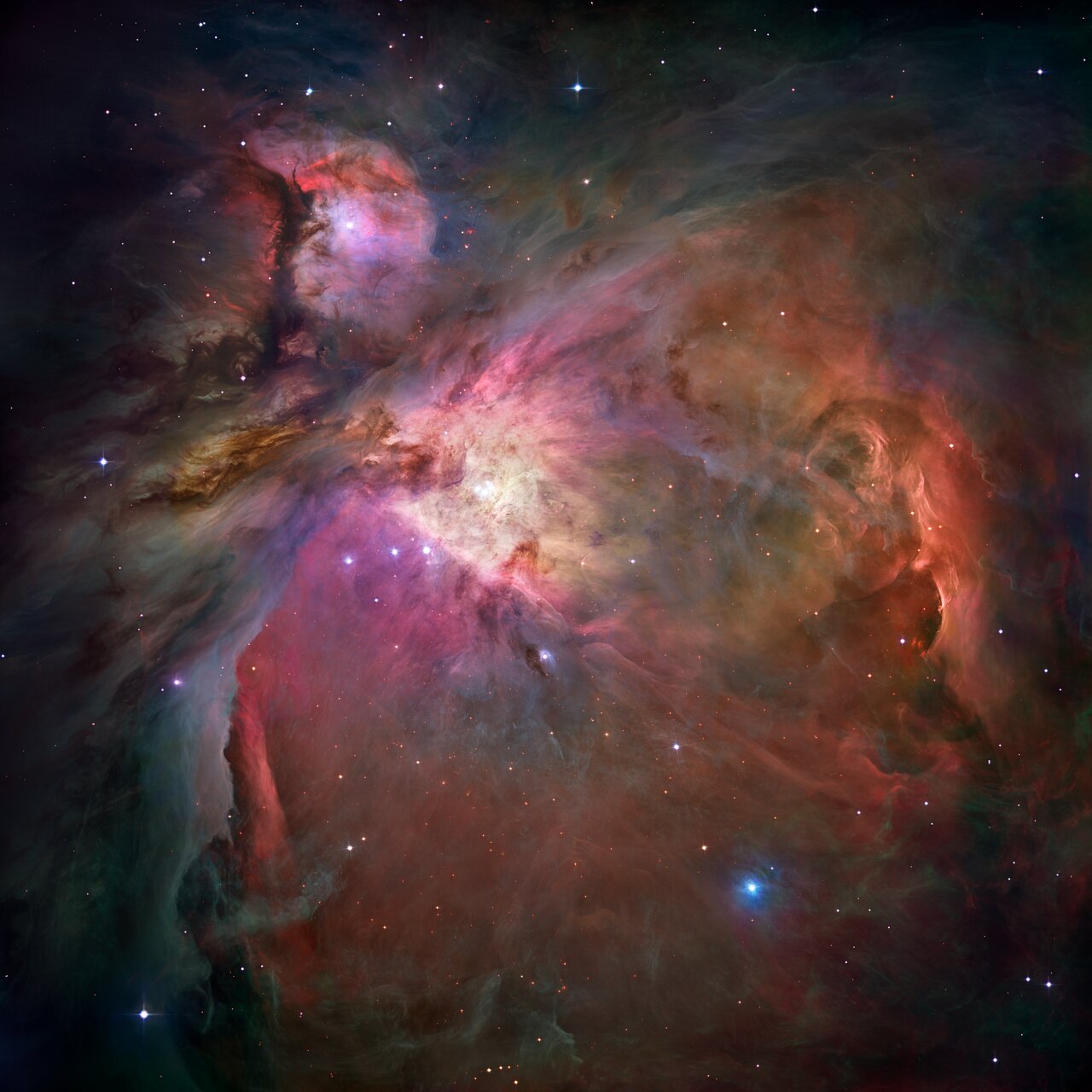
We can't watch our own birth — but we can watch others'
No one saw the Solar System form; it happened billions of years before anyone existed. But the beauty of astronomy is that the sky is full of systems at every stage of the same process, so we can piece the story together by watching other stars being born. The nearest and finest example is easy to find: the Orion Nebula, a glowing cloud below Orion's Belt, visible in binoculars and stunning in a small telescope. Inside it, thousands of young stars are switching on, several still wrapped in the very disks — called proplyds — from which planets may one day grow.
So the observing target here is star birth itself. Find the Orion Nebula on a winter night and you are looking at the same kind of event that made our Sun and Earth — a reminder that our origin was not a one-time miracle but a common, ongoing act of nature, repeating across the galaxy.
New to stargazing? See how to observe the night sky, and if you're choosing gear, the no-hype telescope buying guide.
Not the Big Bang, not built in place, and older stars than the Sun
A frequent mix-up is that the Solar System formed in the Big Bang. It didn't. The Big Bang, about 13.8 billion years ago, made almost only hydrogen and helium; our system came together far later, 4.6 billion years ago, from a cloud already seasoned with heavier elements — carbon, oxygen, iron, gold — forged inside earlier stars and scattered when they died. The very calcium in your bones and iron in your blood was made in stars that lived and died before the Sun was born. A second misconception is that the planets formed exactly where they now sit; in fact the giant planets likely migrated, drifting inward and outward early on and reshuffling the smaller bodies, which helps explain features of the belts and comets.
Every culture has told a story of how the world began, and they reach for the same idea our science does: order emerging from a formless beginning. In Greek myth, first there was Chaos — the yawning void — from which Gaia, the Earth, and the sky and sea took shape. It is a striking echo of the modern account: not gods shaping a cloud, but gravity, spin, and time drawing worlds out of the dark.
Primary sources: NASA — Solar System Facts and NASA — How the Solar System Formed. Diagram by Michael Paycer; Orion Nebula image: NASA, ESA, M. Robberto (STScI/ESA) and the Hubble Orion Treasury Project Team.
No god shaped it and no single moment made it — only gravity, spin, and time, drawing a cold cloud inward until it lit a star and spun out a family of worlds, in a process the galaxy is still repeating tonight.
The system it built
The Solar System (hub) · The Sun · The Planets · Asteroid Belt · Kuiper Belt · Orion Nebula
More astronomy notes
Continue through the astronomy section for beginner-friendly notes, image credits, viewing tips, history, and the stories behind the night sky.
The Solar System · The Planets · The Sun · Astronomy · Interests