
The Whirlpool Galaxy (M51)
It's the picture-perfect spiral — two bold arms winding out from a bright core, with a small companion galaxy caught at the tip of one arm. But the Whirlpool's real claim to fame is historical: in 1845 it became the very first object in which anyone ever saw spiral structure at all — decades before the word "galaxy" meant anything.
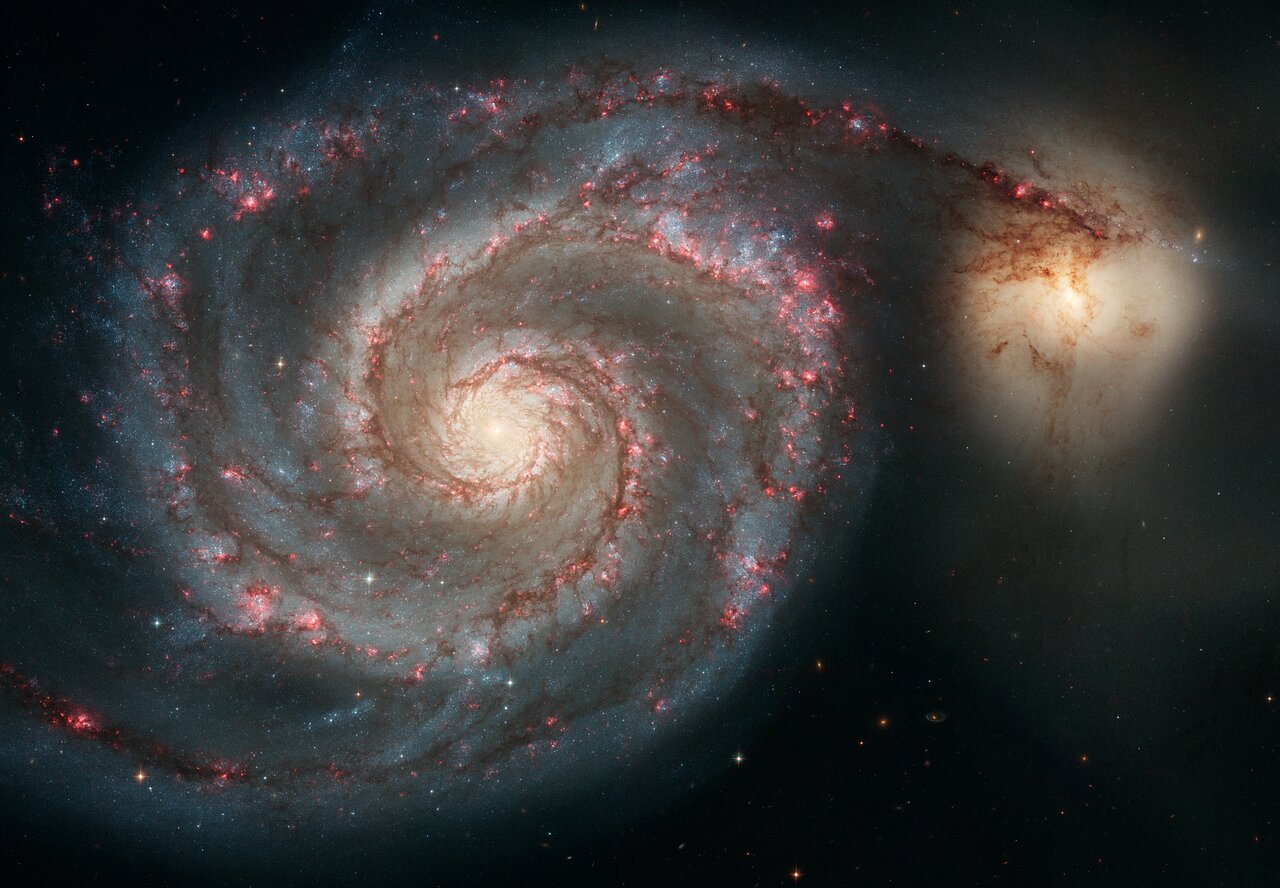
Image: NASA, ESA, S. Beckwith (STScI) & the Hubble Heritage Team. The Whirlpool (M51) in Canes Venatici, about 31 million light-years away — a "grand design" spiral, the type with two clean, dominant arms. The yellowish blob at the top is its companion, NGC 5195, tugging at the Whirlpool as it passes.
A spiral being stirred by a companion
The Whirlpool is the textbook "grand design" spiral galaxy — not a fuzzy scatter of arms, but two bold, symmetric arms sweeping out from the core, traced in glowing pink star-forming regions and dark dust. And those arms aren't just decoration: they're likely being amplified by the small companion galaxy, NGC 5195, which is making a close pass and stirring the Whirlpool's disk with its gravity. It's a galaxy interaction caught mid-act — a gentle collision that's compressing gas and lighting up waves of new stars along the arms. So the Whirlpool is two things at once: the most beautiful nearby spiral, and a live demonstration of how galaxies reshape one another.
At about 31 million light-years, the light in these images left the Whirlpool 31 million years ago — long before there were humans to build the telescopes that would eventually capture it.
The drawing that started it all
Long before photography or the word "galaxy," one man saw the spiral with his own eye — and it changed astronomy.
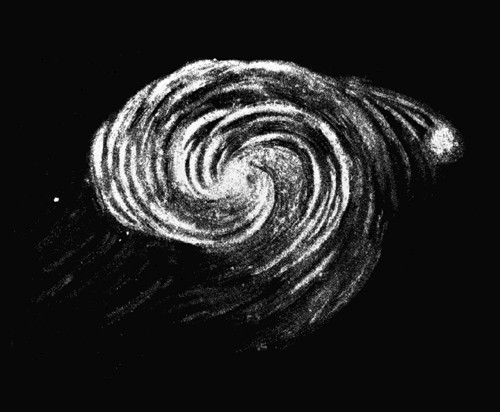
Lord Rosse — a sketch, 1845
Using the "Leviathan of Parsonstown," the largest telescope on Earth at the time, William Parsons (the 3rd Earl of Rosse) drew what he saw: a spiral. It was the first time anyone had ever detected spiral structure in a "nebula" — an observation made purely by eye and hand.
Hubble — a photograph, 2005
160 years later, the Hubble Space Telescope captured the same galaxy in exquisite detail. Set the two side by side and Rosse's pencil sketch is unmistakably the same object — a testament to how good, and how important, that first human glimpse was.
Images: William Parsons, 3rd Earl of Rosse (1845 sketch, public domain); NASA, ESA & the Hubble Heritage Team (2005). Rosse had no idea he was looking at another galaxy — that wouldn't be understood for another 80 years — but he had found the shape that would come to define them.
One of the few galaxies whose arms you can see
The Whirlpool is a special treat, because it's one of the rare galaxies where an amateur can actually glimpse spiral structure — the thing that makes it famous. In binoculars or a small scope, you'll see two soft glows: the Whirlpool's round haze and its companion beside it, an easy and pleasing pair. The arms are the challenge: under genuinely dark skies with an 8-inch or larger telescope, patient observers can trace the faint curve of the spiral arms and the bridge of light to the companion — a genuine thrill, since you're seeing real galactic structure by eye, exactly as Lord Rosse did. From light-polluted skies, though, it collapses to two dim smudges, so a dark site matters more here than aperture. Find it near the end of the Big Dipper's handle. See the telescope guide and how to observe.
A century ahead of understanding
Charles Messier catalogued the Whirlpool as M51 in 1773, noting only a faint patch of light. Rosse's 1845 spiral drawing caused a sensation — but no one knew what it meant. Were spirals swirling clouds of gas condensing into a solar system, as some thought? Or something far larger and farther away? The Whirlpool sat at the center of that mystery for 80 years, until Hubble's 1924 measurement of Andromeda finally proved that spirals like it were entire galaxies, millions of light-years off. Rosse had been sketching a distant island universe all along — he just lived too early to know it. That's the quiet poignancy of the Whirlpool: the shape was seen a lifetime before its meaning.
"We are all in the gutter, but some of us are looking at the stars."
— Oscar Wilde, Lady Windermere's Fan (1892)
Galaxy Collisions · Galaxy Types · Andromeda · Sombrero · Galaxies Hub · Telescopes · Glossary
Return to Michael Paycer
Explore Michael Paycer's professional SQL Server, cloud, ETL, API, automation, and consulting pages, or continue browsing the personal interests section.