Ideology · The Roots

What deal did we strike
to stop fighting?

Before liberalism, conservatism, or socialism had names, three thinkers asked a stranger question: imagine there was no government at all. What would life be like, and what bargain would rational people make to escape it? Their three answers to that thought experiment, the social contract, still run underneath almost every argument about how much power the state should have.

Michael Paycer Michael Paycer
In brief

The idea

Government by an implied agreement

Three views

Hobbes, Locke, Rousseau

The hinge

What life is like without a state

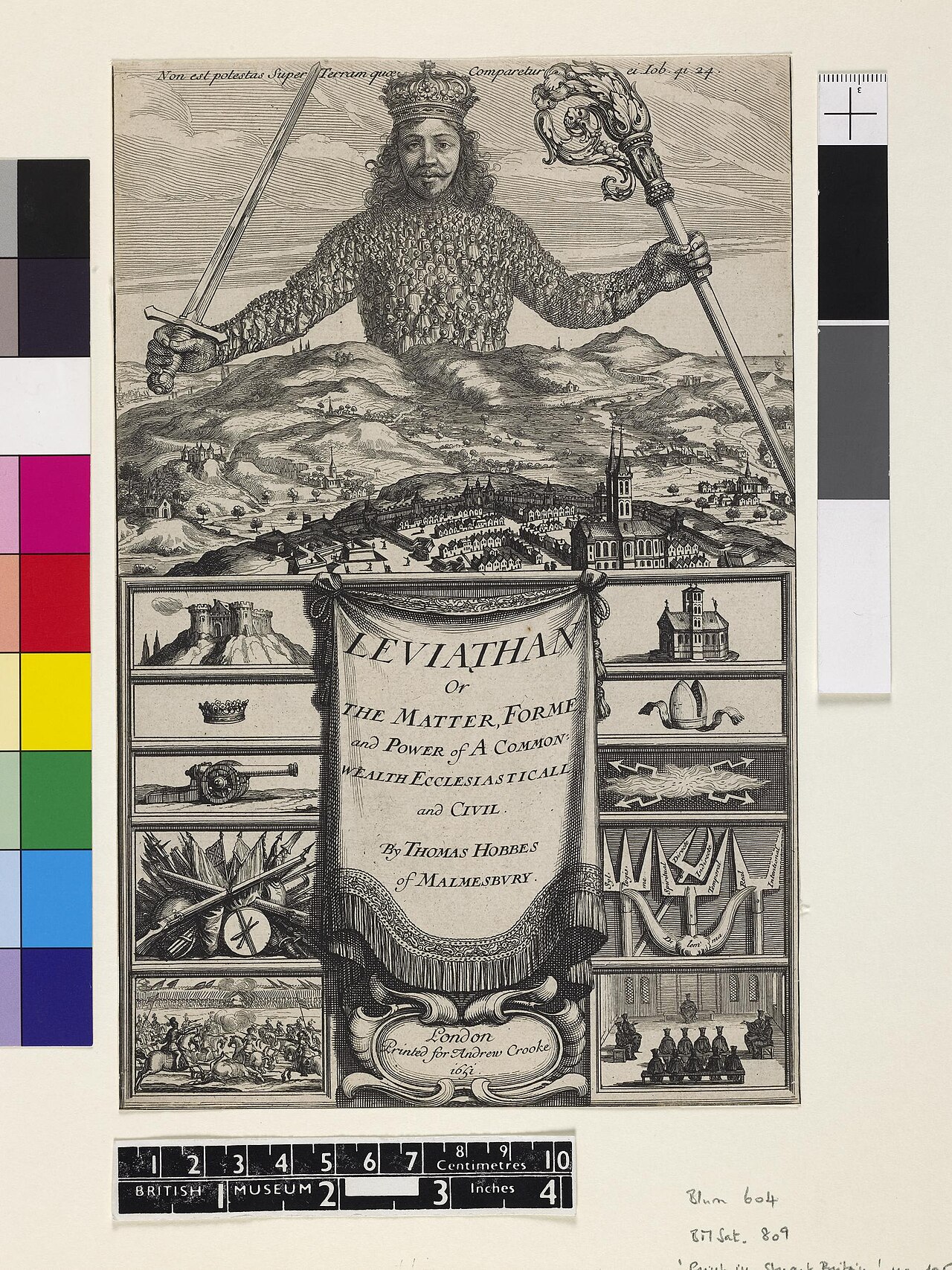
Frontispiece of Hobbes's Leviathan
The frontispiece of Leviathan. Abraham Bosse's engraving shows the sovereign as a giant whose body is composed of his subjects, wielding sword and crosier over the land. Hobbes's picture of the deal that ends the war of all against all. Abraham Bosse, 1651 · Public domain via Wikimedia Commons
Side by side

Same thought experiment, three verdicts

Each thinker started by imagining life without a state. What they saw there decided everything that followed.

ThinkerLife without a stateSo we should build
HobbesA war of all against all: nasty, brutish, shortAn almost absolute sovereign to keep order
LockeFree and equal, with rights, but insecureA limited government by consent, revocable
RousseauFree and decent, corrupted by society itselfRule by the general will of the people
In full

Three ways to leave the state of nature

Hobbes — order at almost any price

Thomas Hobbes wrote during the English Civil War, and it shows. Strip away government, he argued, and you get a war of every person against every person, where life is solitary, poor, nasty, brutish, and short. People are roughly equal in their ability to kill each other, and fear rules everything. To escape it, they hand nearly all their power to a single sovereign, the Leviathan, whose authority must be near-absolute, because any crack in it invites the chaos back. Better one master than the war of all.

Locke — a government that can be fired

John Locke saw the same starting point far more calmly. In his state of nature people are already free, equal, and governed by reason, and they already hold rights to life, liberty, and property. The problem is not war but insecurity: no neutral judge, no reliable enforcement. So they create a limited government to protect the rights they already have, and, crucially, that government rules only by consent and forfeits its authority if it turns tyrant. The right of revolution is built in. This is the contract that shaped liberal democracy and the American founding.

Rousseau — the people rule themselves

Jean-Jacques Rousseau flipped the script. Natural humans, he argued, were free and basically decent; it is society, with its property and inequality, that corrupted them and put them in chains. A legitimate contract, then, cannot just install a ruler over the people; authority can only come from the people ruling themselves, through what he called the general will, the shared common interest of the community. It is a democratic and radical idea, and a double-edged one: critics warn that "the general will" can be claimed by anyone who says they speak for the people.

The life of man: solitary, poor, nasty, brutish, and short.

Thomas Hobbes, Leviathan

Man is born free, and everywhere he is in chains.

Jean-Jacques Rousseau, The Social Contract
The through-line

Tell me what you think people are like without a state, and I can guess how much of one you want. Every argument about big government and small is a rerun of Hobbes, Locke, and Rousseau.
All three answers hang on one prior question the next page takes up directly: are people basically good?

Common questions

People also ask

What is the social contract?

The idea that political authority is justified by an implicit agreement among people to give up some freedom for the benefits of a common government. It is a thought experiment: imagine life with no state, then ask what deal rational people would strike to escape it. Those terms set the limits of legitimate power.

How did Hobbes, Locke, and Rousseau differ?

Hobbes saw a war of all against all and wanted a powerful sovereign. Locke saw free people with rights and wanted a limited state by consent, revocable if it fails. Rousseau saw people as free and decent but corrupted by society, and located legitimate authority in the general will.

What is the state of nature?

The hypothetical condition of human life before or without government, used to reason about what a state is for. A fearful Hobbesian version justifies strong authority; a freer Lockean or Rousseauian version justifies a limited or democratic one.

Why does the social contract still matter?

Its three answers underlie modern politics: Hobbes's fear of disorder in law-and-order conservatism, Locke's rights and consent in liberal democracy, Rousseau's general will in popular movements. Argue about the size of the state and you argue with these three.

Sources
The day job

Built by a SQL Server consultant

When I’m not refereeing Hobbes, Locke, and Rousseau, I tune databases, design high-availability systems, and run cloud migrations.

See what I do →