Socialism begins with a stubborn observation: a society can be free on paper and deeply unequal in fact, because whoever controls the economy controls almost everything else. Its answer is to put the decisive resources under collective control so that wealth and power stop pooling at the top. Marxism is the most rigorous, most disruptive version of that argument, and it changed the world whether or not you accept a word of it.
Michael Paycer
Equality; shared economic control
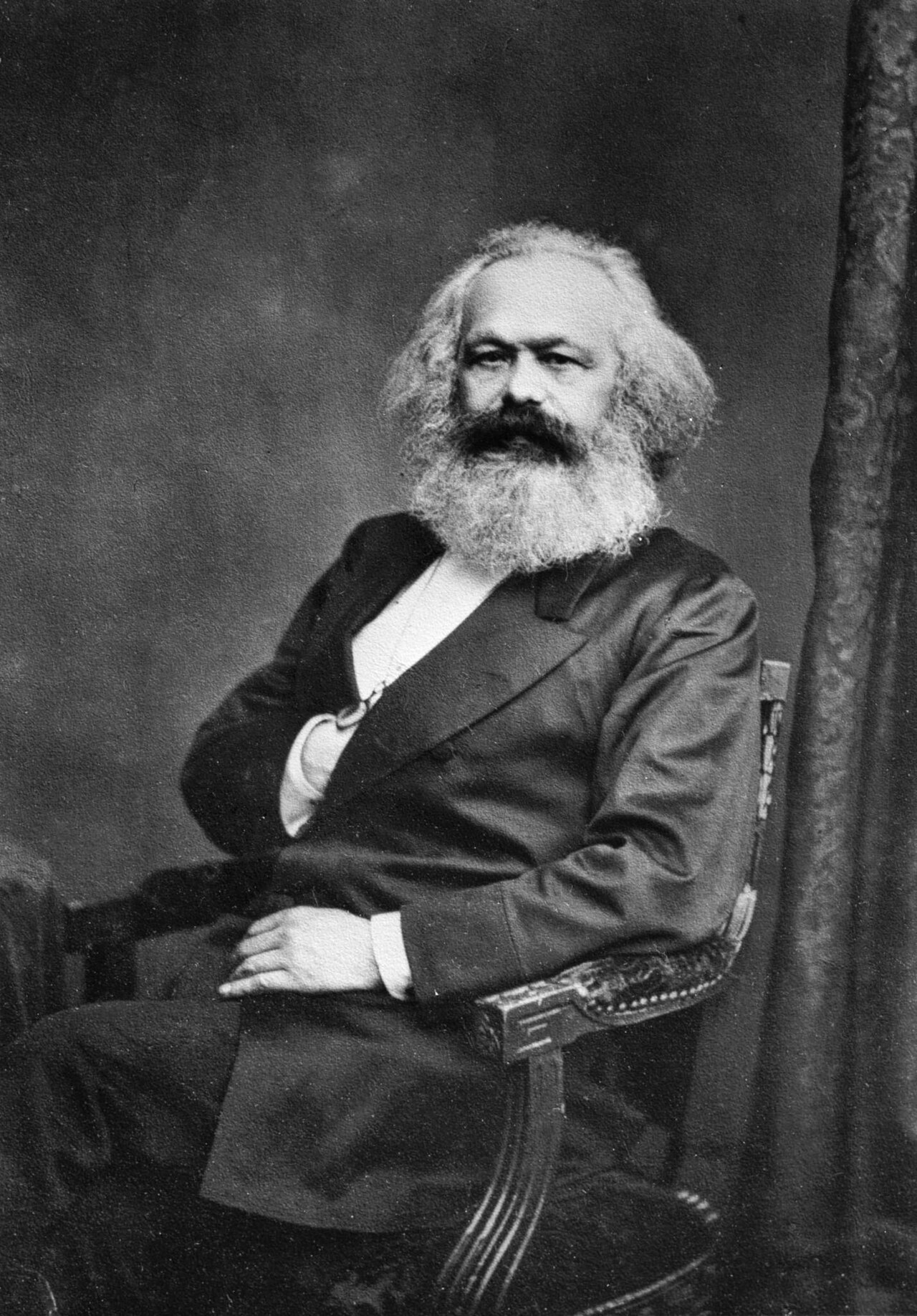
Karl Marx
Planning, incentives, the record
The value socialism guards is equality, not just before the law but in the material conditions of life. Its founding intuition is that the liberal promise of freedom rings hollow if a few own the factories, the land, and the capital while most people own only their labor and must sell it to survive. Real freedom, on this view, requires changing who controls the economy, not just who sits in parliament. That is the thread running from early cooperative experiments through Marx to the modern welfare state.
Karl Marx turned the intuition into a theory. He argued that history moves through the struggle between economic classes, that capitalism systematically pays workers less than the value they produce and pockets the difference as profit (surplus value), and that it alienates people, from the things they make, from their own labor, and from each other. Capitalism, he predicted, would generate its own gravediggers: a working class that eventually overturns it and builds a classless, communal society.
The proletarians have nothing to lose but their chains. They have a world to win. Workers of all countries, unite!
Karl Marx and Friedrich Engels, The Communist Manifesto
From each according to his ability, to each according to his needs.
Karl Marx, Critique of the Gotha Programme
The tradition splits hardest on how to get there. Revolutionary Marxism holds that capitalism must be overthrown, since those who hold power will never vote it away. Social democracy takes the opposite bet: work through elections, tax and regulate capitalism, build universal healthcare and education, and blunt inequality without abolishing markets. The Nordic states are its calling card. Between them sit market socialists, democratic socialists, and cooperativists, all sharing the same target, private economic power, and disagreeing on the weapon.
Friedrich Hayek argued that no central planner can gather the information a market packs into prices. Millions of buyers and sellers signal scarcity and desire every second; a committee cannot replicate that, so planned economies misallocate and stagnate. Alongside it runs the incentive objection: strip away private reward and people work less, innovate less, and the pie shrinks.
The heaviest charge is empirical. The 20th-century states that raised Marx's banner, the Soviet Union, Maoist China, and others, produced not the promised equality but one-party rule, secret police, and famine. Hannah Arendt traced how a total ideology, marched to its logical end, curdles into terror. Defenders answer that these were authoritarian distortions, not the democratic socialism they argue for, and that judging the idea by Stalin is like judging Christianity by the Inquisition.
Socialism names a real problem no one has fully solved: private economic power can swallow political freedom. Its record is the running argument over whether the cure has been worse than the disease.
The family of ideologies that prioritizes social equality and argues the economy's key resources should be owned or controlled collectively rather than by private capital. Its claim is that private ownership of the means of production produces deep inequality and exploitation.
Socialism is the broad family; Marxism is one specific theory within it, adding the analysis that history is driven by class struggle and capitalism will be overturned by the working class. Social democracy seeks to regulate capitalism through elections rather than overthrow it.
That history is shaped by conflict between economic classes, that capitalism exploits workers by paying them less than the value they create, and that it alienates people from their work and each other. He predicted capitalism would be replaced by a classless, communal society.
That central planning cannot match the information markets convey through prices (Hayek), that removing private incentives reduces productivity, and that 20th-century states built in Marx's name produced repression, not equality. Defenders reply that democratic and market-socialist forms avoid those failures.
When I’m not weighing Marx against Hayek, I tune databases, design high-availability systems, and run cloud migrations.