Sky, weather, and the honesty of the evidence
Roman religion divinized the sky in layers. Some of these figures — above all Sol — had genuine cult that mattered to the Roman state. Others, such as the four winds, are mostly poetic personifications: Latin poets treated a storm or a west breeze as a divine agent because that is how epic and cosmological verse works, not necessarily because there was a temple and a priesthood behind every name. This page keeps that distinction visible instead of flattening everything into one tidy pantheon.
An honest evidence note belongs up front. The material here ranges from grade A/B (Sol, Luna, where cult, coinage and poetry all survive) down to C (Vulturnus, whose very identity and wind-direction are uncertain and where no secure direct speech survives). Where the famous stories are Greek inheritances — Caelus's castration myth, Aurora's genealogy — this page says so rather than pretending they are archaic Roman cult. The point is not to diminish these gods but to show how Roman religion handled the boundary between a physical element and a divine person.
Sky, sun, moon and dawn
Caelus
Caelus personified the sky or heavens, corresponding to Greek Uranus in mythographic equivalence; his name is simply the ordinary Latin word for sky, caelum. No canonical first-person speech defines a Roman Caelus, and the evidence is largely cosmological and poetic — he functions as the divinized heavens and as cosmic ancestor in Greco-Roman genealogy. That fluid line between a divine sky and the physical heaven is exactly the philosophical problem the Romans lived with. The elaborate castration myth belongs fundamentally to the Greek Uranus tradition and should not be projected onto an independent archaic Roman cult. His clearest legacy is linguistic: “celestial” descends from Latin caelestis, from caelum. Evidence: B/D.
Sol
Sol was the Roman sun god, and his worship was not merely a late import: solar cult existed in Rome long before the third century CE, even though its forms, imagery, and political importance changed considerably over time. Sol could be a visible celestial deity, a cosmic intelligence, an all-seeing witness to oaths, and a symbol of imperial universality. Modern scholarship specifically cautions against reducing Roman Sol to a simple copy of Greek Helios or assuming one uninterrupted, monolithic solar theology. His functions run from light and the daily cycle to cosmic order and, later, potent imperial symbolism; but the relationships among Sol, Sol Indiges, Sol Invictus, Elagabal, Mithras and Apollo are complex — they were not one god under interchangeable names. His afterlife runs through solar iconography, imperial halos, and the day-name dies Solis. Evidence: A/B.
Luna
Luna was the Roman moon goddess, corresponding broadly to Greek Selene, with cult sites in Rome and an iconography that often shows her driving a chariot. She is at once the visible celestial body and its divine personification, and philosophical astronomy increasingly explained the moon naturalistically without abolishing the religious language around her. Her domain covers the lunar cycle, the illumination of night, calendrical association, and a cosmic balance with Sol. In later triple-goddess schemes Luna overlaps with Diana and Hecate, though these goddesses were not simply interchangeable in every cult context. The words “lunar” and — through old beliefs about lunar influence — “lunatic” preserve her name. Evidence: A/B.
Aurora
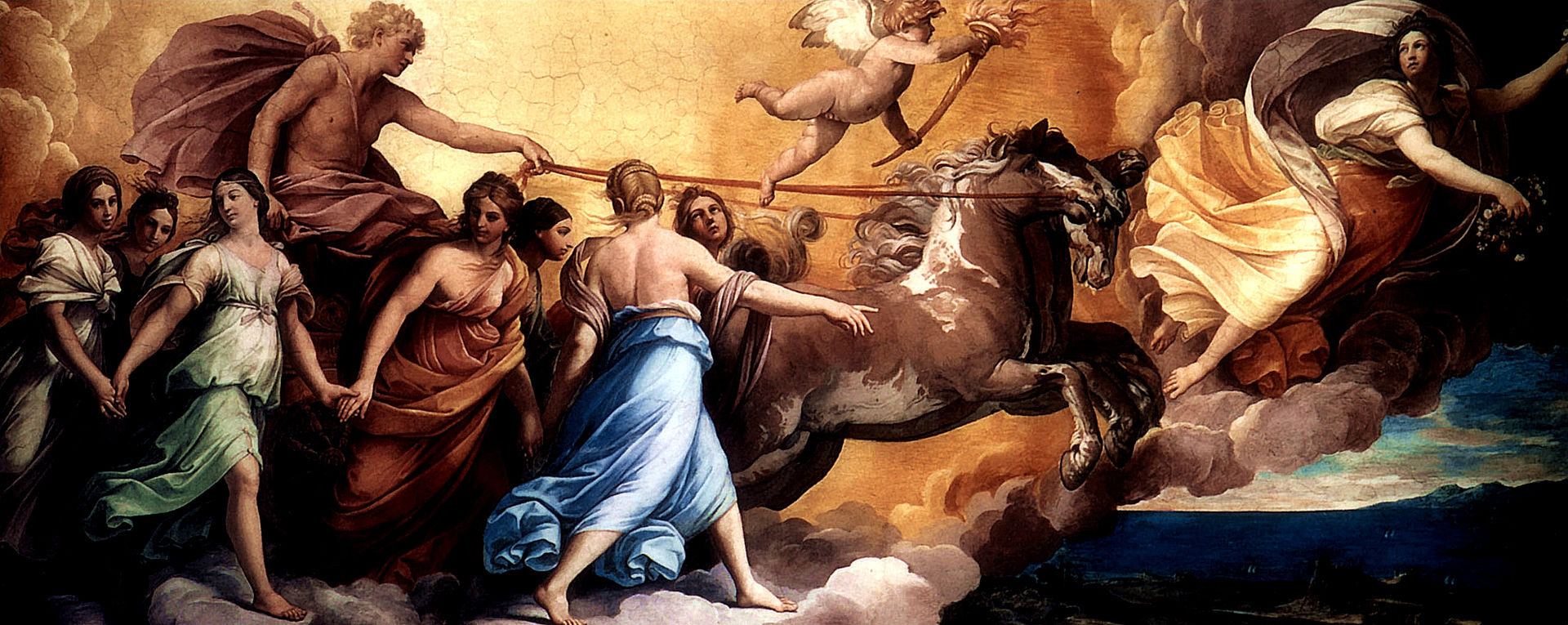
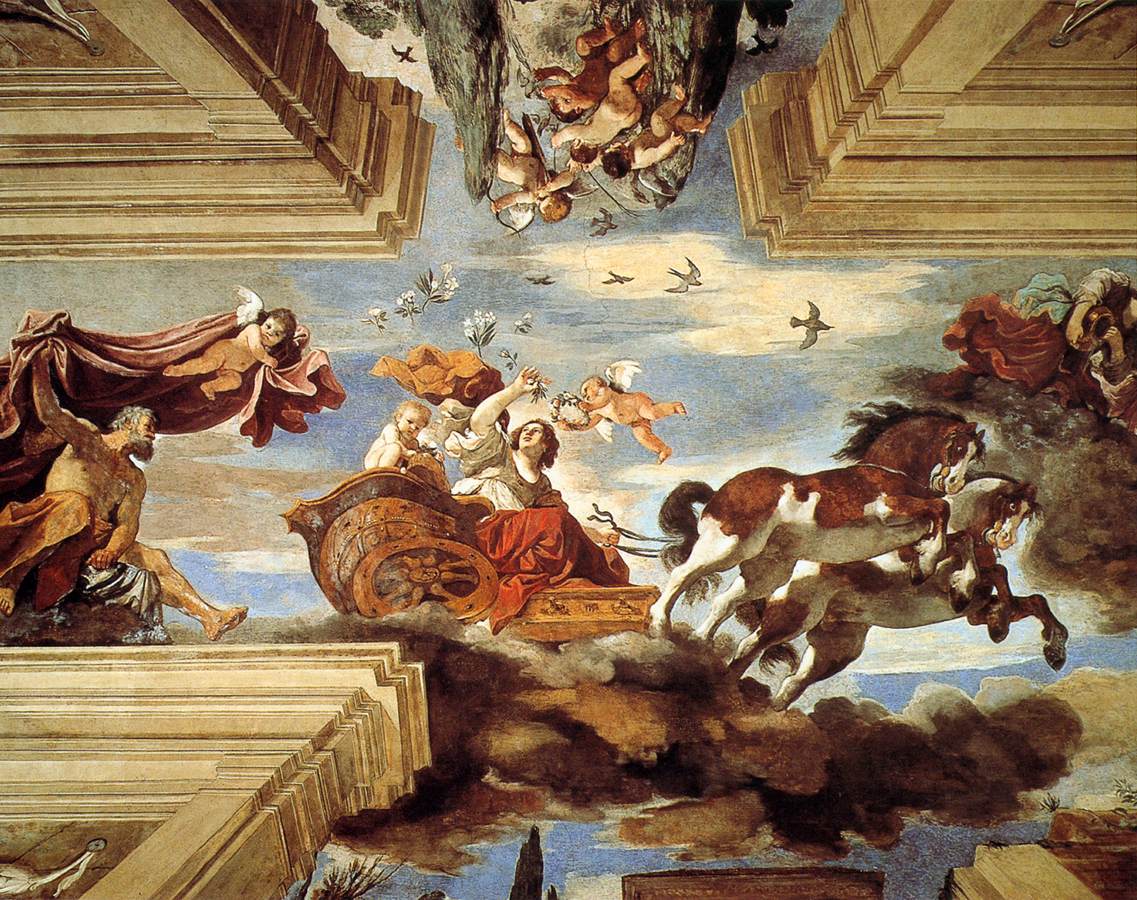
Aurora personified the dawn, corresponding to Greek Eos, and she is primarily a literary and poetic deity in the Roman evidence — a goddess who opens the day with rosy color and celestial motion. Her function is to bring the dawn and renew daily time, and she gave Latin poetry one of its most enduring visual formulas. Much of her personal mythology is Greek-derived and independent Roman cult evidence is limited, which is worth stating plainly. Her name lives on in the word “aurora,” the aurora borealis and australis, and in personal names and astronomical imagery. Evidence: B/D.
Storm and the four winds
Tempestas
Tempestas — often plural, the Tempestates — personified storm and dangerous weather, and Roman seafarers could vow offerings after surviving a storm at sea. Ovid mentions a shrine of Tempestas in Fasti 6, which makes this one of the clearer cases of a natural force treated as a divine agency with real ritual attached. The role is storm, weather-danger, and appeasement in a seafaring context. Singular-versus-plural usage varies in the sources and narrative mythology is sparse, so the figure is more cultic than storied. The English word “tempest” descends from Latin tempestas. Evidence: B.
Auster
Auster personified the south wind, often associated with heat, moisture, rain and stormy weather; his Greek equivalent is Notus. He is primarily a poetic personification of a natural force rather than a major Roman state-cult god, and Virgil and Ovid use Auster as an active wind in their storm scenes. Wind directions and characteristics shift with ancient geography and authorial convention, so precision is limited. The geographical vocabulary “austral” and “Australia” ultimately derive from Latin auster, “south” — from the direction, not from the god as an independently worshipped figure. Evidence: B/D.
Aquilo
Aquilo was the north or northeast wind, broadly corresponding to Greek Boreas — mostly a poetic personification of cold, powerful northern air. Latin epic regularly names Aquilo among the storm winds, and no separate canonical divine speech is needed to establish him. His function is the cold northern wind as a seasonal and nautical force. Directional equivalence with the Greek wind system is not always exact, another reminder that these are literary conventions rather than a fixed meteorological creed. He survives chiefly in learned, poetic and meteorological vocabulary. Evidence: B/D.
Favonius
Favonius was the favorable west wind, corresponding to Greek Zephyrus and associated with the coming of spring — a benevolent poetic personification of seasonal air and renewal. Roman poets use Favonius as the mild wind that awakens spring; no secure individual creed survives for him. His domain is the gentle west wind, spring, vegetation and favorable weather. Like the other winds his evidence is chiefly literary, with limited independent cult. His legacy lives in classical poetry, garden imagery and the enduring western-wind motif. Evidence: B/D.
Vulturnus
Vulturnus was an ancient Roman or Italic deity associated with a wind and possibly with the river Volturnus, and both the exact direction and identity of the wind vary across ancient and modern reconstructions. He is a specialized natural power whose festival, the Vulturnalia, is attested in the Roman calendar — firmer evidence than any narrative myth, because no secure direct speech survives. His function is a wind or river power with a recognized festival. Confident statements that he was simply “the east wind” oversimplify the conflicting evidence, and his significance today is mainly antiquarian and regional. Evidence: C.
Famous public-domain depictions — click any image to view it full size.
Was Sol just the Roman version of Greek Helios?
No. Solar cult existed in Rome long before the third century CE, and modern scholarship cautions against reducing Roman Sol to a passive copy of Greek Helios or assuming one unchanging solar theology. Sol was a celestial deity, an all-seeing witness to oaths, and later a powerful symbol of imperial universality, and the relationships among Sol, Sol Indiges, Sol Invictus, Mithras and Apollo are complex rather than interchangeable.
Who were the four Roman winds?
The classic Roman winds were Auster, the south wind (Greek Notus); Aquilo, the north or northeast wind (Greek Boreas); Favonius, the favorable west wind of spring (Greek Zephyrus); and Vulturnus, an old Italic wind of uncertain direction with its own festival, the Vulturnalia. Most appear chiefly as poetic personifications of natural forces.
What is the difference between Caelus and Jupiter?
Caelus is the personified sky or heavens — the ordinary Latin word caelum divinized, corresponding to Greek Uranus in mythographic equivalence. Jupiter is the sky-father and supreme god of the Roman state. Caelus is closer to the physical heavens as a cosmic region, while Jupiter is an active civic and political deity.
Did the Romans actually worship the weather and winds?
Partly. Tempestas, the storm, had a shrine and received vows from seafarers who survived storms, and Vulturnus had a festival in the Roman calendar. But figures such as Auster, Aquilo and Favonius survive mainly as poetic personifications in Latin literature rather than as major independent state cults.
 Michael Paycer