Who is Diana?
Diana was the Roman goddess of the hunt, of wild and forested places, of women and childbirth, and of the moon. She was an old Italic deity in her own right before she was strongly identified with Greek Artemis. Where later poetry gives her Artemis's stories, her deepest Roman roots lie in the wilderness sanctuaries of central Italy — above all the famous cult on Lake Nemi.
What makes her distinctive is that she is a goddess of thresholds. She crosses boundaries that ordinary religion keeps apart: wilderness and city, virginity and childbirth, the moon overhead and the hunt below. Roman poets caught this by calling her Trivia, “of the three ways” — a goddess of crossroads and triple form.
Origins & history
Diana began as an old Italic goddess of wild places, hunting, women, and childbirth. Her sanctuary at Aricia on Lake Nemi — the “mirror of Diana” — was among the most famous cult centers in all of Italy, drawing worshippers well before her thorough fusion with the Greek Artemis. That native origin is why she carries meanings the Greek huntress does not: she is embedded in the Italian landscape and in the lives of Italian women.
As Greek myth and art flowed into Rome, Diana absorbed Artemis's identity as virgin huntress and lunar goddess. The result is a layered figure: authentically Roman in cult and setting, but clothed in Greek narrative myth through Latin poetry.
Cult & worship
Diana's most celebrated worship was at the wooded sanctuary on Lake Nemi, near Aricia. That shrine was served by a strange and much-discussed priest, the Rex Nemorensis — the “King of the Wood” — whose office later became central to James Frazer's The Golden Bough, though Frazer's sweeping evolutionary theories are now treated with caution. Beyond Nemi, Diana was a goddess whom women invoked, especially in matters of childbirth. The Arician priesthood is historically real; sensational reconstructions of ritual kingship, however, go well beyond the surviving evidence.
Greek equivalent
Diana was identified with Greek Artemis, and much of her narrative mythology — the virgin huntress, the punisher of those who trespass on her, the twin of Apollo — is inherited from the Greek tradition. But the identification is not the whole story. Artemis is a Panhellenic goddess of the wild; Diana is that and a specific Italian cult figure rooted at Nemi and woven into Roman women's religion. Reading the two together shows what was native and what was borrowed.
Famous myths & stories
Actaeon and the goddess bathing
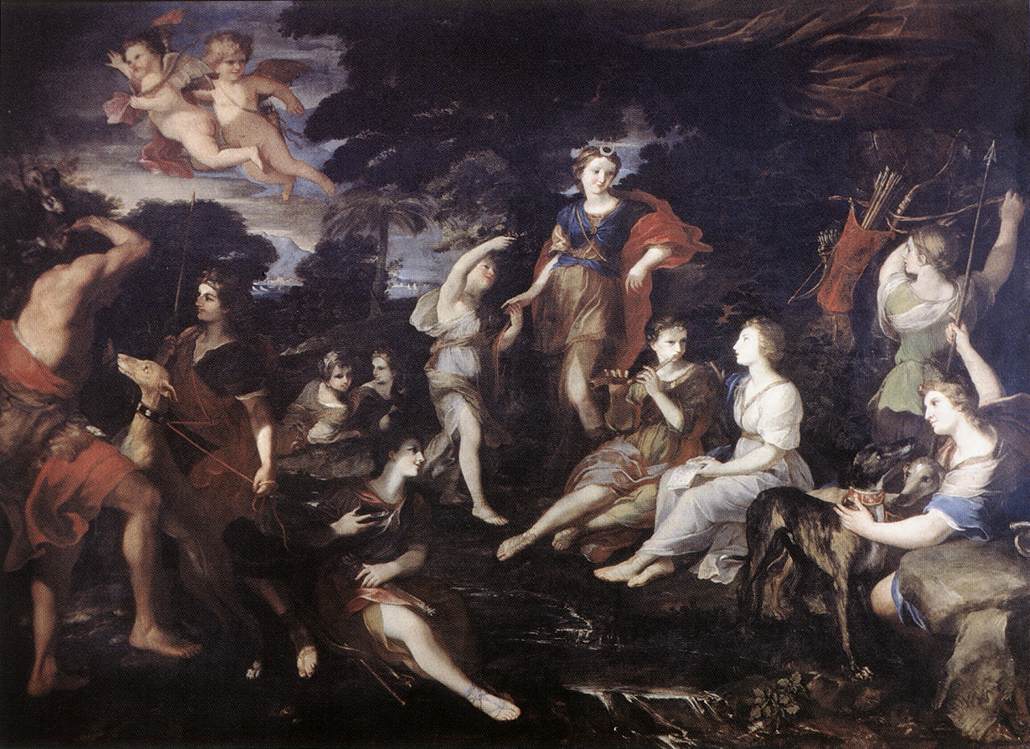
The hunter Actaeon stumbles on Diana bathing in the forest. For seeing what no mortal should see, she transforms him into a stag, and his own hounds tear him apart. The myth captures her uncompromising side: the wilderness she rules is beautiful and deadly, and her privacy is absolute.
Trivia of the crossroads
Roman poets call Diana Trivia, linking her to crossroads and to a triple form that binds together moon, hunt, and the shadowed underworld. She is a goddess of in-between places — where roads meet, where night edges into day, where the tame world gives way to the wild.
The mirror of Nemi
At Lake Nemi, called Diana's mirror, the goddess of the moon looked down on her own reflected light. The wooded sanctuary and its priest-king, the Rex Nemorensis, made Nemi one of antiquity's most evocative holy places — a real cult that later fed vast (and now doubted) theories about sacred kingship.
Legacy & influence
Diana remains one of antiquity's most recognizable goddesses. She is everywhere in art and literature, a central figure in modern Pagan traditions, and a constant presence in popular culture. Her name became enduringly personal and even royal — a rare case of an ancient deity surviving as a living given name. Whenever a huntress with a bow and a crescent moon appears in a painting or a story, she is reaching for Diana.
Symbolism
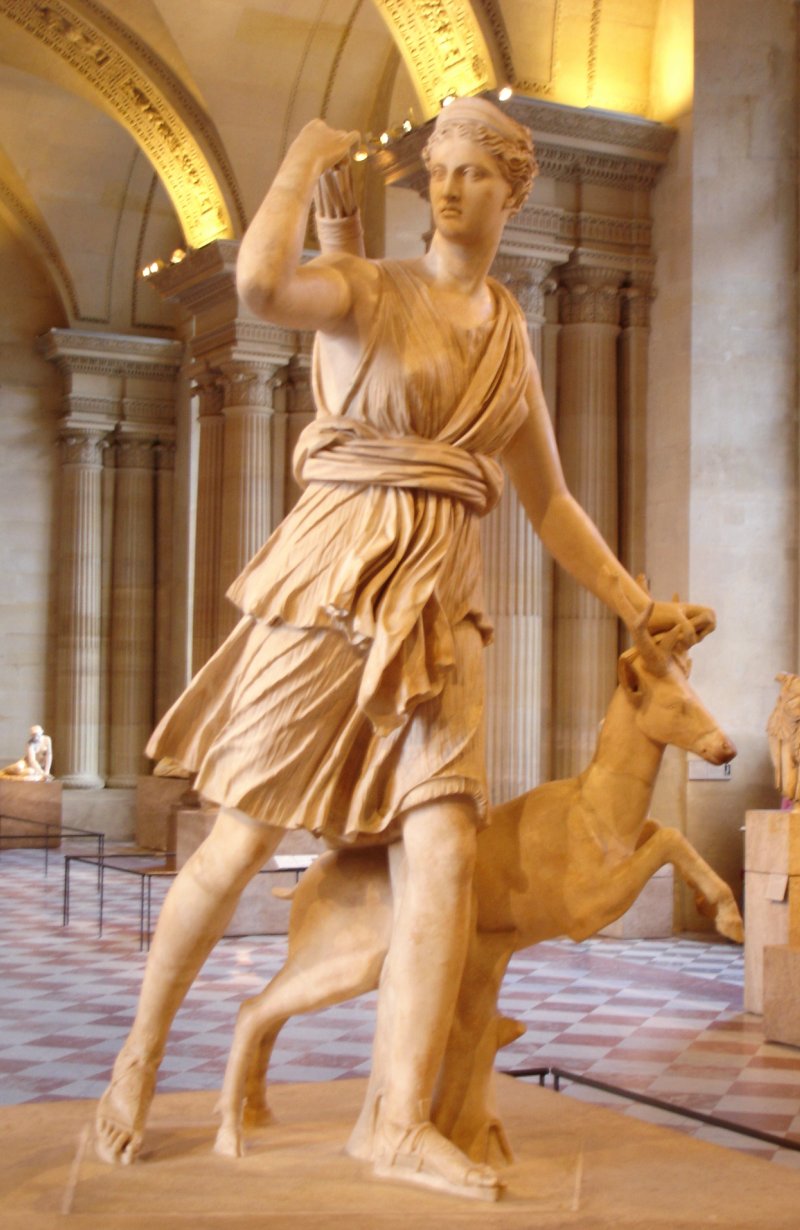
Her symbols encode her nature: the bow and arrows mark her as huntress and mistress of the wild; the crescent moon ties her to the night sky and to cycles of time; the stag is the creature of the forest she rules and, in the Actaeon myth, the shape of her vengeance; the torch is the light she carries through the dark, fitting for a goddess of crossroads and thresholds.
Famous public-domain depictions — click any image to view it full size.
Is Diana the same as Artemis?
Diana was strongly identified with Greek Artemis and shares her role as virgin huntress and moon goddess, but she began as an old Italic deity of wild places, women, and childbirth. Much of her narrative myth is inherited from Artemis, while her most distinctive Roman cult — the sanctuary at Nemi — is native Italian.
What was Diana the goddess of?
The hunt, wild and forested places, women and childbirth, and the moon. She was a goddess of thresholds and boundaries — between wilderness and city, virginity and childbirth, moon and hunt.
Where was Diana worshipped?
Her most famous cult center was the sanctuary at Aricia on Lake Nemi, one of the best-known holy places in Italy, served by a priest called the Rex Nemorensis. She was also invoked by women and in matters of childbirth.
Why is Diana called Trivia?
Roman poets regularly call her Trivia, “of the three ways,” emphasizing her association with crossroads and triple-form imagery linking moon, hunt, and underworld. The individual quotations vary by context and were never fixed as a single creed.
 Michael Paycer