Field & Harvest · Orchard · Flock · The Sacred Countryside
Roman Gods of Field and Harvest
Rome divinized the whole agricultural year — the soil, the granary, the orchard, the flock, even the blight that ruined the wheat. These are the specialist gods of the countryside, from Tellus Mater to Fons.
Where Greek myth reached for grand Olympian dramas, archaic Roman religion did something quieter and more practical: it assigned a god to nearly every step of agricultural life. The soil had its mother, Tellus; the stored grain had Consus; the fruit trees had Pomona; the flocks had Pales; the springs had Fons; and even wheat rust, a disease that could wipe out a harvest, was addressed as the god Robigus. This is religion built around function rather than biography — a divine map of the farm and the calendar that ordered it.
A word on the evidence, honestly stated. A few of these gods — Tellus Mater, Priapus, Liber, Pomona, Vertumnus — are reasonably well attested, largely through Ovid's poetry. Others — Ops, Consus, Pales, Robigus, Libera, Fons — are thinly documented, surviving mostly in festival calendars, antiquarian tradition, and passing literary references rather than rich independent cult records. Several ancient etymologies attached to them are uncertain and should be read as hypotheses, not settled fact. Where later, sometimes hostile, sources are the main witness, that testimony is worth using but worth flagging as what it is.
Earth, Store & Orchard
Gods of the cultivated earth
Tellus Mater
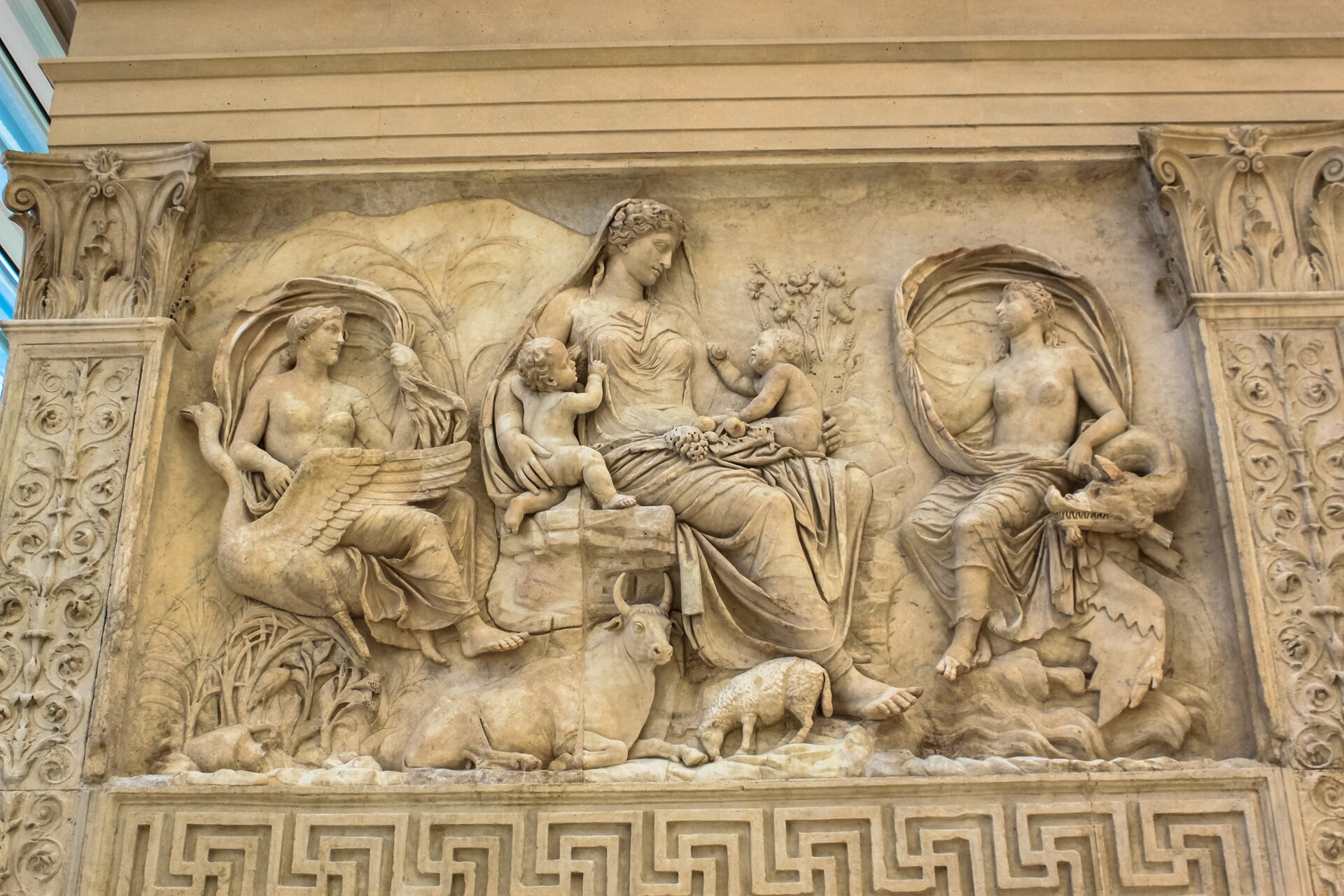
The Roman Earth goddess, “Mother Earth,” associated with the soil, fertility, agriculture, motherhood, and the land itself. She received public cult and figured in rites concerned with the productivity of the fields, and also with burial, the return of bodies to the earth. Her nature sits right on a philosophical fault line that Roman natural theology loved: is she a person, or the physical earth divinized, or the rational power working within nature? In literature she overlaps with Terra Mater and with Greek Gaia, and the names may be interchangeable in some contexts — though they should not be assumed to carry one unchanged theology across every period. Her root survives in the words terrestrial and terra and in the enduring image of Mother Earth. Evidence grade: A/B.
Ops
Goddess of abundance, resources, agricultural plenty, and wealth, closely associated with Saturn and celebrated in festivals including the Opalia. Her name is connected with opes — resources or riches — and she stands for material sufficiency in a heavily agricultural society: the harvest not as it grows but as it is gathered and held. Her mythic biography is thin, and her later equation with the Greek Rhea tends to overshadow her distinctly Roman cultic identity. She matters most as a window onto Roman agricultural religion and its vocabulary of stored plenty. Evidence grade: B.
Consus
An archaic Roman deity of stored grain and subterranean storage. His altar in the Circus Maximus was normally kept underground and uncovered only for his festivals, the Consualia — a fitting image for a god of grain kept safe below the surface. Ancient writers also tied his festival to the legendary seizure of the Sabine women, giving him a place in Rome's foundation legends. The old etymology connecting Consus with consilium, “counsel,” is uncertain, and outside a narrow ritual context his identity is genuinely obscure. He is chiefly valuable for reconstructing archaic Roman religion and the agricultural calendar. Evidence grade: B/C.
Pomona
Goddess of fruit trees, orchards, and cultivated abundance. Unlike a generalized fertility goddess, her sphere is specifically arboriculture and fruit, which makes her a textbook case of Roman religious specialization: a precise divine function rooted in everyday agricultural work. Her fame rests largely on Ovid's Metamorphoses 14, which tells the story of Pomona and Vertumnus; there is no secure independent speech proving a fixed theology beyond that literary narrative, and her cult history is far less richly documented than that of Ceres or Flora. Her legacy runs through art and horticulture, and the term pomology descends from Latin pomum (“fruit”) rather than directly from the goddess. Evidence grade: B/C.
Vertumnus
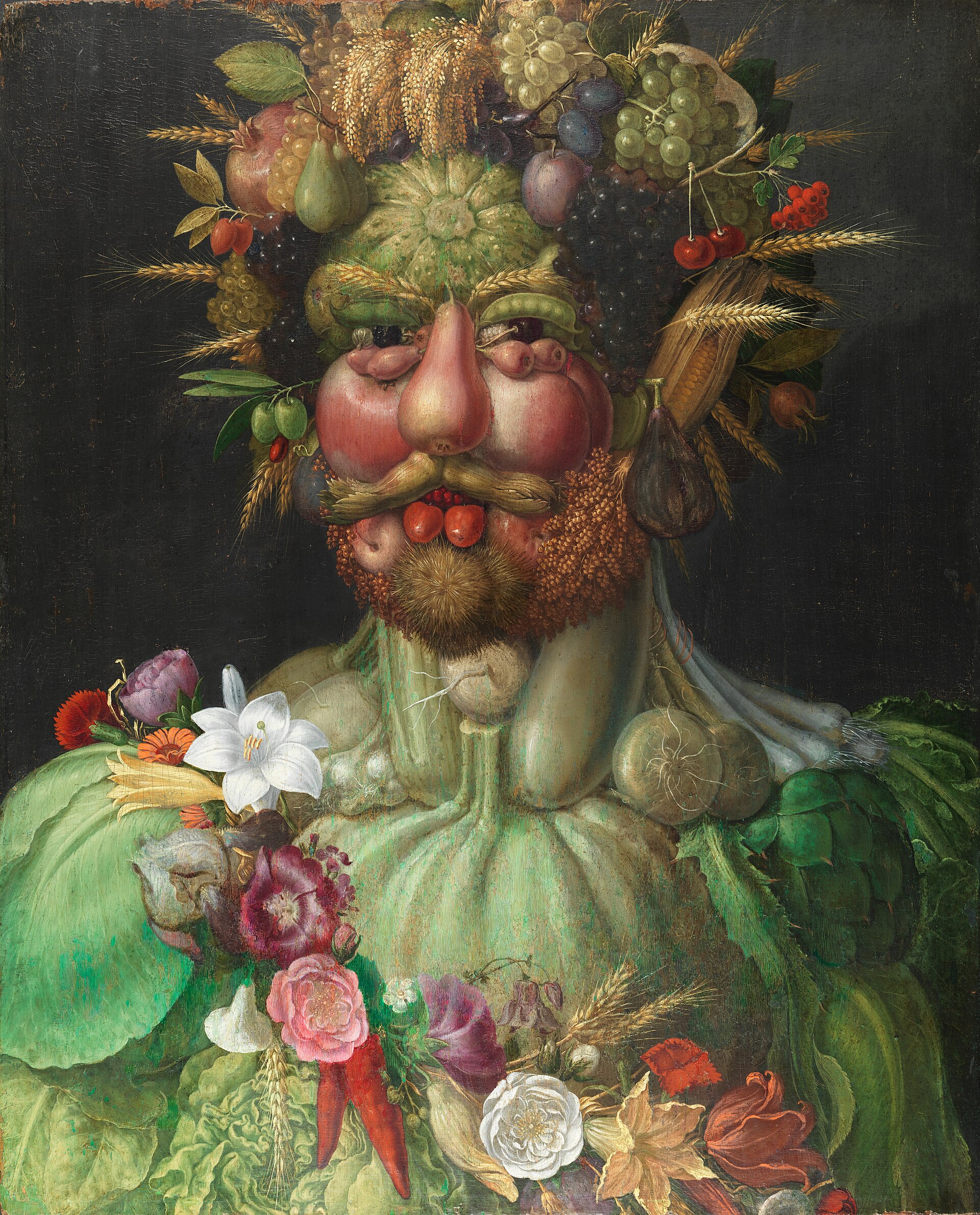
God of change, seasonal transformation, gardens, and fruit — the deity of the turning year. Ancient writers linked his name to vertere, “to turn” or “to change,” though ancient etymology is not always reliable. In Ovid's Metamorphoses 14 shape-shifting is his defining power: he assumes many forms to approach Pomona before finally revealing himself and winning her. His cult is far less documented than his literary fame, and the courtship narrative reflects ancient assumptions about persuasion and female consent that a modern reader will rightly scrutinize. His greatest artistic afterlife is Arcimboldo's celebrated portrait of Emperor Rudolf II composed as Vertumnus, a face built entirely of fruit and flowers. Evidence grade: B.
Fons
Fons, or Fontus, was the god of springs, wells, and flowing water, honored at the festival of the Fontinalia. He personifies the sacred value of fresh water in both urban and agricultural life — a reminder that Rome's religion sanctified the infrastructure it depended on. Very little narrative mythology survives; his importance is practical and ritual rather than biographical, and no secure direct divine speech is preserved, so calendars and antiquarian testimony carry the case. The English word fountain descends from Latin fons/fontis. Evidence grade: B/C.
Flock, Blight & Garden
Gods of flock, blight, and the sacred garden
Pales
A pastoral deity of shepherds and flocks — and, tellingly, one whose very gender and number the ancient sources leave open, since Pales appears as male, female, or plural in different traditions. The festival of the Parilia on April 21 involved purification rites for shepherds and livestock and later became linked with the birthday of Rome itself. Ovid's Fasti 4 gives an extended account of the Parilia and its rites of cleansing. The uncertainty about who or what Pales was is itself instructive: Roman cult could preserve real ambiguity of gender and number without any theological crisis, and that ambiguity should not be “solved” by modern confidence. Evidence grade: B.
Robigus
Robigus — or Robigo in some sources — was the divine power of grain rust, a devastating crop disease, addressed at the festival of the Robigalia in the hope of protection from blight. He is the clearest Roman example of apotropaic religion: the Romans could sacrifice not only to beneficial powers but to a destructive force itself, treating it as a divine agent in order to turn it aside. Ovid's Fasti 4 preserves the priestly prayer that asks the rust to spare the tender crops and to fall instead upon iron and weapons of war. The evidence concerns ritual response to agricultural risk, not any demonstrated biological effect, and the god's gender and name vary in the sources. Robigus remains a striking case study in the history of plant disease, ritual, and environmental uncertainty. Evidence grade: B.
Priapus
A fertility god of gardens, livestock, and fruitfulness, marked by conspicuously exaggerated male sexuality. Originally associated especially with the Greek world of the Hellespont, he entered Roman religion and literature as a garden guardian, fertility emblem, comic figure, and blunt threat against thieves — his statues could carry aggressively sexual warnings meant to frighten off intruders. His most famous myths involve failed sexual aggression: Ovid's Fasti 6 tells the comic story of Priapus attempting to assault the sleeping Vesta, only to be exposed when Silenus's donkey brays and wakes her. That coercive, obscene content is part of the record; it is reported here factually, neither euphemized nor sensationalized. The medical term priapism descends from his name. Evidence grade: A/B.
Liber
An Italic god of fertility, wine, male maturation, and freedom, who with Ceres and Libera formed the plebeian Aventine Triad. Over time he was increasingly identified with Bacchus and Dionysus, and his very name invited association with libertas, liberty and liberation — though that ancient etymological link should be handled carefully rather than pressed as proof. Ovid discusses him extensively in the Fasti, including his festivals and his fusion with Bacchic tradition. That fusion is also his interpretive problem: his distinct archaic Roman identity is often obscured by Dionysus, and not every statement about Dionysus can be transferred to Liber. He is central to understanding Roman religious syncretism and plebeian cult. Evidence grade: A/B.
Libera
Paired with Liber and Ceres in the Aventine Triad, Libera was a goddess of female fertility whose identity became associated with Proserpina and Persephone in later Greco-Roman interpretation. She belongs to the recurring Roman pattern in which old Italic divine names were reinterpreted through Greek mythology. Her independent mythology is sparse, and the equation with Proserpina can erase whatever earlier, distinctly Roman distinctions once set her apart. Her chief interest today is scholarly — as a case study in Roman adaptation and the evolution of divine identities. Evidence grade: B/C.
In Art
Roman farming gods in art
Famous depictions of the agrarian gods — click any image to view it full size.
Vertumnus (Emperor Rudolf II as Vertumnus)Giuseppe Arcimboldo, 1591.Skokloster Castle, Sweden · Public domainPanel of Tellus, Ara Pacis AugustaeTellus, the nourishing earth, cradles twin infants amid fruit, grain and livestock on Augustus’ Altar of Peace. Roman relief, 13–9 BC.Museo dell’Ara Pacis, Rome · Photo: Andy Hay, CC BY 2.0
Roman religion angle
These gods show Roman religion at its most characteristic: precise, functional, and unsentimental. A single agricultural process — storing grain, guarding an orchard, warding off blight — could have its own dedicated divine power, and worship was about doing the right ritual at the right point in the calendar rather than telling a great story. Even a crop disease could be treated as a god to be turned aside. Function, not biography, is the key to the Roman countryside.
Questions
Common questions about the Roman farming gods
Who were the Roman gods of farming and the harvest?
Rome had a whole cluster of specialist agrarian gods, each tied to a precise task: Tellus Mater for the soil, Ops for stored abundance, Consus for grain in the granary, Pomona for orchards, Vertumnus for the turning seasons, Pales for flocks, Robigus for warding off wheat rust, Priapus for guarding gardens, Liber and Libera for wine and fertility in the Aventine Triad, and Fons for springs and wells.
Did the Romans really worship a god of wheat rust?
Yes. Robigus (or Robigo) was the divine power of grain rust, a devastating crop disease, and the festival of the Robigalia sought protection from blight. This is apotropaic religion: Romans could address a destructive force as a divine agent in order to avert it. Ovid's Fasti preserves the priestly prayer asking the rust to spare the tender crops and to attack iron and weapons instead.
What was Priapus and why are his myths so obscene?
Priapus was a fertility god of gardens, livestock, and fruitfulness, marked by conspicuously exaggerated male sexuality and used as a guardian against thieves, whose garden statues carried aggressively sexual warnings. His best-known myths involve failed sexual aggression, including Ovid's comic tale of his attempt to assault the sleeping Vesta, foiled when a donkey brays. The coercive content is part of the record and should be reported factually rather than euphemized or sensationalized.
How well documented are these farming gods?
It varies. Tellus Mater, Priapus, Liber, Pomona, and Vertumnus are reasonably attested (roughly grades A/B to B), largely through Ovid's poetry. Ops, Pales, Robigus, Consus, Libera, and Fons are thinner (grades B to C), known mainly from festival calendars, antiquarian tradition, and scattered references rather than rich independent cult records. Several ancient etymologies for these gods are uncertain and should be treated as hypotheses.
Sources
Ovid, Fasti (Parilia and Pales in Book 4; the Robigalia prayer in Book 4; Priapus and Vesta in Book 6; Liber's festivals).
Ovid, Metamorphoses 14 (Pomona and Vertumnus).
Plutarch, Roman antiquarian works (the Consualia and the Sabine episode).
Roman festival calendars, inscriptions, and antiquarian tradition (Varro and later writers) for Ops, Consus, Fons, and the Aventine Triad.
Evidence grades: A/B for Tellus Mater, Priapus, and Liber; B for Vertumnus, Ops, Pales, and Robigus; B/C for Pomona, Consus, Libera, and Fons. Thin and thickly mediated evidence is flagged rather than smoothed over.
 Michael Paycer