Flowers · Spring · Blossom · Fertility
Flora, Roman Goddess of Flowers
Goddess of the flowering moment — spring, blossom, and renewal — honored at the Floralia, one of the liveliest festivals in the Roman year.
 Michael Paycer
Goddess of the flowering moment — spring, blossom, and renewal — honored at the Floralia, one of the liveliest festivals in the Roman year.
Michael PaycerRole
Flowers, blossom, spring, fertility
Symbols
Flowers, garlands, blossoming boughs
Cult
The Floralia; games & theatrical license
Greek equivalent
Flora was the Roman goddess of flowers, blossoming plants, spring, and fertility. Her domain was not agriculture in general but something more precise and more fleeting: the generative moment of flowering — the instant when a plant blossoms and the year turns green. Her cult drew together beauty, fertility, seasonal abundance, and public festivity into a single bright figure.
That focus on the flowering moment sets her apart from the great grain goddess Ceres. Where Ceres governs the harvest and the food supply, Flora presides over the blossom that comes before it — the promise of abundance rather than its gathering.
Flora belonged to the old strand of Roman religion concerned with growth and the fertility of the land. But much of her best-known narrative biography comes later, from the poet Ovid, whose account is a literary Greek-Roman synthesis rather than a transcript of ancient cult. In his Fasti, Ovid identifies her with the Greek nymph Chloris and lets her tell her own story — a graceful fusion of Greek myth and Roman festival that shaped how she has been imagined ever since.
This is a recurring pattern in Roman mythology: a genuinely Roman cult figure acquires a fuller, more Greek-flavored personality through the work of the poets. With Flora, the two layers — the old goddess of blossom and the Ovidian nymph — sit comfortably together.
Flora's worship centered on the Floralia, her festival, celebrated with games and theatrical license. It became one of Rome's liveliest and most exuberant celebrations — a season of flowers, performances, and public festivity that matched the goddess's own generative brightness. The Floralia's openness and frankness were part of its character; later moralists sensationalized its sexual license, but for Romans it was above all a joyful marking of spring and abundance. Through it, the abstract idea of flowering became a shared civic celebration.
Flora's Greek counterpart is Chloris, a nymph of flowers and spring. The identification comes above all from Ovid, who has the goddess herself acknowledge the connection. But as with so many Roman deities, the equation is a poetic bridge rather than a strict equivalence: the Roman Floralia, with its games and civic exuberance, has no exact Greek twin. Chloris gives Flora a mythological backstory; the festival gives her a distinctly Roman public life.
In Ovid's Fasti, the goddess tells how she was once the nymph Chloris, transformed into the Roman Flora — mistress of flowers, whose breath scatters blossoms across the fields. It is the defining story of her identity, and a model of how Roman poets wove Greek myth into Roman religion.
Flora presides over her own festival, the Floralia, with its games and theatrical license. In the Roman imagination she is the patron of the season's exuberance — flowers, performance, and the sheer abundance of spring made into a public holiday.
Flora's myths keep returning to a single idea: the flowering instant. She is not the goddess of the whole growing cycle but of its brightest, briefest phase — the blossom that precedes the fruit, beauty and fertility caught at their peak.
Flora's name became a common noun. “Flora” now means the plant life of a region — its whole living cover of flowers and growing things — a usage that carries the goddess into every botany textbook. She survives too in art, in festivals, and in personal names, wherever spring and blossom are personified. Like Jupiter lending his name to a planet, Flora shows how a Roman deity can outlive her cult by becoming a word we still use every day.
Her symbols are the emblems of spring: flowers and garlands for blossom and beauty, blossoming boughs for renewal and fertility, and the fresh green of the season itself. Together they say what Roman religion meant by her — the generative, joyful moment when the year comes into bloom, beauty and abundance held for an instant before the harvest.
Famous public-domain depictions — click any image to view it full size.
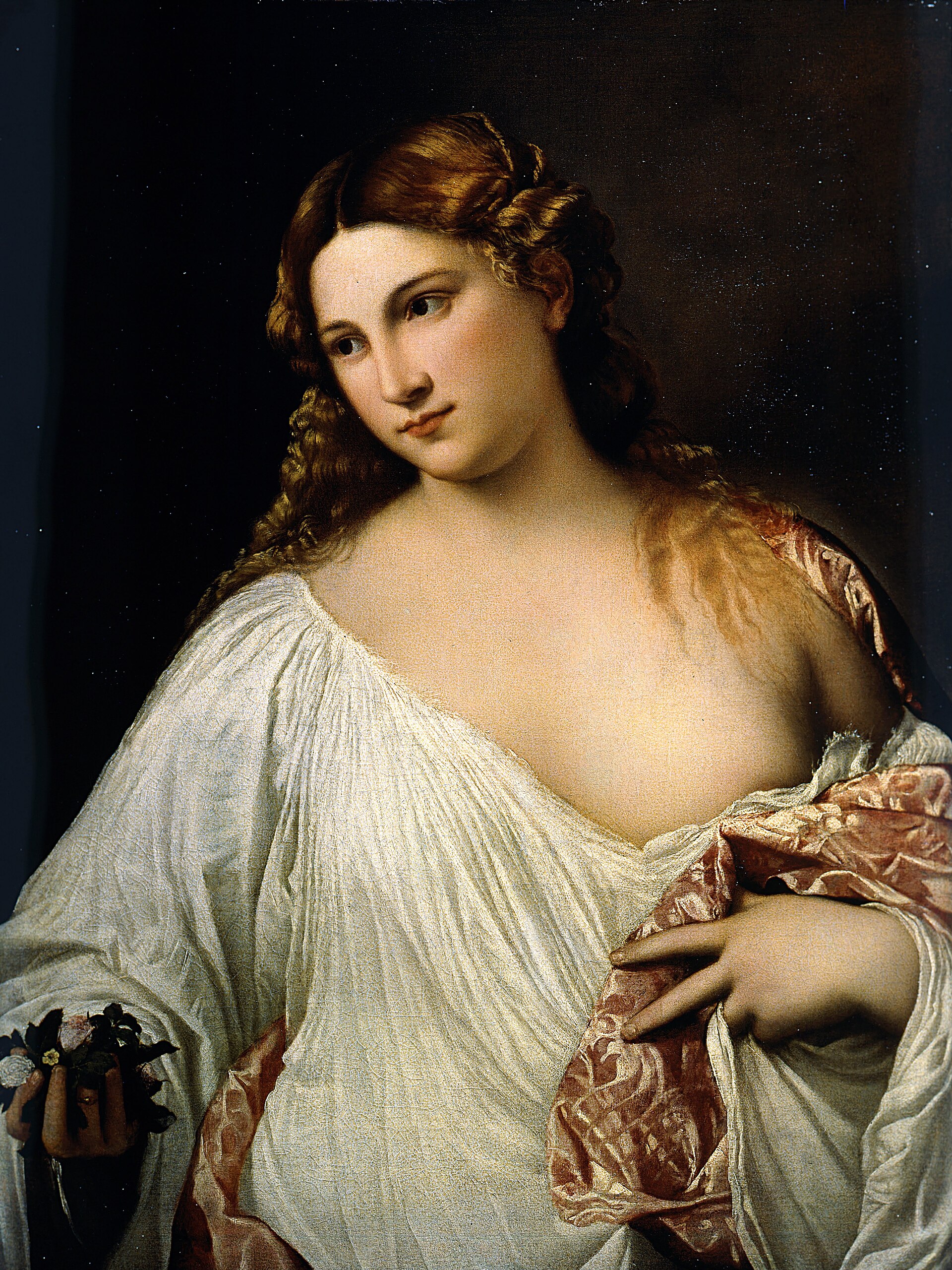
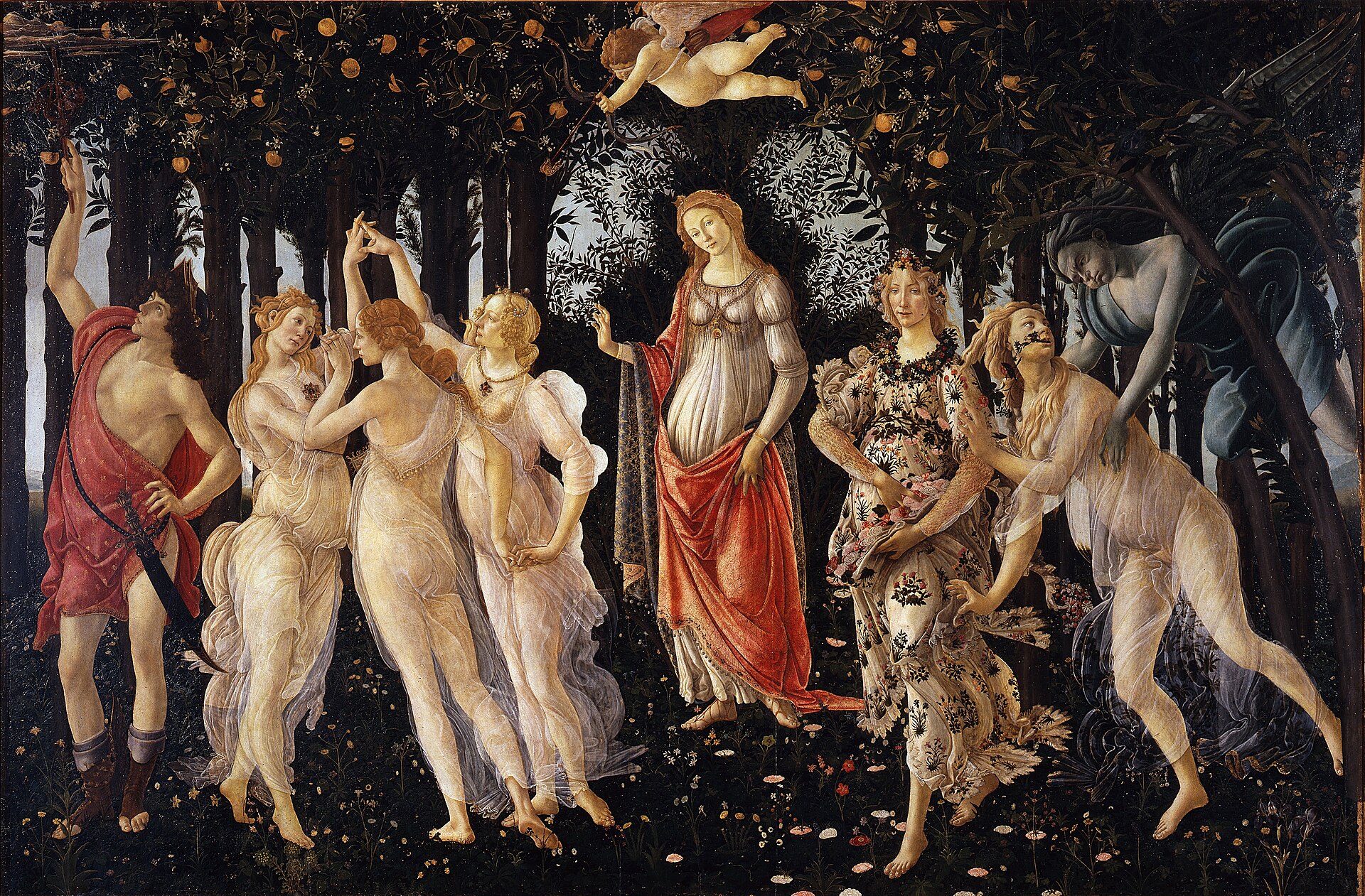
“I who now am called Flora was formerly Chloris.”
Ovid, Fasti 5.195 (Flora tells her own origin)
Flora shows how Roman religion braided together cult and poetry. An old goddess of blossom acquires, through Ovid, a Greek backstory as Chloris — while her festival, the Floralia, remained thoroughly Roman. The same figure is at once ancient cult, literary myth, and civic celebration.
Roman goddess of flowers and spring — patron of the Floralia, a lively public festival with games and theatrical license.
Greek nymph of flowers and spring — the mythological identity Ovid gives Flora, but without the Roman festival life.
Flowers, blossoming plants, spring, and fertility. She represented the generative moment of flowering rather than agriculture as a whole — the instant of blossom, renewal, and abundance.
Flora's festival, celebrated with games and theatrical license. It became one of Rome's liveliest festivals, known for its openness and festivity — and later sensationalized by moralists for its frankness.
Ovid identifies Flora with the Greek nymph Chloris, giving her the line “I who now am called Flora was formerly Chloris.” Much of her best-known narrative in Ovid is a literary Greek-Roman synthesis rather than old Roman cult.
The goddess's name became the word for the plant life of a region. “Flora” survives in botany, art, festivals, and personal names, keeping her association with flowers and growing things alive.
When I am not reading Virgil or Cicero, I tune databases, design high-availability systems, and run cloud migrations.