Morphy's Principles
Morphy never wrote a textbook, yet he taught the world to play. His games revealed the principles of open-game chess so clearly that they became the foundation every beginner still learns: develop fast, fight for the centre, open lines, and attack with the whole army. This is the method behind the magic.
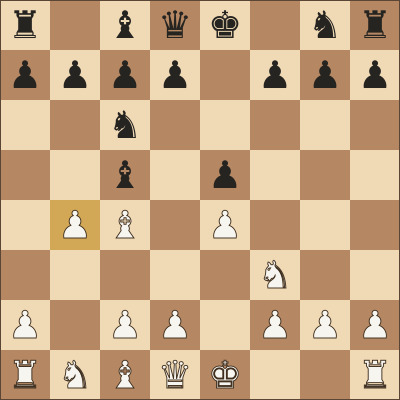
The Evans Gambit (1.e4 e5 2.Nf3 Nc6 3.Bc4 Bc5 4.b4) — exactly the kind of opening Morphy thrived in. White gives a pawn to rip the position open and develop with threats. It is the principles of development turned into an opening: speed and the initiative over material.
How Morphy actually won
Strip away the romance and Morphy's method is strikingly simple and entirely modern. He followed, by instinct, the principles still printed in every beginner's book: develop a new piece on almost every move; do not move the same piece twice in the opening without a good reason; do not bring the queen out early, where it becomes a target; castle to tuck the king away; and then open lines toward the enemy king so the developed pieces can strike.
The thread running through all of it is time. Morphy got his pieces into play faster than anyone, and a big enough lead in development is itself a winning advantage — the opponent is effectively a rook or two down because half his army is still at home. The Opera Game in Part 1 is the perfect demonstration: White finishes with every piece active and Black with almost none.
Why open games teach the most
Morphy was an open-game player: 1.e4 e5, into the Italian Game, the Evans Gambit, the Ruy Lopez, and the King's Gambit. These openings open lines early and reward exactly what he did best — fast development and active pieces. They are still the openings teachers recommend for learning, because in them the principles are visible: a wasted move or a stranded piece is punished immediately.
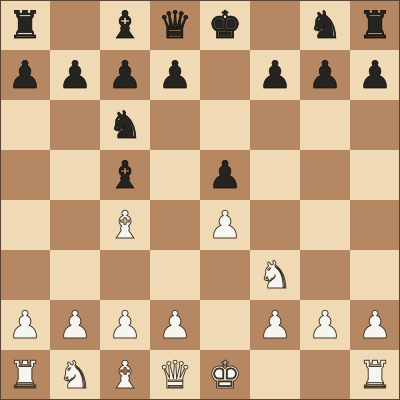
The Italian Game (1.e4 e5 2.Nf3 Nc6 3.Bc4) — the natural open game, aiming the bishop at f7 and developing toward the centre. It is the ideal training ground for Morphy's principles, which is why it remains the most recommended first opening.
The father of modern development
Morphy's games were a generation ahead of their time. Where his contemporaries attacked first and developed later, he understood that the attack must be built on a foundation of developed pieces and open lines. Wilhelm Steinitz, the first official world champion, would later formalize chess into a science — but Steinitz built on Morphy's example, and modern opening theory traces its roots directly to the New Orleans genius who showed what active piece play could do. Every "develop your pieces" lesson is, in the end, a Morphy lesson.
Morphy's Principles — FAQ
What are Morphy's principles of chess?
Develop your pieces quickly toward the centre; don't move the same piece twice in the opening without reason; don't bring the queen out too early; castle to safety; and open lines toward the enemy king so your developed pieces can attack. His games demonstrate them so clearly they became the foundation of opening play.
Why is development so important in the opening?
A piece on its starting square does nothing. The side that develops faster has more force at the crucial moment. Morphy's wins came from a development lead so large his opponents were effectively playing with half an army — exactly as the Opera Game shows.
What openings did Morphy play?
Open games: 1.e4 e5 into the Italian Game, the Evans Gambit, the Ruy Lopez, and the King's Gambit. They open lines quickly and reward fast development — the perfect vehicles for his style, and still the best openings for learning his principles.
The Evans Gambit — a pawn for speed and the initiative, Morphy's principles as an opening.
The Italian Game — the open-game training ground where development is rewarded at once.
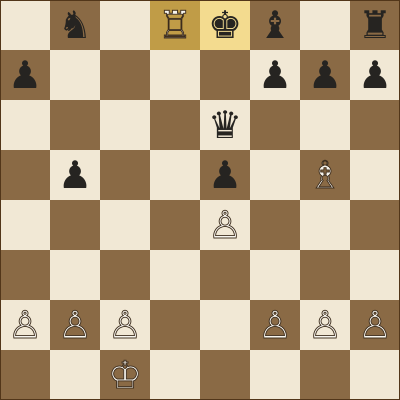
The Opera Game (Part 1) — the principles in their purest form, ending in 17.Rd8#.
- Lawson, D. Paul Morphy: The Pride and Sorrow of Chess.
- Reinfeld & Fine, The Unknown Morphy and game collections.
- Open-game opening theory (Italian Game, Evans Gambit, Ruy Lopez).
- Kasparov, G. My Great Predecessors, Vol. I (Morphy).
Paul Morphy — Part 2 of 2
That completes the Morphy guide — the meteoric career and the Opera Game, and the principles of development that make him the father of modern opening play. Learn them in the open-game guides.