Who is Neptune?
Neptune was an old Roman god whose identity became increasingly fused with the Greek Poseidon. He governed waters and, in literary mythology, the sea, earthquakes, and horses. Where he began as a deity of water and springs in Italy, he ended as the majestic sea-god familiar from Greek myth — trident in hand, master of the deep.
That double nature is the key to him. In cult he answered a practical Italian concern with water; in epic he became a figure of vast power over the sea, brother in myth to Jupiter and lord of a realm all his own.
Origins & history
Neptune was an old Roman water god before he was a sea-god. His festival, the Neptunalia, was held in July, a season when water supply mattered intensely in the Italian summer — a sign of his original sphere. Only gradually did he take on the full sea mythology of Poseidon. Much of that familiar material — the sea, earthquakes, horses — is Greek inheritance rather than securely archaic Roman tradition, and the fusion of the two is itself part of his history.
Cult & worship
In cult Neptune was a water deity. His chief observance, the Neptunalia in July, fell when Italians most felt the pressure of drought and water supply, and it points to a god concerned with rivers, springs, and drinkable water before he was ever the epic ruler of the sea. As Rome's engagement with the Mediterranean deepened, he also became protector of seafaring. Yet his cult, though significant, was never politically dominant in the way that Jupiter's state religion or the war-god Mars's was.
Greek equivalent
Neptune was identified with Greek Poseidon, and much of what we picture when we think of him — the sea, the earthquakes, the horses, the trident — is inherited from the Greek god through Latin poetry. What is genuinely Roman is older and smaller: a god of fresh water and its scarcity, honored at the Neptunalia. Reading Neptune beside Poseidon shows how Rome could take over a Greek persona wholesale while keeping an Italian cult underneath it.
Famous myths & stories
Calming the storm
In the opening storm of Virgil's Aeneid, the winds have been loosed against Aeneas's fleet, and Neptune rises to rebuke them and restore calm. His famous half-finished threat — breaking off to still the waves before he even names the punishment — is one of the most memorable moments of divine command in Latin epic. The scene makes him the god who imposes order over chaos.
Sea, earthquake, and horses
From the Greek tradition Neptune inherits a threefold domain: the sea itself, the earthquake that shakes the land, and the horse. It is a strikingly wide reach for one god — the boundary between water and earth, the violence beneath both, and the tamed animal that carries it into human life.
Order over chaos
By calming the storm that threatens Aeneas, Neptune does more than save a fleet: he stands for the restoration of order over chaos at the very start of Rome's founding voyage. Even a god not central to the state cult can carry that weight in the poetry of Rome's origins.
Legacy & influence
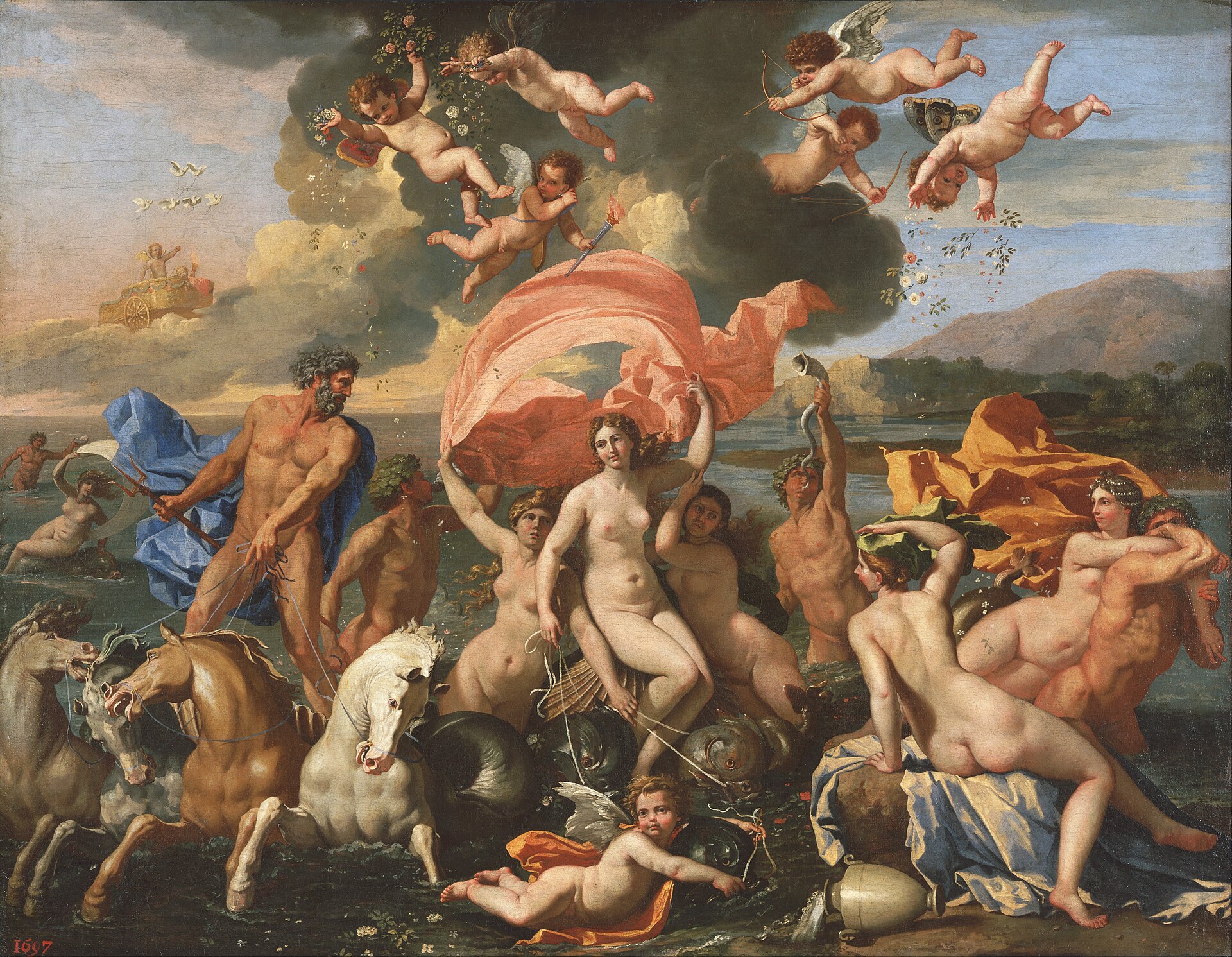
Neptune's afterlife is everywhere water is imagined. The planet Neptune carries his name; fountains across Europe cast him rising from the waves; naval imagery reaches for him whenever it wants the sea made majestic. Above all the trident has become a universal emblem of sea power, from ancient coinage to modern navies — a long iconographic legacy from a god who began by watching over Italy's summer water.
Symbolism
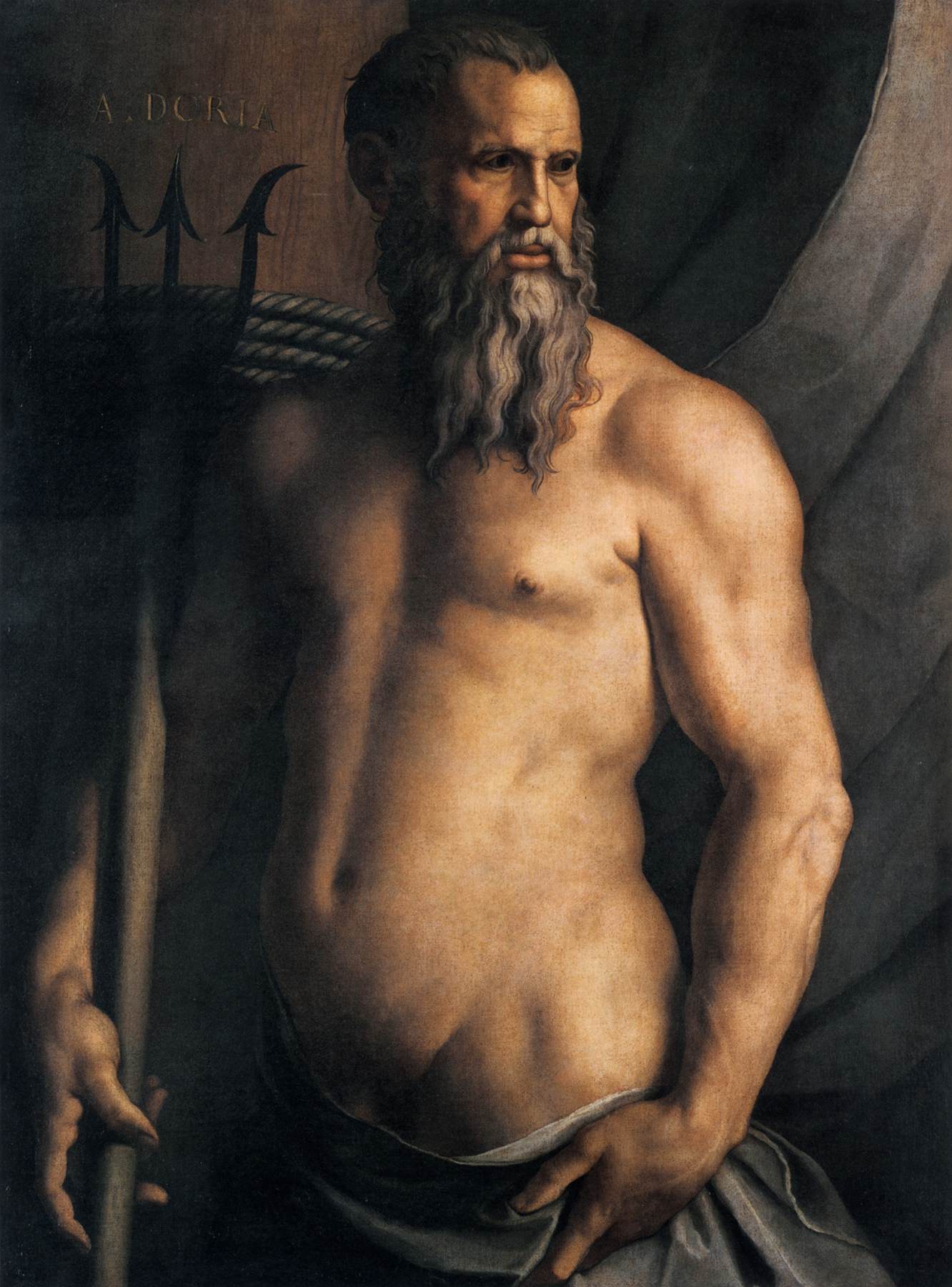
His symbols carry his double nature. The trident is command over the deep — the three-pronged spear that stirs or stills the sea. The horse joins his marine power to speed and untamed force on land. And the sea itself is his sign: vast, moody, and dangerous, but capable of being calmed by the god who rules it. Together they say what the Romans meant by him — power over the element that both sustained the city and threatened its ships.
Famous public-domain depictions — click any image to view it full size.
Is Neptune the same as Poseidon?
Neptune was an old Roman water god whose identity became increasingly fused with Greek Poseidon. Much of the familiar sea mythology — the sea, earthquakes, and horses — is Greek inheritance rather than securely archaic Roman tradition, so the two overlap heavily even though Neptune began as a distinct Italian deity.
What was Neptune the god of?
Neptune governed waters and, in literary mythology, the sea, earthquakes, and horses. He began as an old Roman god of water and springs and, through fusion with Poseidon, became the majestic sea-god familiar from Greek myth.
What is the Neptunalia?
The Neptunalia was Neptune's festival, held in July — a season when water supply mattered intensely in Italy. It reflects his older role as a water deity rather than only the epic sea-god of poetry.
How was Neptune worshipped in Rome?
In cult Neptune was a water deity, honored at the Neptunalia in July and associated with the protection of seafaring. His cult was significant but never politically dominant in the way that Jupiter's or Mars's was.
 Michael Paycer