Who is Mercury?
Mercury was the Roman god of commerce, exchange, travel, and communication — and, in the same breath, of profit, trickery, and thieves. His very name is related to the Latin merx, “merchandise,” which points straight at his heart: he is the god of the marketplace, of goods changing hands and messages crossing distance. His Roman cult became deeply fused with that of Greek Hermes.
He is above all a liminal god — a mover between worlds. He carries messages between gods and mortals, escorts souls to the underworld, and crosses moral boundaries as easily as physical ones. That is why the same god patronizes both honest merchants and thieves: he governs exchange itself, with all its intelligence and all its ambiguity.
Origins & history
Mercury's core Roman identity is commercial: the god merchants and traders looked to for profit and safe exchange, his name rooted in the word for merchandise. As Greek myth entered Rome he was fused with Hermes, and much of his richer mythic biography — the messenger, the inventor, the trickster of the cradle — came with that fusion rather than growing independently in Italy.
Philosophically and allegorically, Mercury drifted toward something larger. As the god who carries and interprets messages, he became associated with reason, speech, interpretation, and mediation — the very roots of the word “hermeneutics.” A Roman could pray to Mercury for a good bargain while a philosopher treated him as a figure for the mind that interprets and connects.
Cult & worship
Mercury was, first and foremost, the patron of merchants and traders — the divine guarantor of the commerce that fed and enriched the city. That commercial role is written into his name, related to merx, “merchandise.” Travelers also looked to him, fitting for a god forever in motion between places. His worship reflects a very Roman practicality: this is the god of the working marketplace, of profit sought and journeys made, honored by the people whose livelihoods depended on both.
Greek equivalent
Mercury was identified with Greek Hermes, and much of his narrative mythology — the messenger with winged sandals, the psychopomp, the clever inventor and thief — is inherited from the Greek tradition. But the identification is not the whole story. Hermes is the all-purpose divine go-between; Mercury is that and the specifically Roman god of merx, commerce, and profit. Reading the two together shows how a native economic deity took on a whole Greek mythology.
Famous myths & stories
The messenger to Aeneas
In Virgil's Aeneid, Jupiter sends Mercury down to Aeneas at Carthage to remind him of his destiny and order him to leave Dido and sail for Italy. Mercury transmits the divine command with brutal efficiency — the messenger whose single errand turns the whole course of the story back toward Rome.
Patron of merchants and thieves
Mercury blesses honest trade and cunning theft alike. That double patronage is not a contradiction but a truth about exchange: the same quick intelligence that closes a good deal can also pick a pocket. He is the god of the marketplace in all its brilliance and all its risk.
The guide of souls
As psychopomp, Mercury escorts the dead across the last boundary to the underworld. The god who carries messages between gods and mortals also carries souls between the living world and the next — the ultimate crossing for the ultimate go-between.
Legacy & influence
Mercury runs through the modern world. The planet nearest the sun and the liquid metal both carry his name; “mercurial” still means quick and changeable; commerce, postal symbolism, and the winged caduceus all trace back to him. Alchemy made mercury a central principle, and hermeneutics — the art of interpretation — carries his Greek name. Whenever a swift messenger or a symbol of trade appears, it is reaching for Mercury.
Symbolism
His symbols encode his nature: the caduceus, the herald's staff twined with serpents, marks him as messenger and mediator; the winged sandals and winged cap are speed and freedom of movement between worlds; the purse is commerce and profit, the plain reminder that he is the god of the marketplace. Together they say what Roman religion meant by him: intelligence in motion, connecting, carrying, and exchanging.
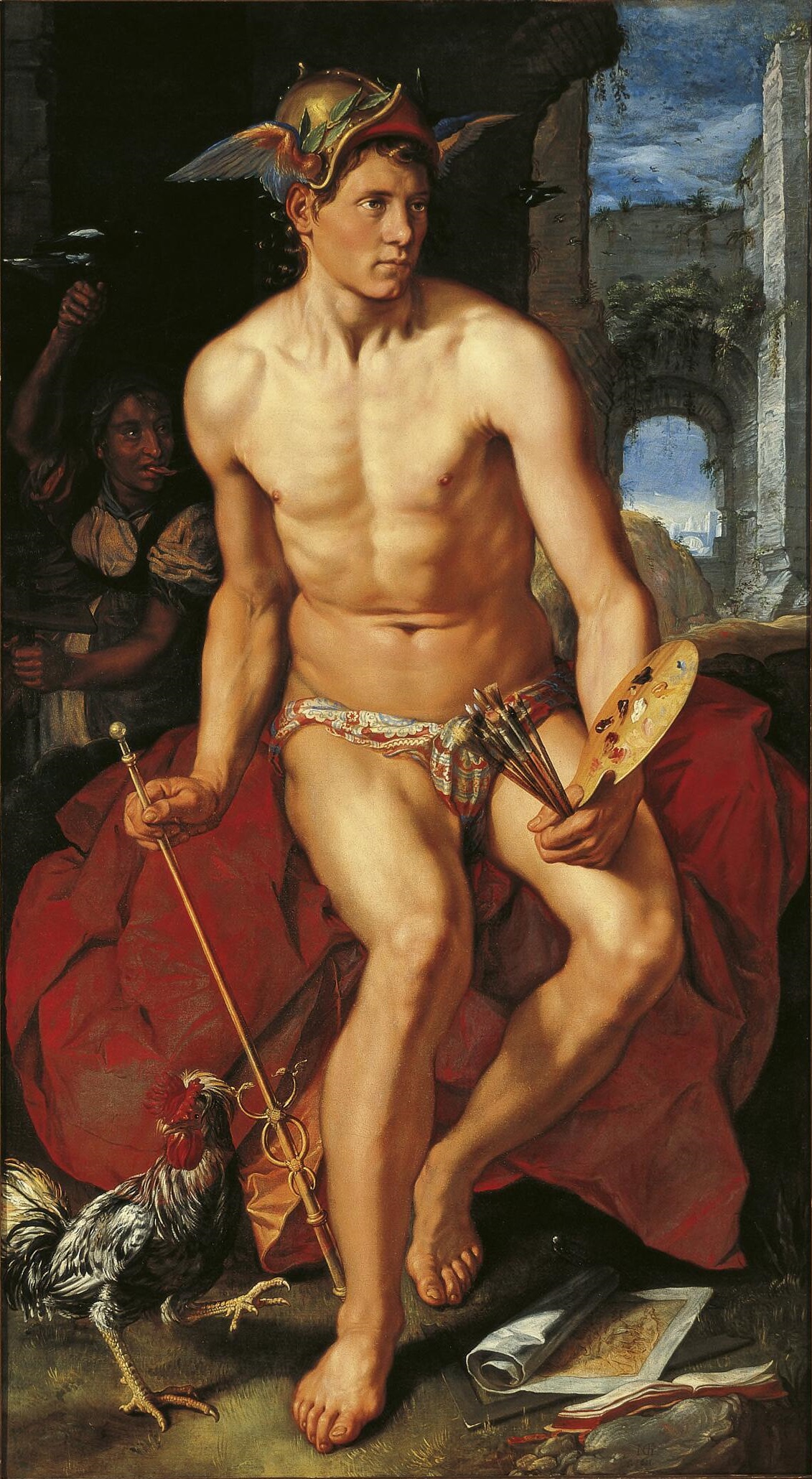
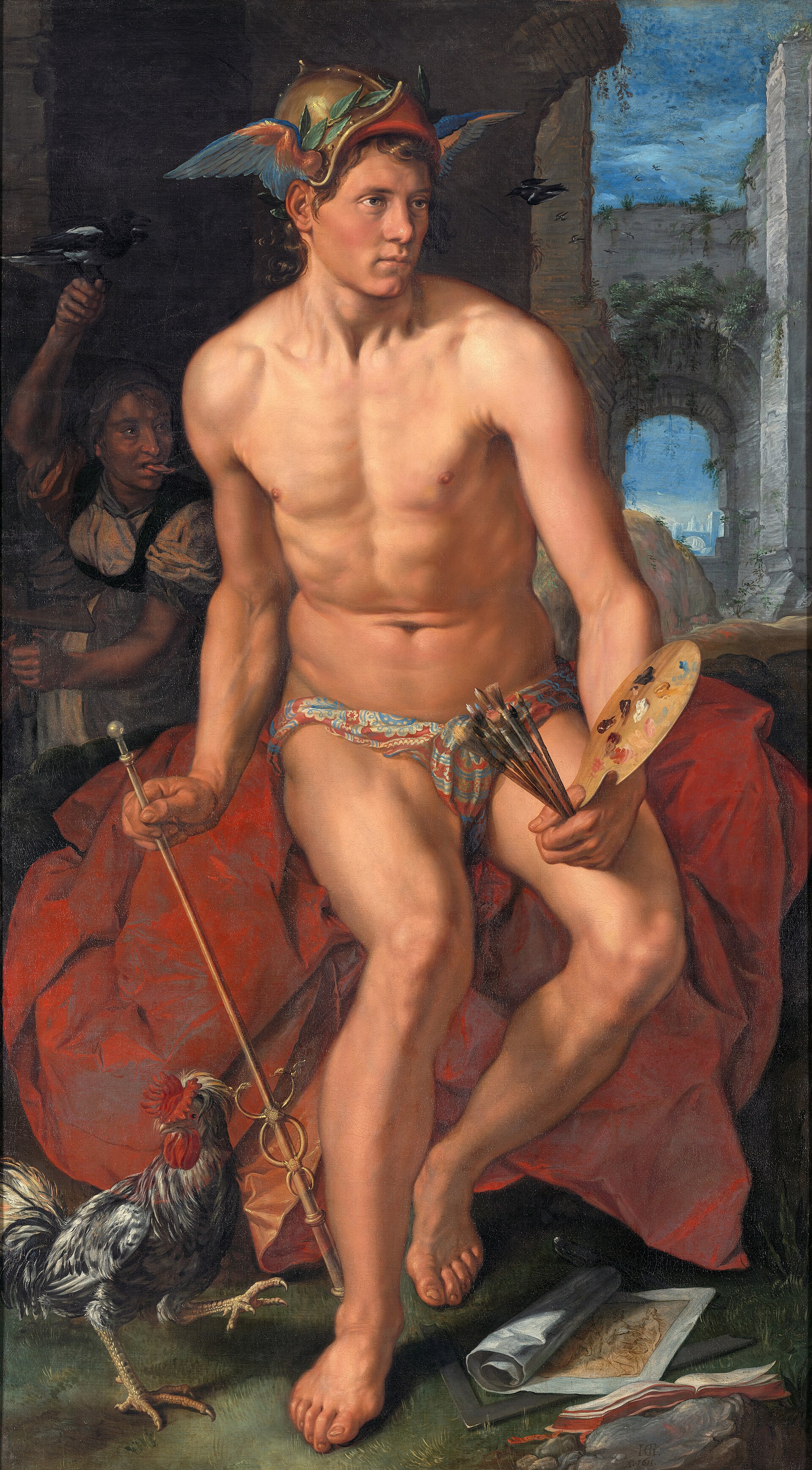
Famous public-domain depictions — click any image to view it full size.
Is Mercury the same as Hermes?
Mercury became deeply fused with Greek Hermes and inherited much of his mythic biography — messenger, psychopomp, trickster, and inventor. But Mercury's core Roman identity is bound up with commerce and profit: his name is related to merx, “merchandise,” and he was above all the patron of merchants and traders.
What was Mercury the god of?
Commerce, exchange, travel, communication, profit, trickery, and thieves. He was a messenger of the gods, a psychopomp who escorted souls, and a patron of merchants and travelers.
Where does the name Mercury come from?
The name Mercury is related to the Latin merx, meaning “merchandise.” That etymology points straight to his central Roman role as the god of commerce, trade, and profit, before his fusion with Greek Hermes broadened his mythology.
What was Mercury's role in the Aeneid?
In Virgil's Aeneid, Jupiter sends Mercury to Aeneas at Carthage to remind him of his destiny and command him to leave Dido and sail for Italy. Mercury's role is to transmit divine command with brutal efficiency — the messenger who moves history forward.
 Michael Paycer