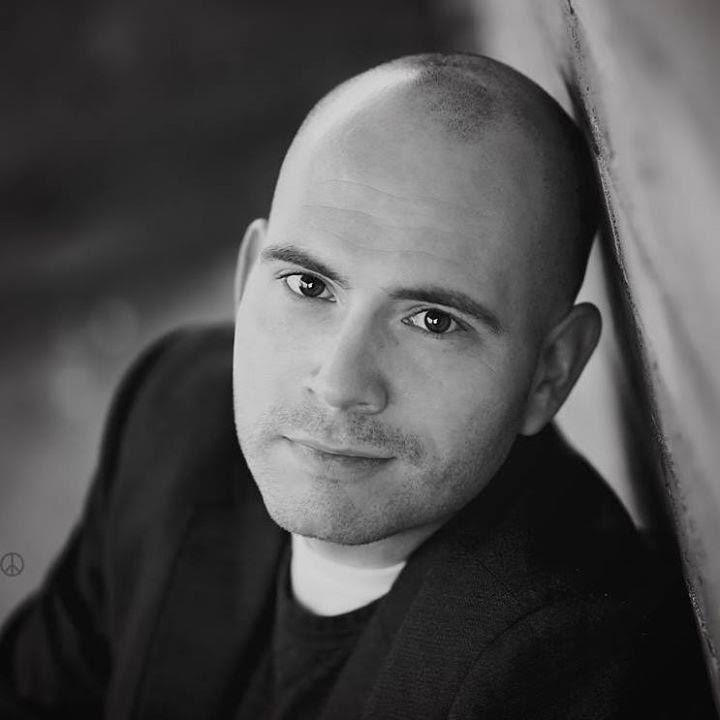
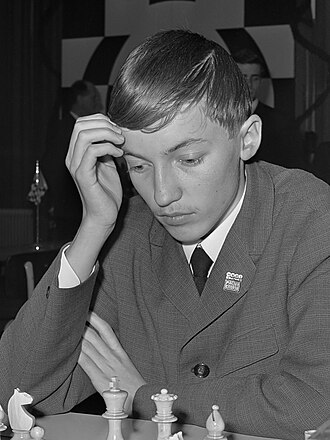
Anatoly Karpov
The python. World Champion from 1975 to 1985, Anatoly Karpov never needed to attack to win — he simply tightened his grip, move by quiet move, until his opponent could no longer breathe. His positional understanding and endgame technique set a standard that defined an era, and his decade-long rivalry with Garry Kasparov produced some of the deepest chess ever played.
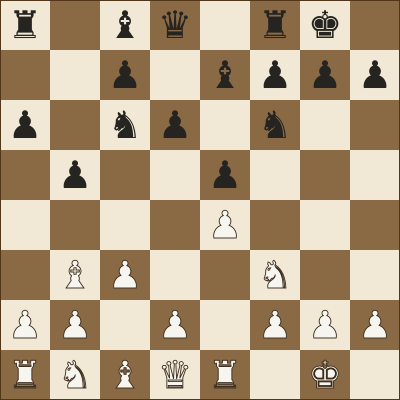
The Closed Ruy Lopez — Karpov's favourite battlefield as White. In games like his 1974 model win over Wolfgang Unzicker, he used exactly this structure to manoeuvre patiently, seize space, and squeeze until Black was paralyzed. No fireworks — just a slow, inevitable tightening.
Born
1951 · Zlatoust, Russia (USSR)
World Champion
1975–1985 (classical); FIDE champion again 1993–1999
Style
Positional squeeze, prophylaxis, flawless endgames — the "boa constrictor"
Great Rivalry
Five World Championship matches vs Garry Kasparov, 1984–1990
Winning without attacking
Karpov's chess can look deceptively simple. There are rarely sacrifices or sharp tactics — instead, a stream of small, unhurried improvements, each one barely noticeable, that add up to a position where the opponent has no moves left. He was a master of prophylaxis: anticipating and quietly preventing the opponent's plans before they could begin. When the smallest weakness appeared, his technique converted it without fail.
Karpov came to the title in 1975 when Bobby Fischer, unable to agree match conditions, forfeited the crown. Some questioned a champion crowned without a game — and Karpov answered them by dominating top-level chess for ten straight years, winning tournament after tournament with a consistency the chess world had rarely seen.
Karpov–Unzicker, Nice 1974
One of the most-studied positional games ever played. In a Closed Ruy Lopez, Karpov slowly built up on the queenside, exchanged at exactly the right moments, and manoeuvred his pieces to dominating squares while Unzicker — a strong grandmaster — was reduced to shuffling helplessly. By the end, every black piece was passive and White's were perfectly placed; the game is a textbook on how to win a "quiet" position.
6. Re1 b5 7. Bb3 d6 8. c3 O-O 9. h3 Na5 10. Bc2 c5
11. d4 Qc7 12. Nbd2 Nc6 13. d5 Nd8 … the long squeeze begins
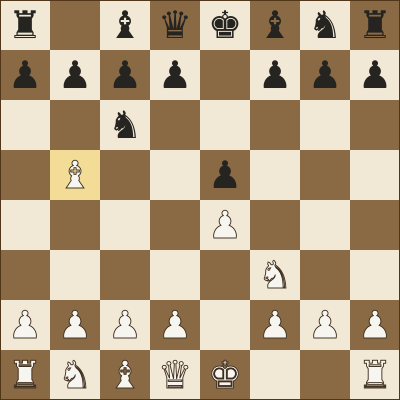
Where it begins: the Ruy Lopez (1.e4 e5 2.Nf3 Nc6 3.Bb5). From this classical starting point Karpov steered toward the Closed main lines, where his understanding of slow manoeuvring and prophylaxis gave him a decisive long-term edge against almost anyone.
The lesson of Karpov–Unzicker is patience. There is no single brilliant move to point to — the brilliance is the plan, sustained over forty moves, in which White's advantage grows so gradually that Black is lost before there is anything dramatic to see.
Where his games live in this library
The Ruy Lopez
Karpov is one of the greatest exponents of the Ruy Lopez — the classical 1.e4 opening built for exactly his style: long games, slow pressure, and rich endgames where a small edge decides.
Solid classical defenses
As Black he favoured rock-solid systems like the Caro-Kann and the Queen's Gambit Declined — openings that gave him sound structures to defend and then outplay opponents from equality.
Anatoly Karpov — FAQ
What was Anatoly Karpov's playing style?
Karpov was the supreme positional player — often likened to a python or boa constrictor. He avoided unnecessary risk, made quiet prophylactic moves that improved his position by tiny increments, and slowly squeezed opponents until they had no good moves left. His endgame technique was flawless.
How did Karpov become world champion?
He won the 1974 Candidates to earn a match with Bobby Fischer. When Fischer's demands for the 1975 match could not be met, Fischer forfeited the title and Karpov became champion in 1975 without a game — then silenced doubters by dominating elite chess for the next decade.
Who did Karpov play in his famous rivalry?
Garry Kasparov. The two played five World Championship matches between 1984 and 1990. The first was halted without result after 48 games; Kasparov won the 1985 rematch. The contrast between Karpov's squeeze and Kasparov's dynamism made it one of sport's greatest rivalries.
The Closed Ruy Lopez — Karpov's positional battlefield, where his slow squeeze did its quiet work.
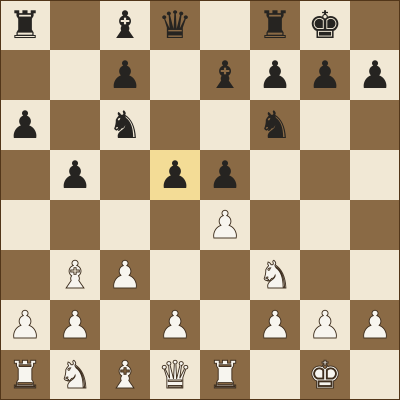
The Ruy Lopez's sharp side — the kind of theory Karpov navigated with effortless positional clarity.
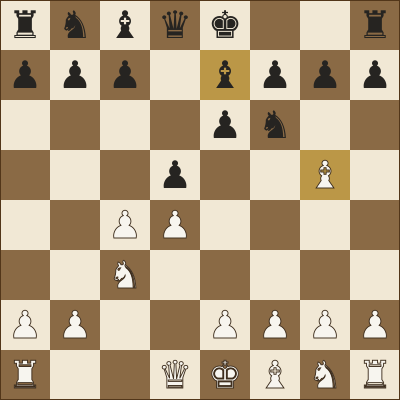
Solid classical structures — the territory where Karpov turned a tiny edge into a full point.
- Karpov, A. Karpov on Karpov and his best-games collections.
- Karpov–Unzicker, Nice Olympiad 1974 (Closed Ruy Lopez, game record).
- Karpov–Kasparov World Championship matches, 1984–1990.
- Kasparov, G. My Great Predecessors, Vol. V (Karpov).
The lineage continues
Karpov held the crown until Kasparov took it in 1985 — and before Karpov, it belonged to Bobby Fischer. Follow the chain through the famous games.