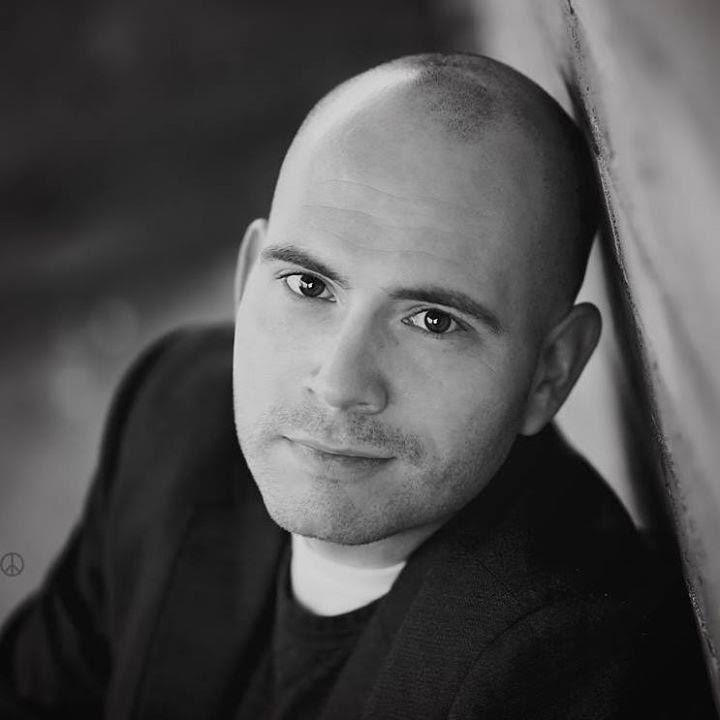
Kasparov vs Karpov
The greatest rivalry chess has ever known. Between 1984 and 1990, Garry Kasparov and Anatoly Karpov contested five World Championship matches and roughly 144 games — two opposite philosophies of chess, so evenly matched that the title swung on the narrowest of margins. No two players have ever fought so long, so hard, at so high a level.
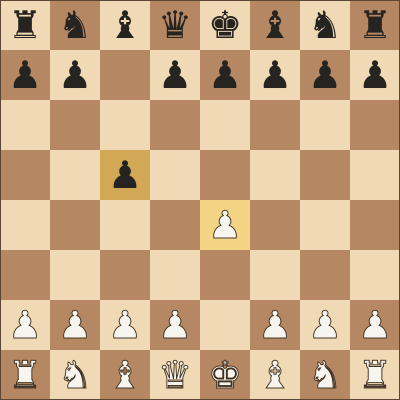
The Sicilian Defence — one of the central battlegrounds of the rivalry. It was in a Sicilian, in game 16 of the 1985 match, that Kasparov planted a knight on d3 — the famous "octopus" — and produced one of the defining wins of his career on the way to the title.
Six years, 144 games
The two met for the world title five times in six years — an intensity of head-to-head competition that has never been repeated. Karpov was the established champion, the positional python; Kasparov was the dynamic young challenger who would dethrone him and define the next two decades.
| Year | Match | Result |
|---|---|---|
| 1984–85 | Moscow (no game limit) | Halted at 5–3 to Karpov, no result |
| 1985 | Moscow (24 games) | Kasparov wins 13–11 — takes the title at 22 |
| 1986 | London / Leningrad | Kasparov retains 12.5–11.5 |
| 1987 | Seville | Drawn 12–12 — Kasparov retains as champion |
| 1990 | New York / Lyon | Kasparov retains 12.5–11.5 |
Look at the margins: 13–11, 12.5–11.5, 12–12, 12.5–11.5. Across hundreds of hours of the best chess on earth, the two were separated by almost nothing. Kasparov came out on top each time after 1985, but never by more than a single point.
1984–85 — halted without a winner
Their first match remains one of the strangest episodes in sport. Played to the old format — first to six wins, draws not counting — it had no fixed length. Karpov raced to a 4–0 lead and seemed certain to win. Then the games began to draw, and draw, and draw. After five months and 48 games the score stood 5–3 to Karpov, but the champion was visibly exhausted while the 21-year-old Kasparov had found his footing and was winning the recent games.
With the momentum shifting, FIDE president Florencio Campomanes halted the match with no result — citing the players' health — and ordered a fresh match with a fixed 24-game limit. It was hugely controversial, widely read as protecting the tiring champion. In the rematch later in 1985, Kasparov won game 24 to clinch the title 13–11 and became, at 22, the youngest undisputed world champion in history.
Why the rivalry defined an era
What made the matches great was the clash of opposites. Karpov won by removing his opponent's options — quiet moves, perfect technique, a slow positional squeeze. Kasparov won by force — seizing the initiative, calculating deeper, and attacking. Neither could simply impose his style; each had to solve the other, match after match, and the chess that resulted is studied to this day.
The rivalry also straddled history. It began in the Soviet Union and ended as that world was collapsing — Kasparov, increasingly outspoken and independent, against Karpov, the establishment champion. Their games carried a weight beyond the board, and together they dragged elite chess to a new level of depth and professionalism.
Kasparov vs Karpov — FAQ
How many times did Kasparov and Karpov play for the world title?
Five times between 1984 and 1990. The 1984–85 match was halted without result; Kasparov won the 1985 rematch and then defended in 1986, 1987, and 1990 — roughly 144 world championship games in all, the most between any two players at that level.
Why was the first Karpov–Kasparov match stopped?
It had no game limit (first to six wins). After five months and 48 games, Karpov led 5–3 but had tired as Kasparov surged. FIDE controversially halted it with no result and scheduled a fixed 24-game rematch, which Kasparov won.
What made the rivalry so great?
It paired two opposite philosophies at the absolute peak — Kasparov's dynamic attack against Karpov's positional squeeze — so evenly matched that matches were decided by a single point, over six years of the best chess on earth.
The Sicilian — the sharp battleground of the famous 1985 "octopus knight" win.
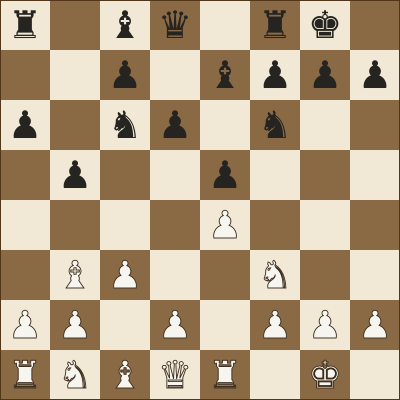
The Closed Ruy Lopez — Karpov's positional territory, where the python did its work.
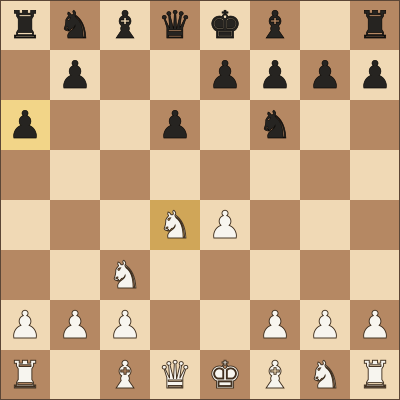
The Najdorf — the kind of razor-sharp theory both men prepared to extraordinary depth.
- Kasparov, G. Kasparov vs Karpov (3 vols., his own account of the matches).
- World Championship matches 1984–85, 1985, 1986, 1987, 1990 (records).
- Karpov–Kasparov rivalry overviews and game collections.
- Contemporary reports on the 1985 halting controversy.
Garry Kasparov — Part 2 of 3
Having conquered every human rival, Kasparov faced an opponent of a wholly different kind. Part 3 tells the story of his battles with the IBM supercomputer Deep Blue — and the match that changed how the world saw machines.