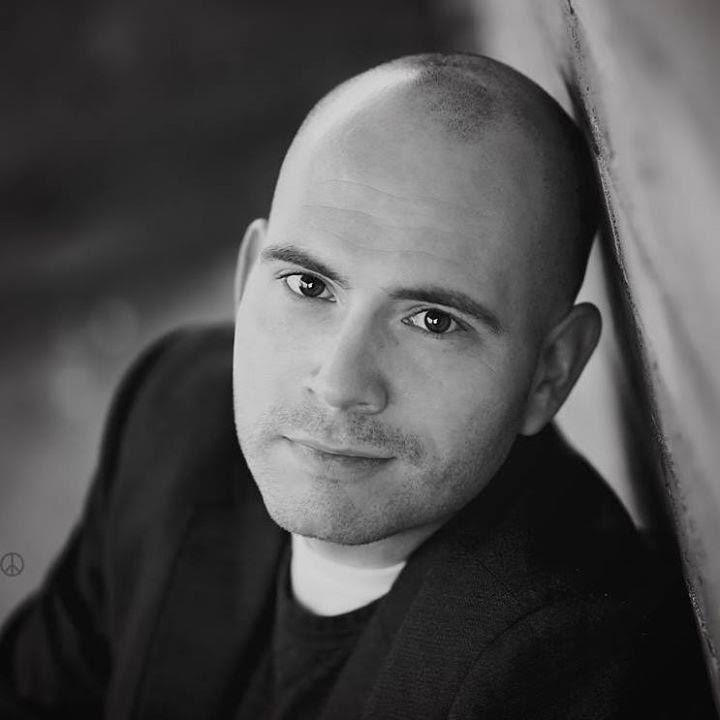
Kasparov vs Deep Blue
Having beaten every human alive, Garry Kasparov faced an opponent of a different order: the machines. From the IBM supercomputer Deep Blue in 1996–97 to the commercial engines Deep Junior and X3D Fritz in 2003, his battles against silicon became some of the most famous events in the history of both chess and computing — the moment the machine caught up, and the world had to reckon with what that meant.
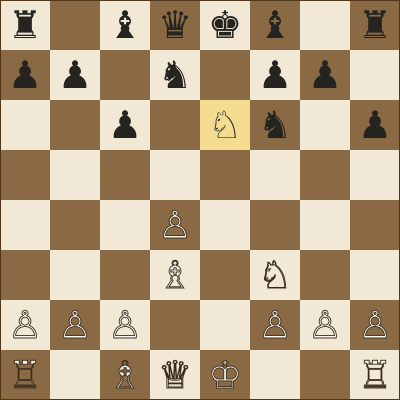
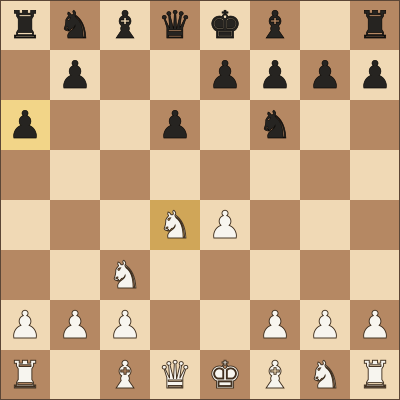
Deep Blue–Kasparov, 1997, game six — after the machine's 8.Nxe6 (the sacrificed knight highlighted). Kasparov, playing the Caro-Kann, walked into a known piece sacrifice; his position collapsed and he resigned in 19 moves, handing Deep Blue the match.
The champion wins, but the machine draws blood
In February 1996 Kasparov played a six-game match against Deep Blue in Philadelphia. He won it 4–2 — but the headline was game one. Deep Blue won it, becoming the first computer ever to beat a reigning world champion in a classical game under tournament conditions. Kasparov recovered, adjusting his strategy to steer the games into the long-term, strategic positions where the machine's brute-force calculation was weakest, and took the match comfortably. Humanity, it seemed, was still on top — but not by as much as everyone had assumed.
The machine catches up
IBM rebuilt Deep Blue into a far stronger machine and the two met again in New York in May 1997. This time it was even, and tense, until the deciding sixth game — where one of the most famous collapses in chess history unfolded.
6. Bd3 e6 7. N1f3 h6?? 8. Nxe6! — and Black is lost
After 8.Nxe6 (highlighted). The knight cannot be taken safely — 8...fxe6 9.Bg6+ wrecks Black's position — and Kasparov, caught in a line he knew was dangerous, was strategically lost almost at once. He resigned on move 19, the fastest loss of his career.
Deep Blue won the game and the match, 3.5–2.5 — the first time a computer had beaten a reigning world champion in a classical match. Kasparov, shaken, questioned whether human intervention had guided some of the machine's moves; IBM declined a rematch and retired Deep Blue. The suspicions were never substantiated, and the result stands as a landmark.
Deep Junior and X3D Fritz — fought to a standstill
Kasparov never got his Deep Blue rematch, but in 2003 he took on the best commercial chess programs of the day — and by then the machines were his equals. In January–February 2003 he played the Israeli engine Deep Junior in a six-game match in New York. It finished level, 3–3: Kasparov won game one, Deep Junior struck back, and game five featured a stunning computer sacrifice (…Bxh2+) that forced a draw and unsettled him into accepting a quiet finish.
That November, Kasparov faced X3D Fritz in a four-game match at the New York Athletic Club — and this one was a spectacle. Billed as "Man vs Machine" and televised on ESPN, it was played with no physical board at all: Kasparov wore special X3D glasses and saw a three-dimensional board floating in the air, speaking his moves to the computer. He won game three with a fine positional effort, X3D Fritz took game two, and the match ended 2–2. Two matches in one year, against two different engines — and a dead heat in both.
The 2003 matches drew a line under the man-versus-machine era. The contests were even, but the trend was clear: the engines were no longer catching up — they had arrived. Within a few more years, no human would beat top software in a match again.
A turning point for chess and for AI
The match was front-page news around the world. The picture of a machine defeating the greatest human player crystallized decades of debate about computers and intelligence, and it marked the start of an era: within a few years, chess engines would surpass all human players entirely. Far from killing the game, the machines transformed it — modern preparation, training, and analysis are now built on engines, and Kasparov himself went on to champion "centaur" chess, in which human and computer play as a team.
Characteristically, he turned the defeat into a question worth asking: not "can machines beat us?" but "what can we build together?" — a fitting final chapter for the most relentless competitor the game has known.
Kasparov vs Deep Blue — FAQ
Did Deep Blue beat Kasparov?
Yes, in the 1997 rematch — Deep Blue won 3.5–2.5, the first time a computer beat a reigning world champion in a classical match. A year earlier, in 1996, Kasparov had won their first match 4–2, though Deep Blue took game one.
What happened in game six of the 1997 match?
Kasparov played the Caro-Kann and allowed the known sacrifice 8.Nxe6, walking into a line he should have avoided. His position collapsed and he resigned after just 19 moves, handing Deep Blue the match.
What were Kasparov's 2003 matches against Deep Junior and X3D Fritz?
In 2003 Kasparov played two more "Man vs Machine" matches, both drawn. He tied Deep Junior 3–3 in New York early in the year, then drew X3D Fritz 2–2 that November in a match televised on ESPN — played with no physical board, Kasparov wearing 3D glasses to see a virtual board floating in front of him. The even results showed the engines had become his equals.
Why was the match historically important?
It was a milestone in artificial intelligence and a cultural landmark. A machine defeating the greatest human player captured the world's imagination and began the era in which engines would eventually surpass all human players.
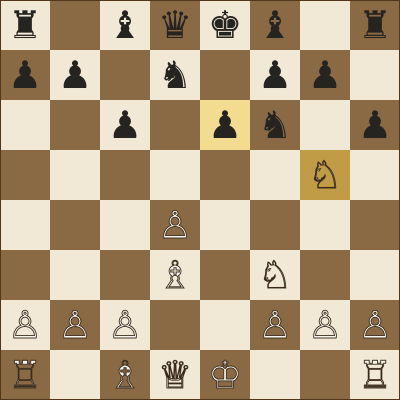
Game 6, 1997 — after Kasparov's 7...h6. Deep Blue's knight on g5 (highlighted) is about to crash in with 8.Nxe6, the sacrifice that decided the match in just 19 moves.
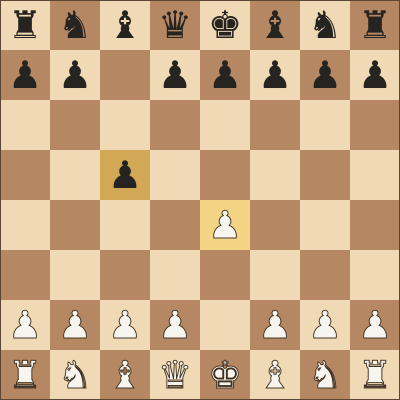
The sharp human theory Kasparov mastered — the kind of chess engines would soon reshape.
The Najdorf — modern opening preparation, now built entirely on the engines Deep Blue foreshadowed.
- Kasparov, G. Deep Thinking (his account of the matches and AI).
- Kasparov–Deep Blue matches, Philadelphia 1996 and New York 1997 (records).
- IBM Deep Blue project histories.
- Deep Blue–Kasparov, 1997, Game 6 (Caro-Kann, game record).
Garry Kasparov — Part 3 of 3
That completes the Kasparov guide — his dominance and the greatest game ever, the six-year war with Karpov, and the matches with Deep Blue that changed the game forever. Explore more champions or the openings he reshaped.