
Christianity · The Gospels

Five loaves, two fish,
and a whole hillside fed.

A tired crowd follows Jesus into open country and stays too long; evening comes and no one has eaten. From a boy's small lunch — five barley loaves and two fish — everyone is fed, with twelve baskets left over. It's the only miracle told in all four Gospels, and one of the most quietly radical: not a display of power, but a picture of enough.

Michael Paycer Michael Paycer
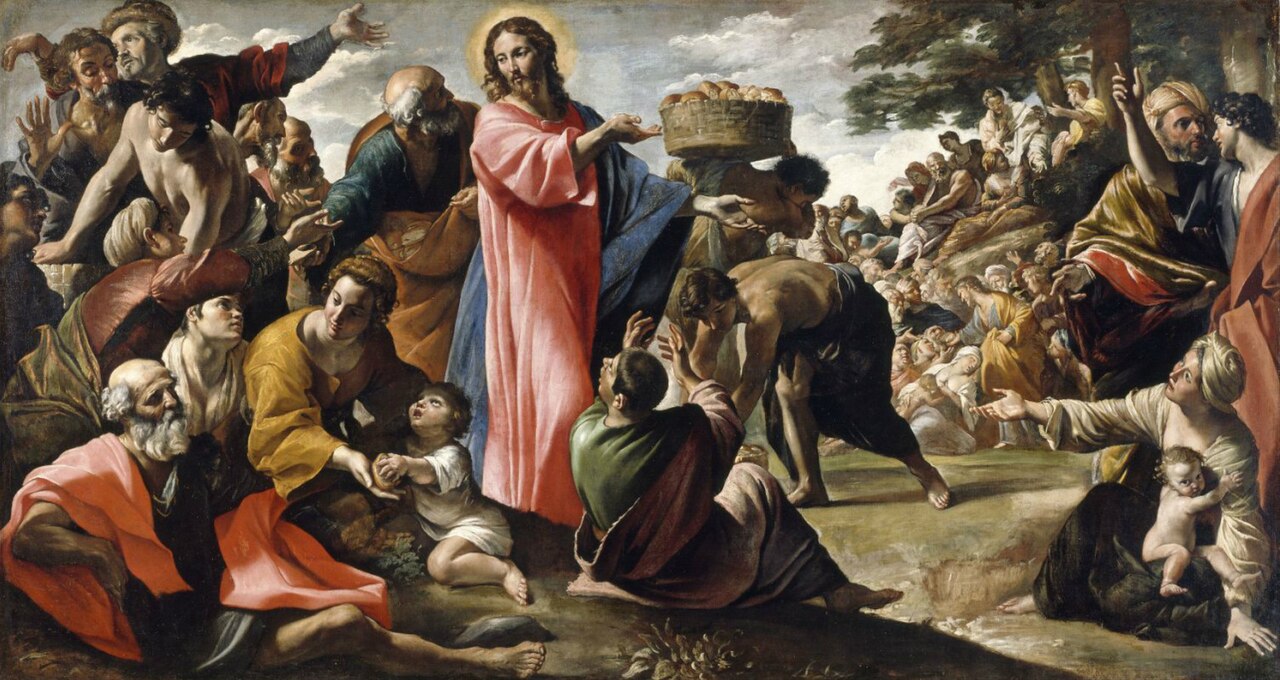
Giovanni Lanfranco, Miracle of the Bread and Fish
Miracle of the Bread and Fish. Giovanni Lanfranco paints the moment the loaves are handed out on the hillside, the crowd pressing in. Giovanni Lanfranco, c. 1620–1623 · Public domain via Wikimedia Commons
In brief

What

Five loaves & two fish feed thousands

Where in the Bible

All four Gospels — Matthew, Mark, Luke, John

Left over

Twelve baskets of fragments

The story

Compassion first, then the miracle

The setting is a lonely place near the Sea of Galilee. Jesus has withdrawn, but the crowds follow on foot, and instead of turning them away he stays — teaching and healing — until the day is nearly gone. The disciples do the sensible math: send everyone home before they starve. What follows is the point.

In Mark's telling, the miracle begins not with power but with pity: “he saw much people, and was moved with compassion toward them… because they were as sheep not having a shepherd” (Mark 6:34). The disciples find one boy with a few barley loaves and a couple of small fish — enough for a child, not a crowd. And then:

“And he took the five loaves and the two fishes, and looking up to heaven, he blessed, and brake, and gave the loaves to his disciples to set before them; and the two fishes divided he among them all. And they did all eat, and were filled. And they took up twelve baskets full of the fragments, and of the fishes.”— Mark 6:41–43 (KJV)

John adds the human detail that it was a boy's lunch that started it, and Matthew notes the count was “about five thousand men, beside women and children” (Matthew 14:21) — so the true crowd was larger still. It's worth knowing there are actually two feeding miracles in the Gospels: this one, and a later feeding of about four thousand (Matthew 15, Mark 8). The Gospel writers treat them as distinct events.

What it means

Three readings, all at once

Compassion. Before it is a wonder, it is an act of care. Jesus feeds people because they are hungry and he is moved by them — the miracle serves the crowd, it doesn't perform for them.

Abundance. The arithmetic is the message. What was obviously not enough becomes more than enough, with twelve baskets to spare. Against the disciples' scarcity — “send them away, we can't feed them” — the story insists that in the right hands, little is not the same as too little.

A foreshadow of the table. Watch the verbs: he took, blessed, broke, and gave. That fourfold action returns, word for word, at the Last Supper — which is why Christians have always read the hillside as a rehearsal for the Eucharist. John makes the link explicit: right after the feeding, Jesus says, “I am the bread of life” (John 6:35), turning a meal of barley loaves into a claim about himself.

The through-line

The disciples saw five loaves and did the math of scarcity. The story's quiet argument is that the math was wrong — that generosity, blessed and shared, doesn't divide down to nothing but multiplies.

My reflection — coming

This page tells the story and what it has traditionally meant. What it means to me — personally — belongs in its own space, and a reflection will live here soon. — Michael

Common questions

People also ask

Where is the feeding of the five thousand in the Bible?

In all four Gospels: Matthew 14:13–21, Mark 6:30–44, Luke 9:10–17, and John 6:1–14. John adds the boy with the loaves and follows it with the “bread of life” teaching.

Are there one or two feeding miracles?

Two. The feeding of the five thousand, and a later, separate feeding of about four thousand (Matthew 15, Mark 8). The Gospels present them as distinct events.

Why twelve baskets of leftovers?

The abundance is the point — there is more left over than they started with. Many readers also hear an echo of the twelve tribes of Israel and the twelve apostles in the number twelve.

Sources
The day job

Built by a SQL Server consultant

When I'm not counting baskets on a hillside, I tune databases, design high-availability systems, and run cloud migrations.

See what I do →