Lasker's Famous Games
Lasker is remembered as a pragmatist and a fighter — but he could attack with the best of them. His 1889 game against Johann Bauer gave the chess world the model demonstration of one of its most beautiful combinations, and his triumph at St. Petersburg 1914 is one of the great competitive achievements in the history of the game.
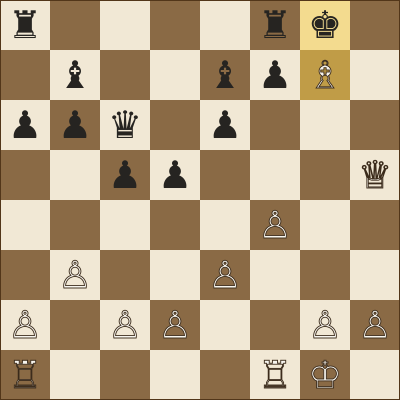
Lasker–Bauer, Amsterdam 1889 — after 17.Bxg7 (the g7 and h7 squares highlighted). Lasker has just given up his second bishop to rip open the king. With the queen on h5 and the bishop on g7, the bare black king cannot survive — the model "double bishop sacrifice."
Lasker–Bauer, Amsterdam 1889
Early in his career, the 20-year-old Lasker produced a combination that has been taught ever since. With both bishops aimed at Black's castled king, he struck on h7 and then on g7 — sacrificing both bishops to demolish the pawn cover — and then collected the loose pieces with a queen fork. It is the textbook example of the double bishop sacrifice.
6. Nf3 Bb7 7. Nc3 Nbd7 8. O-O O-O 9. Ne2 c5 10. Ng3 Qc7
11. Ne5 Nxe5 12. Bxe5 Qc6 13. Qe2 a6 14. Nh5 Nxh5
15. Bxh7+!! Kxh7 16. Qxh5+ Kg8 17. Bxg7!! Kxg7 18. Qg4+ & 19. Rf3–h3 wins
After 17.Bxg7. Following 17...Kxg7 18.Qg4+ the king is driven out, the rook swings to the h-file with 19.Rf3 and 20.Rh3+, and Lasker's queen ends up forking Black's two undefended bishops on b7 and d6 — regaining the sacrificed material with a decisive advantage. Beauty in the service of a full point.
Overtaking the young Capablanca
A quarter of a century later, Lasker delivered perhaps his finest competitive triumph. St. Petersburg 1914 gathered the world's elite, and the dazzling young Capablanca led for much of the event, seemingly destined to win. Lasker, the veteran champion, refused to yield — he produced a tremendous run in the final stage, including a celebrated victory over Capablanca himself in an Exchange Ruy Lopez, to overhaul the leader and win the tournament.
The win was Lasker at his most characteristic: against the man widely seen as the future of chess, he chose a quiet, slightly drawish-looking line — the Exchange Ruy Lopez — and then squeezed relentlessly until Capablanca cracked. It was a statement that the old champion's practical mastery still had no equal, and it postponed Capablanca's coronation for seven more years.
Where his ideas live on
Lasker's Defense
His practical streak gave the Queen's Gambit Declined one of its most reliable systems — Lasker's Defense, an early ...Ne4 to exchange pieces and reach a sound, comfortable game.
The Ruy Lopez
His St. Petersburg win showcased the Ruy Lopez Exchange Variation — proof that a "harmless" line, in the right hands, is a precise positional weapon.
Lasker's Games — FAQ
What is the double bishop sacrifice?
An attacking pattern in which both bishops are sacrificed to strip the pawns shielding a castled king — typically Bxh7+ then Bxg7. Lasker's 1889 game against Bauer is the most famous example and the model demonstration of the idea.
Why was St. Petersburg 1914 important?
It was one of the strongest tournaments of the era. Capablanca led much of the way, but Lasker produced a tremendous finish — including a famous win over Capablanca in an Exchange Ruy Lopez — to overtake him and win, a landmark of his long reign.
What is Lasker's Defense?
A solid Queen's Gambit Declined line where Black plays an early ...Ne4 to exchange pieces and ease the position, aiming for comfortable equality — typical of Lasker's practical, no-nonsense approach.
Lasker–Bauer 1889 — the model double bishop sacrifice, after 17.Bxg7.
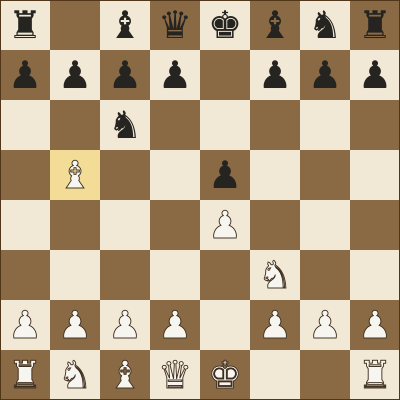
The Ruy Lopez — the Exchange Variation that beat Capablanca at St. Petersburg 1914.
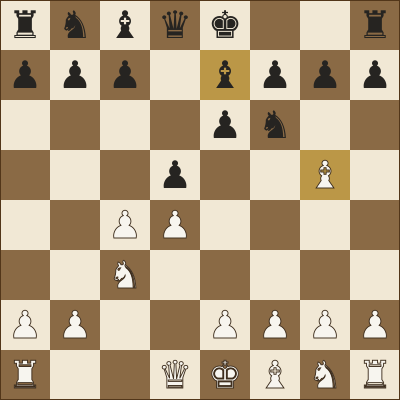
The Queen's Gambit Declined — home of Lasker's Defense, his practical equalizer.
- Lasker–Bauer, Amsterdam 1889 (the double bishop sacrifice, game record).
- St. Petersburg 1914 tournament book; Lasker–Capablanca game record.
- Lasker, E. Lasker's Manual of Chess.
- Kasparov, G. My Great Predecessors, Vol. I (Lasker).
Emanuel Lasker — Part 2 of 2
That completes the Lasker guide — the 27-year reign and the fighting, psychological genius behind it, plus the immortal combination and the tournament triumph that defined his greatness. From Lasker the crown passed to Capablanca.