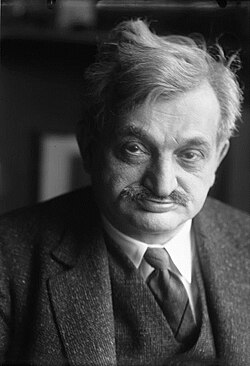
Emanuel Lasker
The longest reign in chess history. Emanuel Lasker held the world title for an astonishing 27 years — from 1894 to 1921 — a record that may never be broken. He was no mere technician but a fighter and a thinker: a doctor of mathematics, a philosopher, a friend of Einstein, and the first champion to understand that chess is played by people, and that the opponent across the board is part of the position.
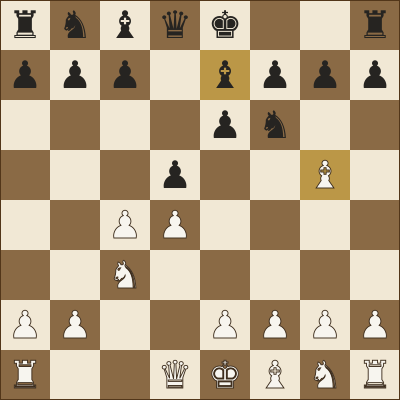
The Queen's Gambit Declined — home of the solid, freeing line known as Lasker's Defense. It is characteristic of the man: a practical, resilient system designed to neutralize White's pressure and steer toward the fighting middlegames where Lasker's judgment and nerve gave him the edge.
Lived
1868–1941 · born Berlinchen, Prussia (Germany)
World Champion
1894–1921 — 27 years, the longest reign in history
Style
Pragmatic and psychological — played the opponent, not just the board
Also
Doctor of mathematics, philosopher, friend of Einstein
A reign that spanned an era
Lasker won the title from Wilhelm Steinitz in 1894 and held it until 1921 — through the turn of the century, the First World War, and the arrival of a whole new generation of masters. No champion before or since has come close to that span. He did not simply survive at the top; he dominated great tournaments deep into middle age, and even after losing the crown he kept finishing among the world's best, most famously at Moscow 1935 in his sixties.
His longevity was no accident. Lasker treated each game as a struggle to be won by any sound means, and he had an almost unmatched gift for turning unclear, equal, or even inferior positions into victories through sheer fighting resourcefulness.
Playing the opponent, not just the board
Lasker's deepest insight was psychological. Chess, he understood, is not played against a perfect machine but against a particular human being with particular weaknesses. So he would sometimes choose a move that was not objectively the best, if it posed the hardest practical problem for the specific opponent in front of him — steering an aggressive player into quiet positions, or a quiet player into chaos.
This pragmatism was long misread as luck or "swindling." In truth it was a profound understanding of practical chess that the rest of the world only caught up to decades later — the same instinct that makes modern players speak of "posing problems" and "practical chances." Lasker invented that mindset. He defended grimly, complicated when behind, and made his opponents earn every half-point, which is exactly how a man stays champion for 27 years.
Mathematician, philosopher, friend of Einstein
Lasker was one of the most accomplished minds ever to play chess. He earned a doctorate in mathematics and made a genuine contribution to algebra — the idea of primary decomposition, later generalized as the Lasker–Noether theorem still taught today. He wrote on philosophy and on the nature of struggle and games, and he counted Albert Einstein among his friends; Einstein wrote a warm, thoughtful foreword to a biography of him. Jewish and living in Germany, Lasker was forced to flee the Nazis in the 1930s, losing his home and savings, and spent his final years in the United States.
His reign ended in 1921, when he lost a title match to the brilliant young José Raúl Capablanca — the "chess machine" whose flawless technique finally outlasted Lasker's fighting spirit.
Emanuel Lasker — FAQ
How long was Emanuel Lasker world champion?
From 1894 to 1921 — 27 years, by far the longest reign in the history of the title. He won it from Steinitz in 1894, defended it for over a quarter-century, and lost it to Capablanca in 1921.
What made Lasker's style unique?
He played the opponent as much as the position, deliberately choosing moves that posed the hardest practical problems for that particular rival rather than the objectively best move. This psychological, fighting approach won him countless games from unclear or worse positions.
Was Lasker a mathematician?
Yes — he earned a doctorate and contributed the concept of primary decomposition (the Lasker–Noether theorem) to algebra. He was also a philosopher and a friend of Albert Einstein, one of the most intellectually accomplished people ever to hold the chess title.
The Queen's Gambit Declined — home of Lasker's Defense, his solid, practical equalizer.
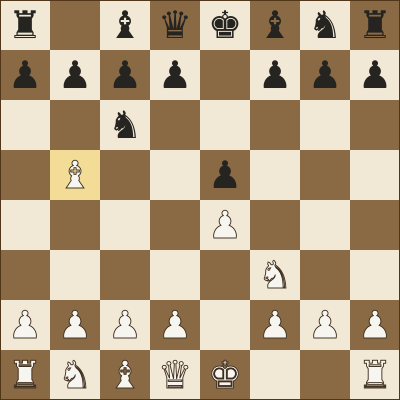
The Ruy Lopez — the classical 1.e4 battleground Lasker handled with deep practical judgment.
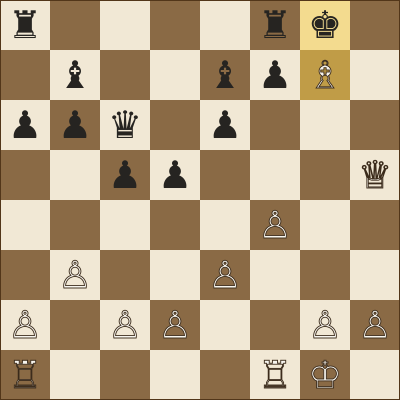
A glimpse of Part 2 — the famous 1889 double bishop sacrifice that announced his attacking power.
- World Championship matches 1894 (Steinitz) and 1921 (Capablanca) records.
- Lasker, E. Lasker's Manual of Chess.
- Hannak, J. Emanuel Lasker: The Life of a Chess Master (foreword by Einstein).
- Kasparov, G. My Great Predecessors, Vol. I (Lasker).
Emanuel Lasker — Part 1 of 2
The reign was built on great chess. Part 2 brings the board to life — the immortal double bishop sacrifice of 1889 and his triumph at St. Petersburg 1914 over the rising Capablanca.