
Comets
A comet is a mountain of ancient ice and dust that spends most of its life frozen in the outer dark — until its orbit swings it near the Sun, the ice turns to vapor, and it unfurls one of the most spectacular sights in the sky: a glowing head and a tail millions of kilometers long.
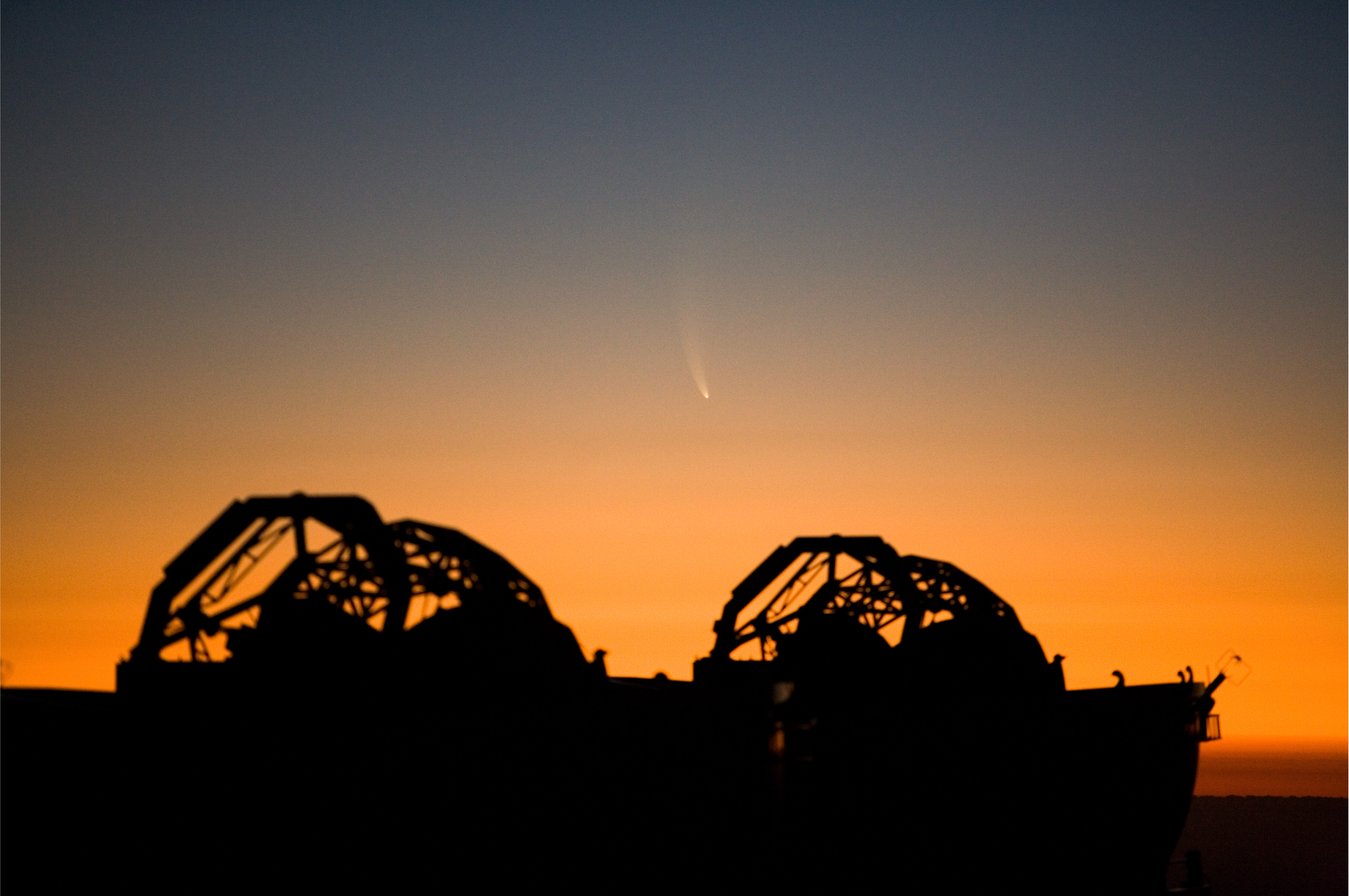
Image credit: ESO/H.H. Heyer. Comet McNaught (C/2006 P1), the Great Comet of 2007 and the brightest comet in over 40 years, setting over ESO's Paranal Observatory in Chile. The vast, curved fan is its dust tail, catching sunlight.
What it is
A "dirty snowball" of ice, dust & rock
Nucleus size
Typically a few kilometers across
Tails
Two — dust (curved) and ion/gas (straight)
Comes from
Kuiper Belt & scattered disk (short-period); Oort Cloud (long-period)
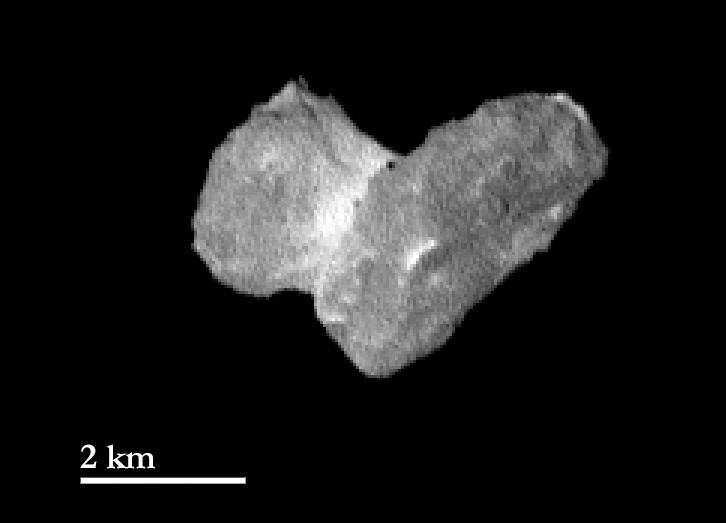
A dirty snowball that comes alive near the Sun
At heart, a comet is a small, solid nucleus — a "dirty snowball" of frozen water, carbon dioxide, ammonia, and methane, mixed with dust and rock, usually just a few kilometers across. For most of its orbit it is a dark, frozen lump in the cold outer Solar System, utterly invisible. Nothing about it suggests the spectacle to come.
Everything changes as it falls toward the Sun. Sunlight heats the surface and the ices turn straight from solid to gas — a process called sublimation — releasing dust and vapor that form a glowing cloud around the nucleus called the coma. Radiation and the solar wind then push that material outward into tails. A comet typically grows two: a dust tail, nudged gently off by sunlight and curving gracefully along the orbit, and a bluish ion tail of charged gas, blown straight back by the solar wind so that it always points directly away from the Sun — no matter which way the comet is traveling.
Comets come from the Solar System's deep freezers. The short-period comets (returning in under ~200 years, like Halley) are nudged inward from the Kuiper Belt and scattered disk. The long-period comets, on vast orbits lasting thousands or millions of years, fall in from the Oort Cloud at the very edge of the Sun's domain.
The waiting game — and the payoff when a great one arrives
Comet-watching is unlike anything else in this section, because the best targets are unpredictable. At any given time a handful of faint comets are within reach of binoculars or a telescope as fuzzy, tail-less smudges — rewarding to hunt down with a chart, but not showpieces. The magic is the great comet: every decade or so, one arrives bright enough to see with the naked eye, hanging in the twilight with a visible tail. Hale-Bopp (1997) was a showpiece for weeks; NEOWISE (2020) drew crowds worldwide.
A key thing to understand at the eyepiece: a comet is not a shooting star. It does not streak. It hangs almost motionless against the stars, drifting only slightly from night to night. When a bright one is predicted, find a dark site, look in the direction of the announced position (often low in the dawn or dusk sky), and use binoculars to trace the tail. Then simply come back the next clear night and watch it move.
Faint comets
Usually a few are in range of binoculars or a scope as small fuzzy patches. Use an up-to-date chart or app.
Great comets
Rare, naked-eye, with a visible tail. When one is announced, get to a dark site and look toward dawn or dusk.
Remember
A comet hangs nearly still and shifts slowly night to night. A streak that lasts a second is a meteor, not a comet.
New to stargazing? See how to observe the night sky, and if you're choosing gear, the no-hype telescope buying guide.
Omens of doom, "burning" ice, and a fatal misunderstanding
For most of human history a comet was a portent — an unmistakable sign written across the sky that something momentous, usually terrible, was coming. A comet blazed over England before the Norman Conquest of 1066 and was stitched into the Bayeux Tapestry as an omen; the same object, later understood to be Halley's Comet, was blamed for wars, plagues, and the deaths of kings across the centuries. The truth is quieter and grander: it is one icy body on a 76-year orbit, keeping perfect time.
The misconceptions are worth clearing up. A comet is not on fire — it glows by sublimating ice and reflecting and re-emitting sunlight, not by burning; there is no oxygen out there to burn in. It is not falling toward Earth when you see it — it is orbiting the Sun, usually at a very safe distance. And it does not shoot across the sky — that is a meteor. The most tragic modern misconception was the 1997 belief, spread by a fringe group, that a "spaceship" was hidden in the tail of Comet Hale-Bopp — a delusion that ended in the Heaven's Gate tragedy. A comet is astonishing precisely because it is real: ancient ice, lit by our own star.
The word comet comes from the Greek komētēs, meaning "long-haired" — the ancient Greeks saw the glowing tail as flowing hair and called these apparitions "hairy stars." They streak past the same mythic constellations that fill the rest of the night sky.
Primary sources: NASA — Comets, ESO — Comet McNaught and the ATs (eso0705a), and NASA/JPL Photojournal PIA18423 (Comet 67P nucleus). Image credits: ESO/H.H. Heyer (McNaught); ESA/Rosetta/MPS for the OSIRIS Team (67P).
A comet is a memory made visible — four and a half billion years of frozen dark, unlocked in a few bright weeks by the warmth of the Sun, and written across the sky in a tail longer than the distance to the planets.
The dust becomes the shower
The trail of dust a comet leaves behind is what Earth runs into each year as a meteor shower — the other half of this story.
Comets & Meteors (hub) · Comets · Meteors & Meteor Showers · The Solar System
More astronomy notes
Continue through the astronomy section for beginner-friendly notes, image credits, viewing tips, history, and the stories behind the night sky.
Meteor Showers · Kuiper Belt · Oort Cloud · Astronomy · Interests