
Comets & Meteors
Comets are the Solar System's dirty snowballs — icy leftovers that grow glowing tails when they near the Sun. Meteors are the flip side: the dust those comets shed, burning up in our atmosphere as shooting stars. One makes the other. Here's how they work, and how to watch them.
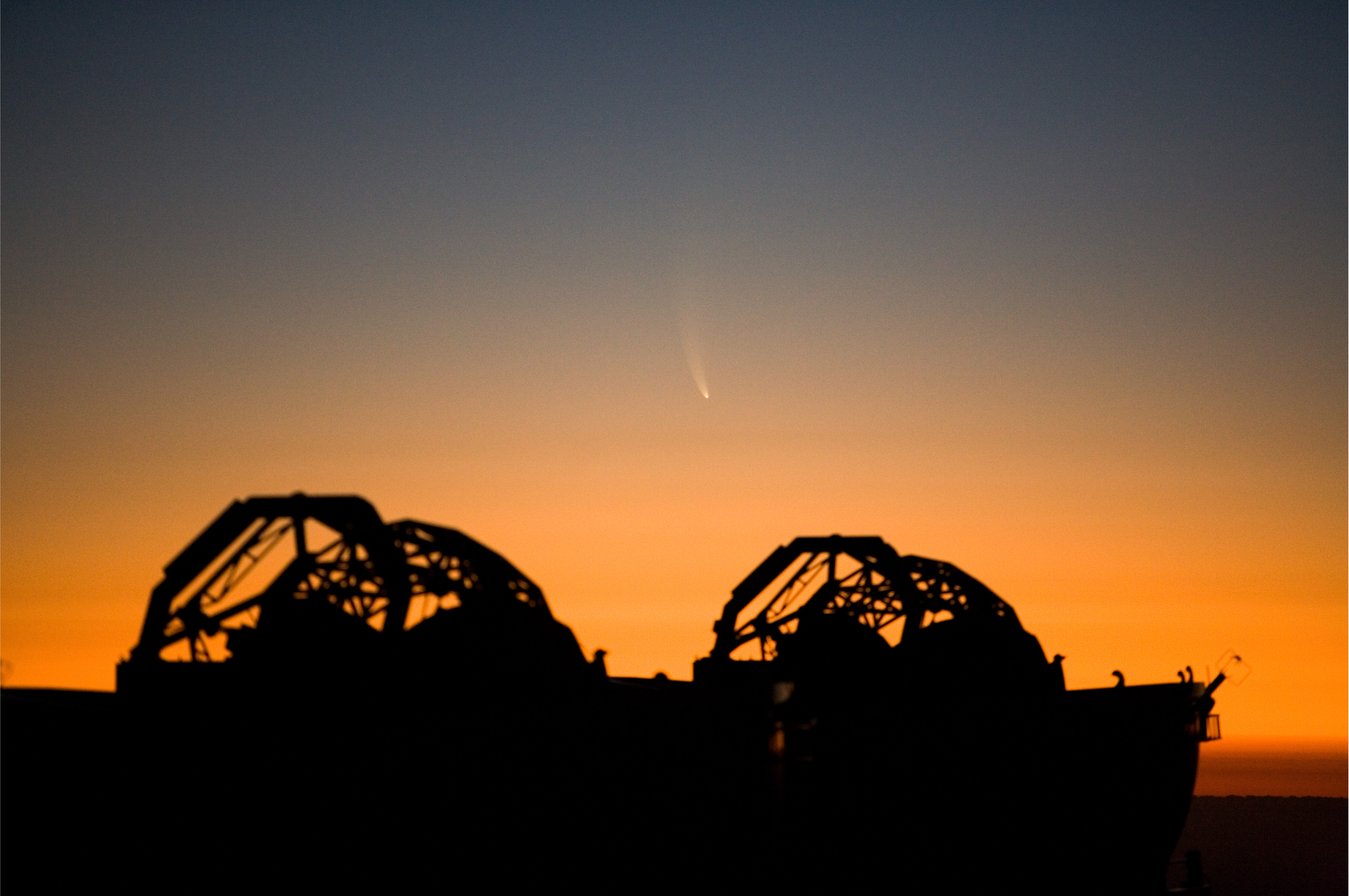
Image credit: ESO/H.H. Heyer. Comet McNaught — the Great Comet of 2007, the brightest in over 40 years — setting over ESO's Paranal Observatory. Its magnificent tail is dust and gas pushed away from the icy nucleus by sunlight and the solar wind.
Comets make meteor showers
The two halves of this section are really one story. As a comet loops through the inner Solar System, the Sun's heat boils ice off its surface and releases a trail of dust along its orbit. When Earth, on its own yearly journey, plows through one of those old dust trails, the grains slam into the atmosphere and burn up in streaks of light — a meteor shower. Every reliable annual shower is Earth crossing the litter left by a particular comet (with one famous asteroid exception). Learn the comet, and you understand the shower.
Comets
What a comet is made of, why it grows two tails, where comets come from — the Kuiper Belt and the Oort Cloud — and the great comets of history, from Halley to McNaught.
Meteors & Meteor Showers
Shooting stars explained — meteoroid, meteor, meteorite — plus a year-round shower calendar (Perseids, Geminids, and more) and exactly how to watch them.
Return to Michael Paycer
Explore Michael Paycer's professional SQL Server, cloud, ETL, API, automation, and consulting pages, or continue browsing the personal interests section.