Bobby Fischer
The lone American who broke the Soviet machine — and, to many, the most naturally gifted player who ever lived. World Champion from 1972 to 1975, Robert James Fischer combined ferocious calculation with absolute clarity of purpose. He produced two things no one has matched: a body of perfectly logical games, and a single 1972 match that made chess front-page news around the world.
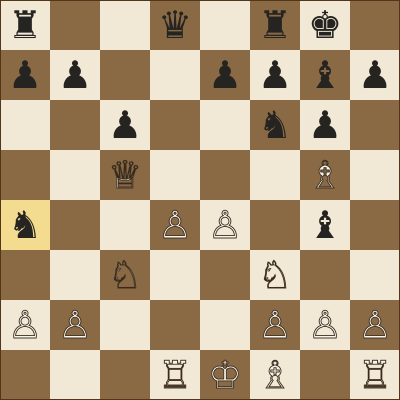
Byrne–Fischer, New York 1956 — "The Game of the Century." Move 11: the 13-year-old Fischer plays the provocative 11...Na4!? (highlighted), inviting wild complications. Six moves later he offers his queen — the boards further down play the whole combination out, stage by stage.
Lived
1943–2008 · born Chicago, raised in Brooklyn, New York
World Champion
1972–1975 — the only American classical champion, defeated Boris Spassky
Signature Game
Byrne–Fischer 1956, the "Game of the Century," age 13
Famous Openings
Najdorf Sicilian, King's Indian, Ruy Lopez; author of "A Bust to the King's Gambit"
A genius from Brooklyn
Fischer learned the moves at six and was U.S. Champion at fourteen — winning the 1957–58 title outright against the country's best adults. At fifteen he became the youngest grandmaster in history to that point. What set him apart was not just talent but an almost frightening single-mindedness: Fischer studied chess with a totality few have ever matched, learning Russian to read Soviet analysis the rest of the West couldn't.
His style was the opposite of mystical. Where Tal bewildered opponents with chaos, Fischer beat them with clarity — straightforward, powerful, technically flawless chess in which every move had an obvious point and the points added up to a win. He believed there was a best move in every position and spent his life trying to find it.
Byrne–Fischer, New York 1956
In an unremarkable tournament game, the 13-year-old Fischer, playing Black against the strong master Donald Byrne, produced a combination so deep that the journalist Hans Kmoch named it "The Game of the Century" on the spot. After a quiet Grünfeld-style opening, Byrne grabbed material — and Fischer answered with the move that made him famous.
6. Qb3 dxc4 7. Qxc4 c6 8. e4 Nbd7 9. Rd1 Nb6 10. Qc5 Bg4
11. Bg5 Na4 12. Qa3 Nxc3 13. bxc3 Nxe4 14. Bxe7 Qb6 15. Bc4 Nxc3
16. Bc5 Rfe8+ 17. Kf1 Be6!! — the queen offer
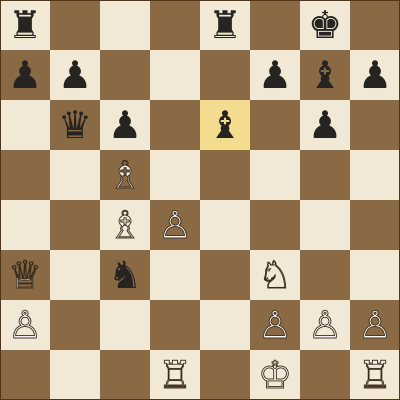
After 17...Be6!! (e6 highlighted). If 18.Bxb6 then 18...Bxc4+ 19.Kg1 Ne2+ 20.Kf1 Nxd4+ (a discovered check) 21.Kg1 Ne2+ 22.Kf1 Nc3+ 23.Kg1 axb6 and Black emerges with a rook, two bishops, and a pawn for the queen — a winning material edge. Byrne took the queen and was ground down.
What made the combination immortal is the "windmill" of discovered checks that follows: Fischer's pieces rake the board with check after check, winning material each time, while the white queen sits uselessly on a3. Byrne played on to checkmate — a rare courtesy that let the full combination appear on the board for posterity.
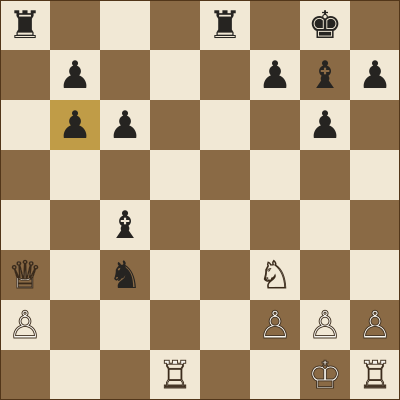
After 23...axb6 (b6 highlighted) — the dust settles. Fischer's windmill has won a rook, two bishops, and a pawn for the sacrificed queen. Black is overwhelmingly ahead and converts cleanly; Byrne is checkmated on move 41.
Reykjavik, 1972 — Fischer vs Spassky
For two decades, the world title had been a Soviet possession, defended by a state apparatus that treated chess as proof of ideological superiority. Fischer dismantled it almost single-handedly. In the 1970–72 Candidates cycle he produced one of the most dominant runs in chess history — including two 6–0 shutouts of grandmasters Taimanov and Larsen, results so lopsided they remain almost unbelievable.
Fischer lost game one to a tiny error, then forfeited game two in a dispute over conditions — falling 0–2 to the reigning champion Boris Spassky. From there he won 7 of the next 19 games and lost only one, taking the match 12.5–8.5. It made him the first American-born world champion, and against the Cold War backdrop it became the most famous chess match ever played.
Fischer never defended the title. Demands over the 1975 match conditions could not be met, and he forfeited the crown to Anatoly Karpov without a game. He withdrew almost entirely from public chess, re-emerging only for a 1992 rematch with Spassky. His competitive career was short — but its peak burned brighter than almost any other.
Where his games live in this library
The Najdorf Sicilian
As Black against 1.e4, Fischer was the supreme champion of the Najdorf Sicilian — "the Rolls-Royce of openings," in his phrase. He trusted it in the sharpest theoretical battles of his career and helped turn it into the most analyzed defense in chess.
"A Bust to the King's Gambit"
In 1961 Fischer published an essay claiming the King's Gambit was refuted by 2...exf4 3.Nf3 d6 — the "Fischer Defense." Engines later softened the verdict, but the essay shows the analytical fearlessness that defined him: he was willing to bust a 400-year-old opening in print.
Bobby Fischer — FAQ
Why is Byrne–Fischer 1956 called the Game of the Century?
A 13-year-old Fischer, playing Black against the strong master Donald Byrne, unleashed 17...Be6!! — offering his queen to launch a decisive combination. Journalist Hans Kmoch dubbed it "The Game of the Century" because a player so young had produced a combination of such depth and beauty against a serious opponent. Fischer won, and the game made him famous overnight.
What happened in the 1972 Fischer–Spassky World Championship?
In Reykjavik, Iceland, Fischer defeated reigning Soviet champion Boris Spassky to become the first American-born world champion. Framed against the Cold War, the "Match of the Century" drew unprecedented attention. Fischer lost game one and forfeited game two, then stormed back to win 12.5–8.5.
What openings was Fischer famous for?
As Black against 1.e4 he was the great champion of the Najdorf Sicilian and the King's Indian Defense. As White he was devoted to 1.e4 and the Ruy Lopez. He also wrote "A Bust to the King's Gambit" in 1961, claiming 3...d6 refuted it.
Stage 1 — 11...Na4!?, the provocation. Fischer invites the complications that will let his combination ignite.
Stage 2 — 17...Be6!!, the queen offer that announced a 13-year-old genius to the world.
Stage 3 — 23...axb6, the windmill done: a rook, two bishops, and a pawn for the queen. Black is winning.
- Fischer, R. (1969). My 60 Memorable Games.
- Kasparov, G. My Great Predecessors, Vol. IV (Fischer).
- Brady, F. Endgame: Bobby Fischer's Remarkable Rise and Fall.
- Byrne–Fischer, "Game of the Century," New York 1956 (game record).
Bobby Fischer — Part 1 of 3
The prodigy and the Game of the Century were only the beginning. Part 2 takes you inside Reykjavik 1972 — the Cold War title match that stopped the world.