
Reykjavik 1972: The Match of the Century
For 24 years the world title had been Soviet property. In the summer of 1972, in a sports hall in Iceland, one American took it away — and the whole world watched. The Fischer–Spassky match was chess as Cold War theatre, equal parts brilliance and brinkmanship, and it remains the most famous chess event ever held.
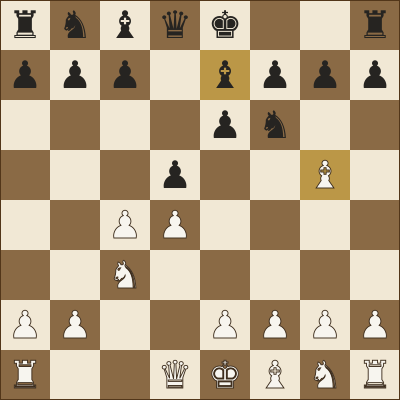
The Queen's Gambit Declined — the opening of game six, the turning point of the match. Fischer, almost never a 1.c4/1.d4 player, surprised Spassky with it and produced a game so clean that Spassky himself applauded along with the audience when it ended.
The most dominant run in chess history
Before he could challenge Spassky, Fischer had to win the Candidates — and he did so in a manner no one had ever seen. In the 1971 quarter- and semi-finals he beat two of the world's best grandmasters, Mark Taimanov and Bent Larsen, by the impossible score of 6–0 each: not a single draw, not a single loss. He then dispatched former champion Tigran Petrosian to earn the title shot. Players simply did not win elite matches by perfect scores; Fischer did it twice in a row.
The chess world arrived in Reykjavik braced for something historic — and for the temperamental American's demands about lighting, cameras, prize money, and the playing hall, which nearly sank the match before it began.
0–2 down, then the storm
It began as a disaster for the challenger. In game one Fischer grabbed a poisoned pawn in a drawn endgame and lost. He then forfeited game two by refusing to play amid a dispute over the cameras in the hall, falling 0–2 to the reigning champion. Many expected him to quit and fly home.
He stayed. In game three — moved to a back room away from the cameras — Fischer beat Spassky for the first time in his life. Something broke open. Over the games that followed he overwhelmed the champion, and in game six he produced his masterpiece: a Queen's Gambit so precise and so beautiful that Spassky, on the losing side, rose and applauded. Fischer won the match 12.5–8.5.
The result ended Soviet dominance of the title at a stroke and made Fischer a global celebrity. For a brief moment in 1972, chess was the most famous game on earth, and its champion an American household name.
The champion who vanished
Fischer never played another competitive game as champion. When terms for the 1975 defence against the young Anatoly Karpov could not be agreed, he forfeited the title without moving a piece. He withdrew almost entirely from public life, re-emerging only in 1992 for a celebrated, unofficial rematch with Spassky. The 1972 match remained the peak — a summit so high he never tried to climb again.
The 1972 Match — FAQ
Why was the 1972 Fischer–Spassky match so famous?
It was framed as a Cold War showdown — a lone American challenging the Soviet machine that had monopolized the title for decades. The off-board drama plus brilliant chess made it the most widely followed match in history, putting chess on front pages worldwide.
How did Fischer win after losing the first two games?
He lost game one to a rash pawn grab and forfeited game two over playing conditions, falling 0–2. He then won game three — his first ever win over Spassky — and surged, winning seven of the next nineteen while losing one, to take the match 12.5–8.5.
What happened to Fischer's title after 1972?
He never defended it. When terms for the 1975 match with Karpov could not be agreed, he forfeited the title without a game, and largely withdrew from public chess until a 1992 rematch with Spassky.
The Queen's Gambit Declined — game six, the model masterpiece that Spassky applauded.
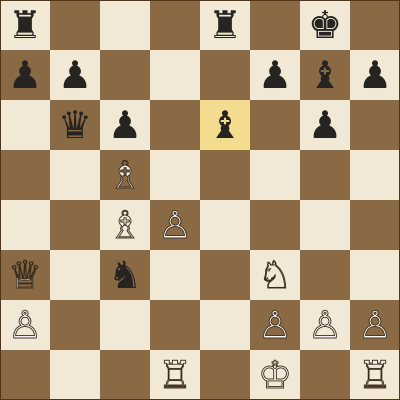
The genius that earned the shot — the queen sacrifice of the 1956 Game of the Century (Part 1).
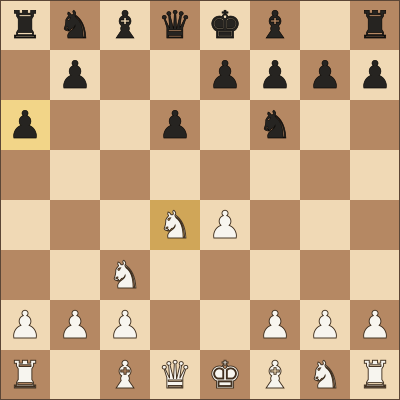
Fischer's Najdorf — the razor-sharp defence he trusted as Black throughout the match.
- World Chess Championship 1972 (Fischer–Spassky), full match record.
- Edmonds & Eidinow, Bobby Fischer Goes to War.
- Brady, F. Endgame: Bobby Fischer's Remarkable Rise and Fall.
- Fischer's Candidates matches, 1971 (Taimanov, Larsen, Petrosian).
Bobby Fischer — Part 2 of 3
The match made him immortal; his ideas made him influential. Part 3 covers Fischer's chess — the Najdorf, the King's Gambit "Bust," and the Chess960 variant he invented to outrun opening theory.