
What Is a Black Hole?
Strip away the science fiction and a black hole is a surprisingly simple idea taken to an extreme: gather enough mass into a small enough space, and gravity's grip becomes so strong that not even light — the fastest thing there is — can escape. Everything strange about black holes follows from that one sentence.
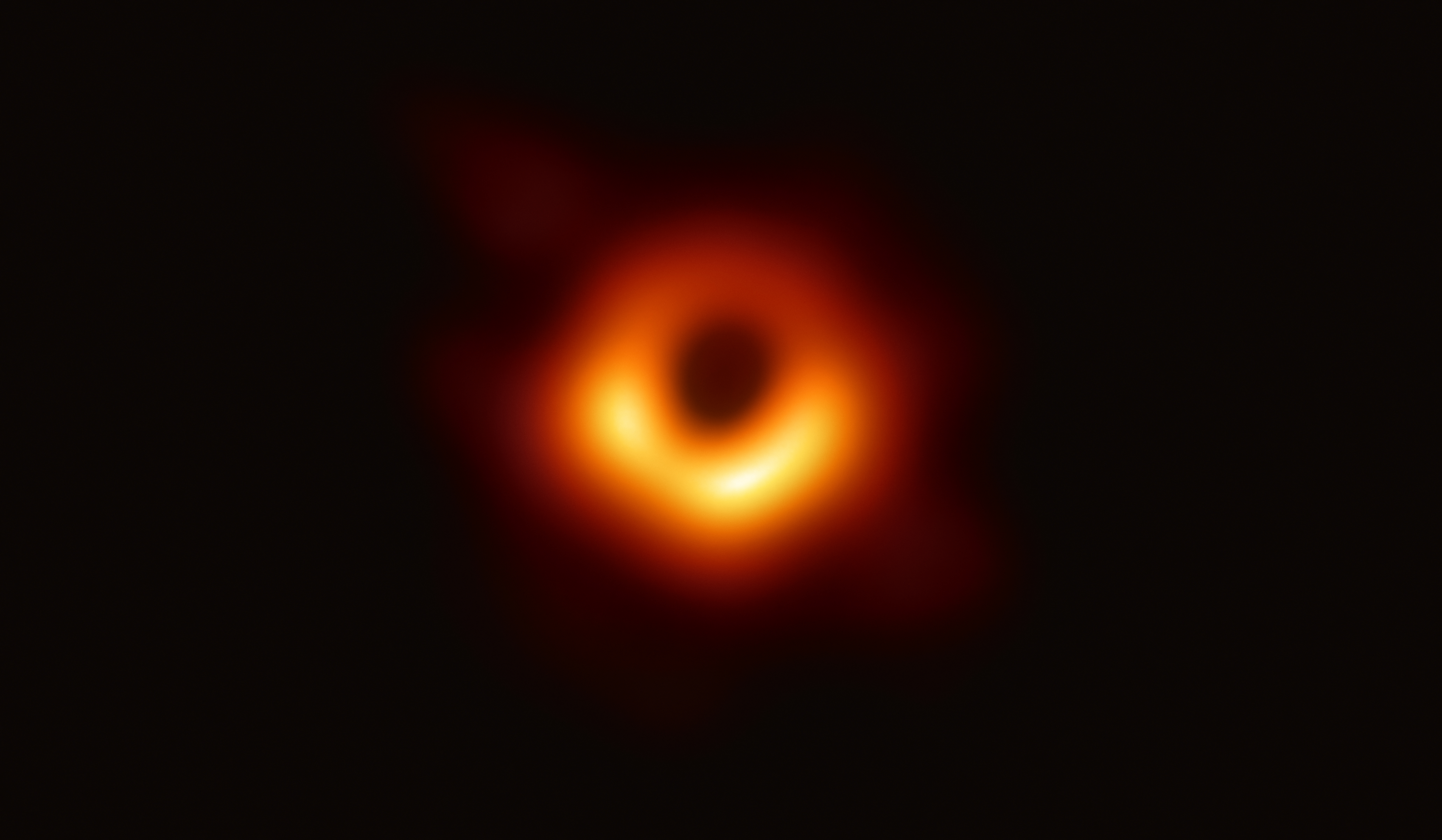
Image: EHT Collaboration. The first image ever made of a black hole (in the galaxy M87, 2019). The dark center is the shadow of the event horizon; the ring is light from hot gas, bent around the hole by its gravity before reaching us.
When escape velocity beats light
Throw a ball up and it falls back. Throw it faster than escape velocity and it never returns. Escape velocity depends on how much mass you're leaving and how close you start: more mass, or a smaller radius, means a higher speed needed to break free. Compress an object enough and its escape velocity keeps rising — until it reaches the speed of light, roughly 670 million mph.
At that threshold, something profound happens. Since nothing in the universe can move faster than light, and light itself can no longer escape, nothing can leave. The object has become a black hole. Its gravity hasn't changed at a distance — what's changed is that it's now compact enough to trap light. The Sun would become a black hole only if you crushed it into a ball about four miles across; Earth would have to be squeezed to the size of a marble.
The parts of a black hole
A black hole has a simple structure with a few named regions. The event horizon is the point of no return — cross it and no signal, no light, no you can ever get back out. The singularity at the center is where our physics breaks down: matter crushed, in the equations, to a point of infinite density. Just outside the horizon lies the photon sphere, where gravity is strong enough to bend light into circles, and often a glowing accretion disk of in-falling gas heated to millions of degrees — the part we actually see.
Diagram by Michael Paycer. The size of the event horizon (the "Schwarzschild radius") is set entirely by the black hole's mass — double the mass, double the radius.
Spaghettification, explained
Fall feet-first toward a black hole and gravity pulls your feet noticeably harder than your head, because they're closer. Near a small black hole this difference becomes so extreme that you're stretched lengthwise and squeezed sideways — drawn out into a thin strand. Physicists really do call it spaghettification. It's the same tidal effect that raises ocean tides on Earth, taken to a lethal extreme.
A quirk worth knowing: for the supermassive giants, the tidal stretch at the horizon is actually gentle — you could cross the event horizon of a billion-solar-mass black hole without being torn apart at all, noticing nothing special as you passed the point of no return. The violence is greatest for the smallest black holes. Either way, once across the horizon, all paths lead inward: the singularity is no longer a place you can steer away from, but a moment in your future.
Setting the record straight
"You'd see the singularity." — No; it's hidden behind the event horizon, and no information from inside can ever reach us. "Falling in is instant." — To a distant watcher you'd appear to slow and freeze at the horizon, reddening and fading, never quite crossing — a genuine effect of how black holes warp time. "A black hole lasts forever." — Probably not; Stephen Hawking showed they should very slowly evaporate over unimaginable spans of time. And "the singularity is settled science" — the opposite: it's where general relativity openly fails, and reconciling it with quantum physics is one of the great unsolved problems, the reason black holes remain a live frontier and not a closed chapter.
Stellar Black Holes · Supermassive Black Holes · TON 618 · Black Holes Hub · Glossary
Return to Michael Paycer
Explore Michael Paycer's professional SQL Server, cloud, ETL, API, automation, and consulting pages, or continue browsing the personal interests section.