
TON 618 — The Titan
If Sagittarius A* is a giant, TON 618 is a titan among giants. It is one of the most massive black holes ever measured — an "ultramassive" monster of tens of billions of suns, so large that the usual comparisons stop being useful and start feeling absurd.
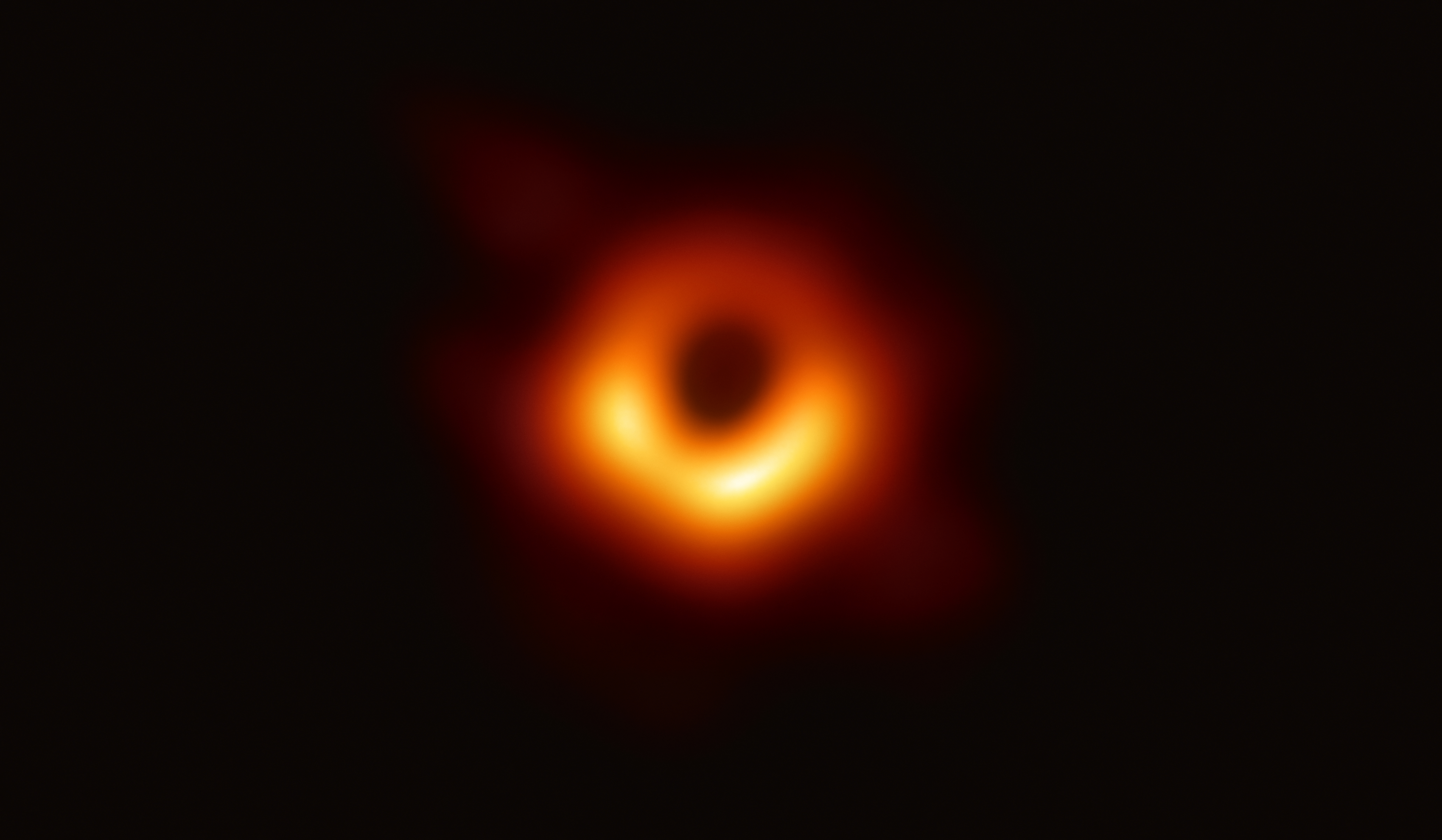
Image: EHT Collaboration. TON 618 is far too distant to photograph as the EHT did with M87 (shown here), but it belongs to the same family — a supermassive black hole ringed by a blazing disk. TON 618's disk is bright enough to see across most of the observable universe.
A beacon from the early universe
TON 618 isn't seen as a black hole directly — it's seen as a quasar, an intensely bright point of light roughly 10 billion light-years away. That means we see it as it was 10 billion years ago, when the universe was young. The light is not from the black hole itself but from the colossal, superheated accretion disk of gas spiraling into it. That disk outshines entire galaxies, which is the only reason we can detect something so far away at all.
Behind that brilliance sits the engine: a single black hole of staggering mass. The name is unglamorous — it's just catalog entry 618 from the Tonantzintla Observatory in Mexico — but the object it labels is among the heavyweight champions of the known universe.
How much is "tens of billions of suns"?
Estimates of TON 618's mass vary with the method used. The most-cited figure, from a 2004 analysis, is about 66 billion solar masses; a later 2019 reanalysis using a different spectral line arrived at a lower 40.7 billion. Either way, it dwarfs everything nearby: it is roughly ten thousand times the mass of our galaxy's Sagittarius A*, and more massive than all the stars in the Milky Way put together.
Diagram by Michael Paycer (M☉ = solar masses; circle areas are illustrative, not exact). Its event horizon alone is estimated to span a diameter many times the size of our entire Solar System.
Numbers that stop meaning anything
The horizon of a black hole this massive is thought to be so wide that light — which crosses our Solar System in hours — would take days or weeks to travel across it. If it replaced the Sun, its event horizon would swallow the orbits of all the planets and reach far beyond. This is the honest difficulty with an object like TON 618: it sits at the edge of what human intuition can hold. We can write the number, and the physics behind it is sound, but no everyday comparison really lands. That's part of why it fascinates people.
It's worth being precise about the superlatives, though. TON 618 is often called "the biggest black hole," but that's not quite settled — it's one of the most massive known, its mass carries real uncertainty, and other contenders exist. The interesting truth doesn't need the exaggeration: an object tens of billions of times the Sun, shining across most of the observable universe, is remarkable enough on the honest numbers.
Keeping the titan honest
"TON 618 is definitively the largest black hole." — It's among the most massive known, but its mass is uncertain (estimates range from about 40 to 66 billion suns) and rival candidates exist. "We've photographed it." — No; at 10 billion light-years it's far beyond the Event Horizon Telescope's reach — we see its quasar glow, not its shadow. "It could reach us." — Its gravity is utterly local to its own region 10 billion light-years away; it has no effect on us whatsoever. And "the size is just hype" — the hype is in the "biggest ever" label, not the object: the real, measured numbers are astonishing on their own.
Supermassive Black Holes · M87 · What Is a Black Hole? · Black Holes Hub · Glossary
Return to Michael Paycer
Explore Michael Paycer's professional SQL Server, cloud, ETL, API, automation, and consulting pages, or continue browsing the personal interests section.