
Supermassive Black Holes
At the center of nearly every large galaxy — including our own — sits a black hole millions to billions of times the mass of the Sun. Nobody fully knows how they grew so large so early, but they anchor galaxies, power the brightest objects in the universe, and are the two we've managed to photograph.
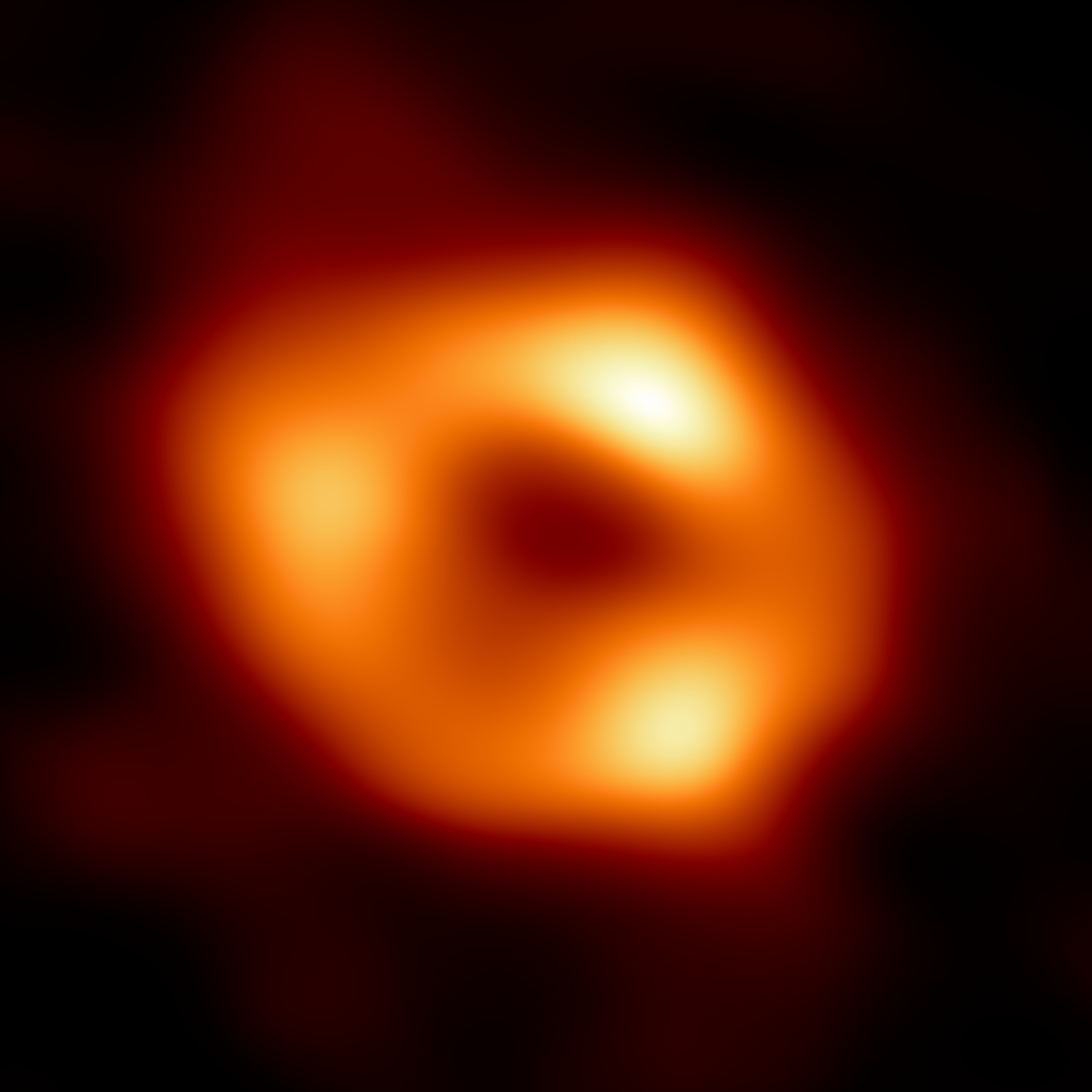
Image: EHT Collaboration. Sagittarius A* — the four-million-solar-mass black hole at the center of our Milky Way, imaged in 2022. Its "shadow" spans a region that would fit inside Mercury's orbit, yet it sits 27,000 light-years away.
A different beast entirely
Stellar black holes are a few dozen solar masses at most. Supermassive black holes are millions to billions — a completely different class of object, and not simply a big version of the stellar kind. They didn't form from a single collapsing star. Exactly how they grew is one of astronomy's open questions: some mix of swallowing enormous amounts of gas, merging with other black holes, and possibly starting from unusually massive "seeds" in the early universe. What's clear is that they were already gigantic when the universe was young — a puzzle the deepest telescopes are still chasing.
Remarkably, these giants are woven into their galaxies. The mass of a galaxy's central black hole tracks the properties of the galaxy around it, as if the two grew up together. A black hole a few light-hours across somehow keeps step with a galaxy a hundred thousand light-years wide — a relationship astronomers are still working to explain.
Sagittarius A* — the Milky Way's heart
Point toward the constellation Sagittarius and you're looking toward the center of our galaxy, where Sagittarius A* (said "Sagittarius A-star") holds about four million solar masses. We know its mass with unusual precision because we've watched individual stars whip around it for decades — one star, S2, loops the invisible mass every 16 years on a tight orbit, and tracking those stellar orbits earned a share of the 2020 Nobel Prize in Physics.
In May 2022 the Event Horizon Telescope released its portrait — only the second black hole ever imaged. Sagittarius A* is a quiet giant these days, sipping rather than gorging on gas, which is part of why our galaxy is a calm place to live. Photographing it was harder than photographing the larger, more distant M87, because gas whips around our smaller black hole so fast — a full orbit in minutes — that the image kept changing as they watched.
M87, and when giants feed
The very first image of any black hole, in April 2019, was of the supermassive giant in the galaxy M87 — a titan of about 6.5 billion solar masses, 53 million light-years away. It was easier to image than our own despite the distance, because it's so enormous that its shadow, though far away, looms large, and its gas orbits slowly enough to hold still for the picture.
When a supermassive black hole feeds aggressively, it becomes the most luminous kind of object in the universe: a quasar. Gas spiraling in piles into a blazing accretion disk that can outshine the entire surrounding galaxy of hundreds of billions of stars, visible clear across the cosmos. The most extreme of these are powered by the largest black holes of all — which brings us to TON 618.
Reading the giants correctly
"The Milky Way's black hole is dragging us in." — It isn't; the Sun orbits it at a safe 27,000 light-years, the same way Earth orbits the Sun, and will for billions of years. "A supermassive black hole is just a huge star-collapse." — No single star is anywhere near big enough; how they actually formed is unsolved. "Quasars are separate objects from black holes." — A quasar is a feeding supermassive black hole, seen while it gorges. And "we understand how they got so big" — we don't yet, especially the giants that already existed in the infant universe; it's one of the field's real open problems.
M87 · TON 618 · Stellar Black Holes · What Is a Black Hole? · Black Holes Hub · Glossary
Return to Michael Paycer
Explore Michael Paycer's professional SQL Server, cloud, ETL, API, automation, and consulting pages, or continue browsing the personal interests section.