Theme · Beauty · Desire
Beauty & Danger
In Greek myth, beauty is never simply lovely. It inspires devotion and war, ascent and ruin — sometimes in the same breath.
 Michael Paycer
In Greek myth, beauty is never simply lovely. It inspires devotion and war, ascent and ruin — sometimes in the same breath.
Michael PaycerThe question
Does beauty lift us or trap us?
Greek figures
Helen, Aphrodite, Narcissus, the Sirens
Philosopher
Plato
Key text
The Symposium
Greek mythology treats beauty as a genuine power — and a perilous one. Aphrodite's gift of Helen ignites a decade of war; Narcissus dies in love with his own reflection; the Sirens' beautiful song lures sailors to their deaths.
Yet the same force can elevate. Plato took the desire beauty awakens and made it the first rung of a ladder the soul climbs toward truth itself. Whether beauty traps us in desire or lifts us toward something higher became one of philosophy's richest questions.
The face that launched a thousand ships: Helen's beauty, promised to Paris by Aphrodite, sets off ten years of war and the deaths of Achilles, Hector, and countless others. Beauty here is the spark of catastrophe.
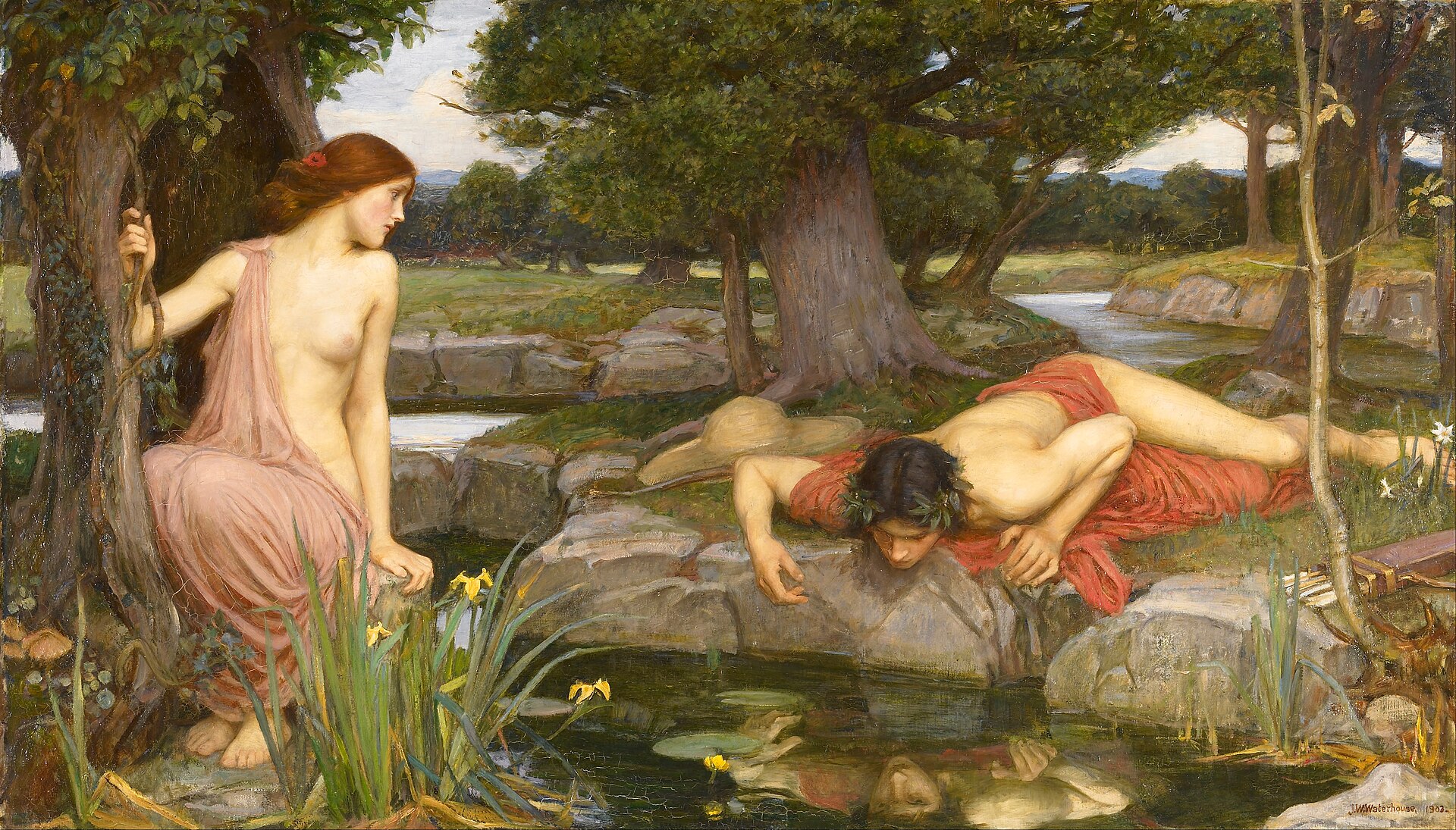
So beautiful that he falls in love with his own reflection, Narcissus wastes away beside the pool, unable to leave the image. The myth warns that beauty turned inward becomes a fatal trap — and gives us the word "narcissism.
The Sirens' singing is irresistibly beautiful, and deadly — sailors who hear it steer onto the rocks. Odysseus survives only by binding himself to the mast: beauty mastered by foresight, not denied.
In the Symposium, Plato turns desire into ascent. The love of one beautiful body can lead, rung by rung, to the love of beautiful souls, then laws, then knowledge, and finally Beauty itself — the eternal Form. Desire becomes a path to truth.
But the same power can hold the soul fast. The danger Plato names is getting stuck on a lower rung — mistaking a particular beautiful thing for the real goal, and being enslaved by desire rather than lifted by it.
Greek thought kept both possibilities alive in Aphrodite herself: she is the doorway to love, art, and even metaphysics, and the source of obsession, betrayal, and ruin. Beauty is never neutral.
Public-domain depictions — click any image to view it full size.
“Beauty is the splendor of truth.”
Platonic tradition
“From the beauty of one body to the beauty of all, and at last to Beauty itself.”
after Plato, Symposium
Because it has power over gods and mortals alike, and that power can inspire obsession, betrayal, and war — as with Helen, Narcissus, and the Sirens. Greek myth never treats beauty as merely pleasant.
From the Symposium: the idea that desire for a beautiful body can lead the soul upward, step by step, to love of beautiful souls, ideas, and finally Beauty itself. Desire becomes a path toward truth.
A youth so beautiful he falls in love with his own reflection and cannot leave it, wasting away beside the pool. The myth gives us the word 'narcissism' and warns of beauty turned inward.
When I am not reading Homer or Nietzsche, I tune databases, design high-availability systems, and run cloud migrations.