Who is Bacchus?
Bacchus was the Roman name most associated with Greek Dionysus: god of wine, ecstasy, theater, altered identity, and ecstatic religious experience. His worship crossed the ordinary boundaries of class, gender, and restraint, offering release from everyday identity through wine and rite.
Where Jupiter stood for order and Vesta for continuity, Bacchus stood for their opposite — the loosening of boundaries. That made him thrilling to worshippers and unsettling to Rome's authorities, a tension that produced one of the most famous episodes in the history of Roman religion.
Origins & history
In Rome, Bacchic religion became politically explosive. The Bacchanalia — the god's ecstatic rites — spread widely, and in 186 BCE the Senate intervened directly, issuing the Senatus consultum de Bacchanalibus, a decree restricting the rites and the associations that practiced them. The decree survives inscribed on bronze, and it is the single most historically important piece of Roman evidence for the cult: not a divine speech or a hymn, but hard proof of the state stepping in to control a religious movement it distrusted.
The philosophical afterlife of the god is separate from that history. Dionysian experience later became a powerful symbol of ecstatic or anti-rational forces, but that much later philosophical use should not be projected wholesale onto Roman worshippers, for whom Bacchus was a living cult rather than a metaphor.
Cult & worship
Bacchus was worshipped through the Bacchanalia, initiatory rites promising ecstatic release and a crossing of ordinary constraints. Their reach across class and gender lines is precisely what alarmed the authorities, and in 186 BCE the Senate moved to suppress and regulate them through the Senatus consultum de Bacchanalibus. It is worth adding a note of caution here: Livy's lurid narrative of the affair reflects elite fear and rhetorical hostility, so while the decree proves that suppression happened, it does not confirm every sensational charge leveled against the worshippers.
Greek equivalent
Bacchus was the Roman counterpart of Greek Dionysus, and shares his mythology of wine, theater, ecstasy, and altered identity almost entirely. But the identification is not the whole story. The most distinctive Roman chapter is historical rather than mythic: no Greek city produced anything quite like the Senate's formal, empire-wide decree against the god's rites. Reading Bacchus alongside Dionysus shows how the same divine figure could be embraced as myth and feared as institution.
Famous myths & stories
The Senate against the god
The defining Roman episode is not a myth but a document: the Senatus consultum de Bacchanalibus of 186 BCE. Faced with the spread of the Bacchanalia, the Senate restricted the cult across Italy. The surviving bronze inscription makes this one of the best-attested confrontations between the Roman state and a religious movement.
Livy's scandal — read with caution
Livy tells the affair as a lurid tale of conspiracy, sexual transgression, forgery, and murder. Modern historians warn that this portrait reflects elite fear and rhetorical hostility more than sober reporting. The decree proves suppression; it does not prove every accusation, and the worshippers' own voice is largely lost.
Wine, theater, and release
Beyond the Roman scandal, Bacchus carries the older story-world of Dionysus: the discovery of wine, the invention of theater, and the liberation of ordinary people from ordinary constraints. His gift is transformation — of the grape into wine, and of the worshipper into someone briefly beyond themselves.
Legacy & influence
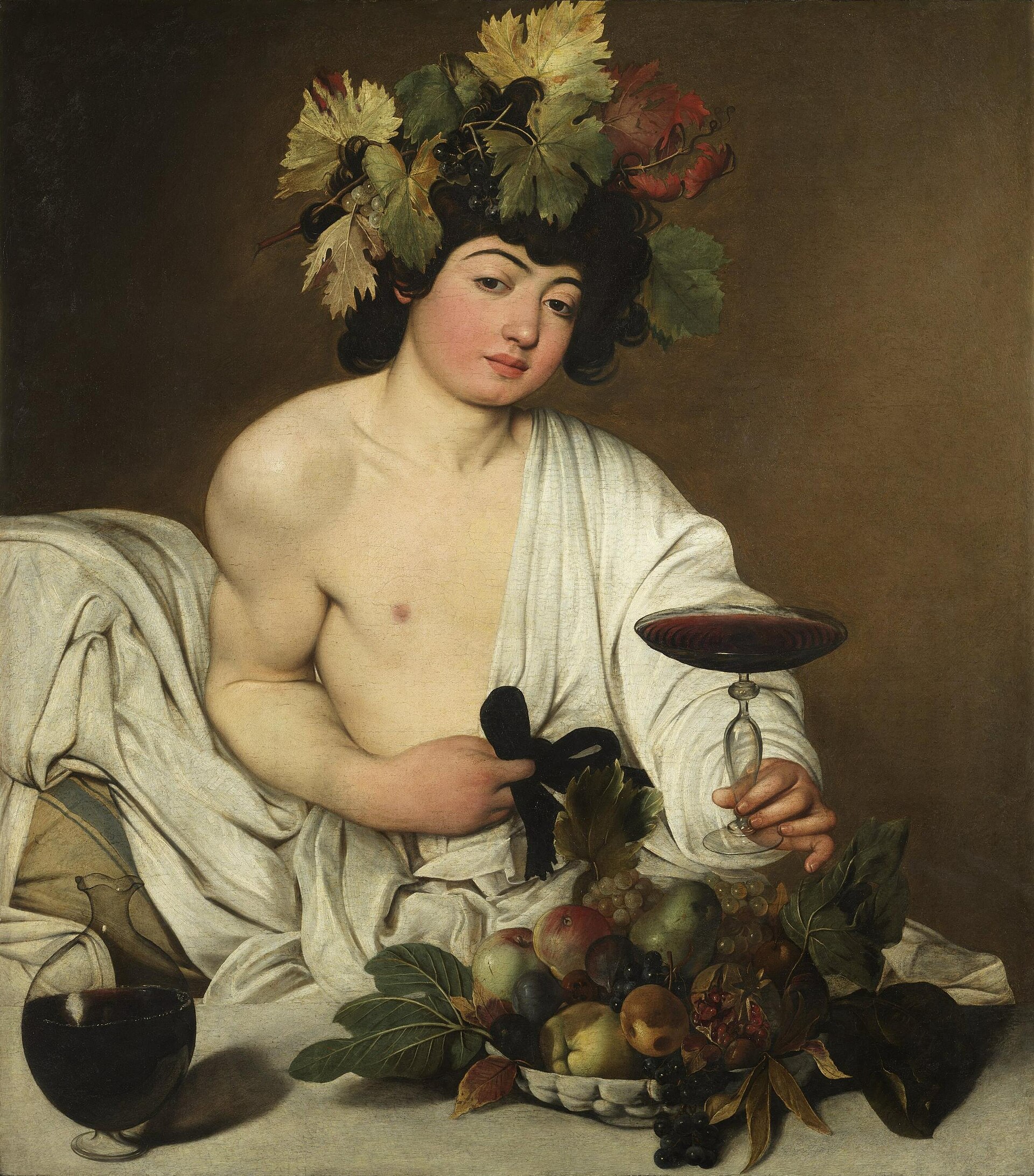
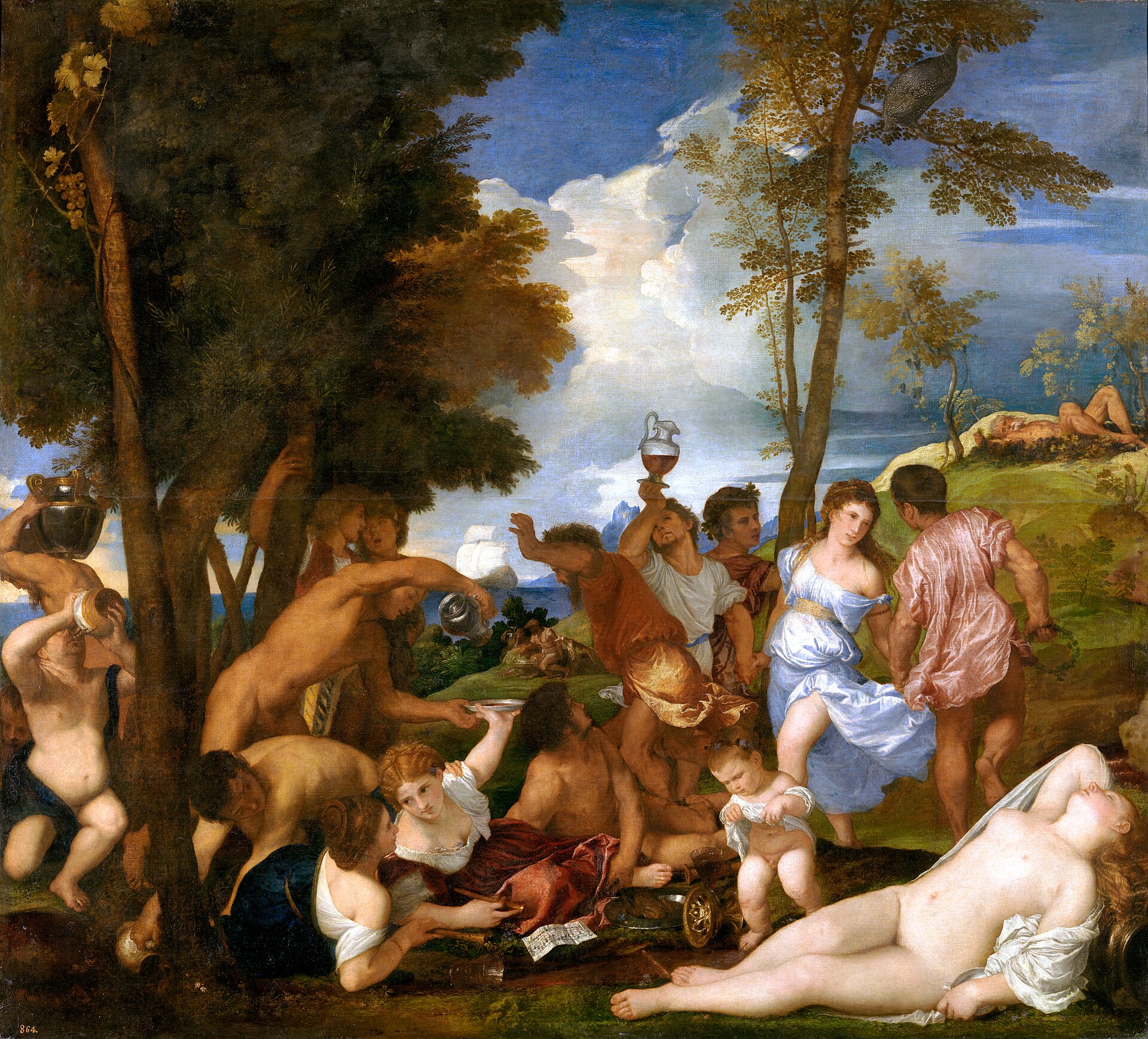
Bacchus survives everywhere in language and art: “bacchanal” and “bacchanalian” still name a wild celebration. Theater and opera trace part of their ancestry to his rites, the Nietzschean reception of Dionysus made him a symbol of the ecstatic and the anti-rational, and countless paintings and sculptures return to the vine-wreathed god. Few divinities have had so long an artistic afterlife.
Symbolism
His symbols encode his nature: the grapevine and wine cup are the gift of wine and its transforming power; the thyrsus, the ivy-tipped wand, is the emblem of his ecstatic followers; the ivy is wild growth and the loosening of order. Together they say what Roman religion both prized and feared in him — release that could become disorder, joy that could slip its bounds.
Famous public-domain depictions — click any image to view it full size.
Is Bacchus the same as Dionysus?
Bacchus was the Roman name most associated with Greek Dionysus, god of wine, ecstasy, and theater. They share the same core mythology, but the most distinctive Roman episode is historical rather than mythic: the Senate's suppression of the Bacchanalia in 186 BCE.
What was Bacchus the god of?
Wine, ecstasy, theater, altered identity, and ecstatic religious experience. His cult crossed boundaries of class, gender, restraint, and ordinary identity.
What was the Bacchanalia?
The ecstatic rites of Bacchus. In Rome they became politically explosive, and in 186 BCE the Senate issued the Senatus consultum de Bacchanalibus restricting the associations. The inscribed decree survives as direct evidence of official intervention.
Was the Bacchanalia really as scandalous as Livy claims?
Livy's lurid account portrays conspiracy, transgression, and murder, but modern historians warn that it reflects elite fear and rhetorical hostility. The 186 BCE decree proves official suppression; it does not prove every sensational accusation.
 Michael Paycer