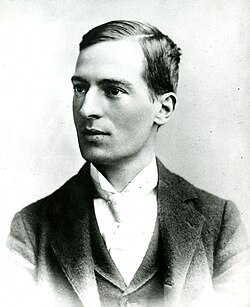
Harry Nelson Pillsbury
The great lost talent of American chess. In 1895, a 22-year-old from Massachusetts walked into the strongest tournament of the age — Hastings — and won it on his international debut, ahead of the reigning and former world champions. For a decade he was among the best players alive, gave his name to an attacking system still used today, and astonished audiences with feats of memory. Then, at 33, he was gone.
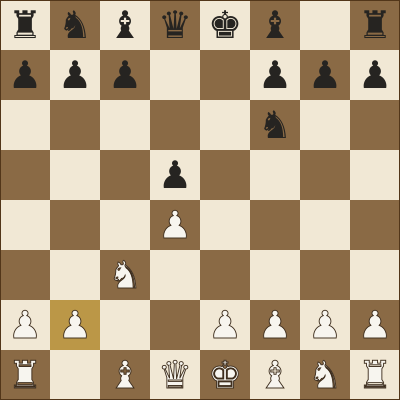
The classical Queen's Gambit structure that produced the Pillsbury Attack — White posts a knight on e5, pushes the f-pawn, and storms the kingside. Pillsbury demonstrated the plan so convincingly that it bears his name to this day.
Lived
1872–1906 · born Somerville, Massachusetts
Breakthrough
Won Hastings 1895 on his international debut
Namesake
The Pillsbury Attack in the Queen's Gambit Declined
Famous For
Prodigious memory and record blindfold/simultaneous play
The greatest debut in chess
The Hastings 1895 tournament was one of the strongest ever assembled — world champion Emanuel Lasker, former champion Wilhelm Steinitz, and every leading master of the era were there. Into this field stepped Harry Nelson Pillsbury, almost unknown internationally, and he won the whole thing. It was a sensation: an American youngster outscoring the entire chess aristocracy at his first attempt. Overnight he became a world-class star and a serious contender for the title.
He backed it up for years, holding his own with the very best, especially excelling against Lasker in tournament games even as the championship match he deserved never quite materialized.
A plan that still wins games
Pillsbury's lasting contribution to opening theory is the attacking system that carries his name. In the Queen's Gambit Declined, from the classical Carlsbad structure, he showed how White could plant a knight on e5, advance the f-pawn, and roll forward on the kingside while the centre stayed closed. It was a model of turning a quiet, strategic opening into a direct attack, and it is still taught as a standard plan for White.
Pillsbury was also one of the greatest blindfold and simultaneous players who ever lived, routinely playing twenty or more games at once without sight of the boards, alongside feats of memorizing long lists of random words. His mind was a marvel of its age — which only deepens the tragedy of how early it was lost.
The champion who never was
Pillsbury's health declined in his early thirties, and he died in 1906 at just 33, his strength failing before he could complete the climb to the world title that his talent had promised. He sits among the greatest players never to wear the crown — and, coming a generation before Capablanca, he is the bridge between the Steinitz–Lasker age and the modern American chess tradition that Morphy began and Fischer would one day carry to its summit.
Harry Nelson Pillsbury — FAQ
Why is Harry Nelson Pillsbury famous?
He won the great Hastings 1895 tournament on his international debut, finishing ahead of world champion Lasker, former champion Steinitz, and the whole elite. It was one of the most sensational debuts in chess history and made the young American an instant star.
What is the Pillsbury Attack?
In the Queen's Gambit Declined, it is White's plan of posting a knight on e5, advancing the f-pawn, and attacking on the kingside out of the Carlsbad structure. Pillsbury demonstrated it so well that it carries his name and remains a model attacking plan.
Why didn't Pillsbury become world champion?
He had the talent but never won a title match, and his life was cut short — his health failed and he died in 1906 at just 33. Had he lived, many believe he would have challenged for the world championship.
The Carlsbad structure — the launch pad of the Pillsbury Attack on the kingside.
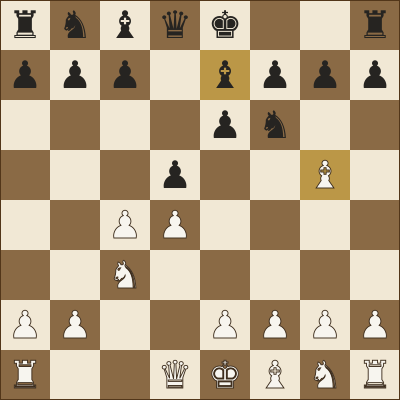
The Queen's Gambit Declined — the classical opening Pillsbury turned into a direct attack.
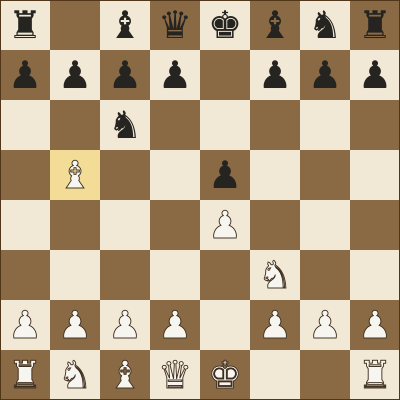
The classical open games of the Steinitz–Lasker era in which Pillsbury made his name.
- Hastings 1895 tournament book and game records.
- Pillsbury Attack theory (Queen's Gambit Declined, Carlsbad structure).
- Sergeant & Watts, Pillsbury's Chess Career.
- Accounts of his blindfold and memory exhibitions.
Trailblazers & champions
Pillsbury is one of chess's great might-have-beens. Explore the champions of his era and the trailblazers alongside him.