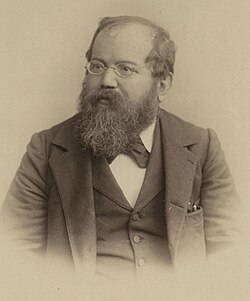
Wilhelm Steinitz
The first World Champion, and the man who taught chess to think. When Steinitz beat Johannes Zukertort in 1886, he became the first official champion in history — but his deeper claim to greatness is that he changed what chess is. He replaced the romantic cult of the attack with a scientific method, and every champion since has built on the foundation he laid.
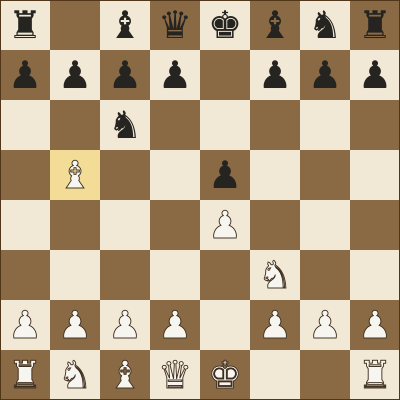
The Ruy Lopez — home of the solid Steinitz Defense (3...d6). It is fitting that one of the most classical, strategic openings carries his name: Steinitz taught players to accept a slightly cramped but sound position and win through understanding rather than fireworks.
Lived
1836–1900 · born Prague; later in London and New York
World Champion
1886–1894 — the first official champion, beat Zukertort
Legacy
Father of positional chess and the scientific method
Key Idea
Win by accumulating small, lasting advantages
The man who changed his mind
Steinitz began his career as a fierce attacker — so sharp that he was nicknamed "the Austrian Morphy." But over time he came to a radical conclusion: the brilliant sacrificial attacks of the romantic era only worked because the defence was poor. Against correct play, he argued, an unjustified attack must fail. The real path to victory was quieter and harder — to build, patiently, an accumulation of small advantages until they became overwhelming.
It was a revolution. Steinitz turned chess from an art of inspiration into a discipline with principles you could state and teach. He was also a tireless, combative writer who argued his theories in print for decades, and though many contemporaries resisted, the results spoke for themselves: in 1886 he won the first official World Championship and held it for eight years.
The accumulation of small advantages
At the heart of Steinitz's teaching is a single idea: chess advantages are real, lasting things — a better pawn structure, control of an open file or a key square, the bishop pair, a safer king, more space — and the way to win is to gather them, one by one, until together they decide the game. A player should not lash out; he should improve his position and only attack when the advantages justify it.
Among the ideas he established: only attack when you have an advantage, or the attack will rebound; if you have an advantage, you are obliged to attack or risk losing it; the defender has real resources and a sound position can be held; the king is a strong piece able to help defend itself; and weaknesses in the pawn structure are permanent targets. These sound obvious today only because Steinitz made them so.
Wilhelm Steinitz — FAQ
Who was the first World Chess Champion?
Wilhelm Steinitz, who beat Johannes Zukertort in 1886 in the first match recognized as being for the World Championship. He held the title until 1894, when he lost to Emanuel Lasker, and is regarded as the first official champion and founder of the modern game.
What was Steinitz's positional revolution?
He argued chess is won not by spectacular sacrifices but by accumulating small, lasting advantages — pawn structure, key squares, the bishop pair, king safety — and that you should only attack when you hold an advantage. This overturned the romantic style and made chess a science.
How did Steinitz change defence?
He pioneered the idea that positions can be defended, that the defender has real resources, and that holding firm against an unjustified attack — even with a cramped position — is a winning strategy. He even argued the king was a strong piece that could defend itself.
The Ruy Lopez — home of the Steinitz Defense and the classical, strategic chess he championed.
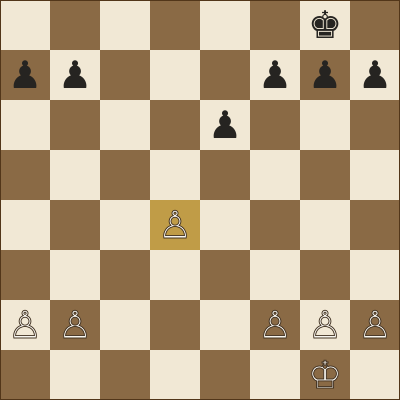
A structural feature — the kind of permanent strength or weakness Steinitz taught players to accumulate and exploit.
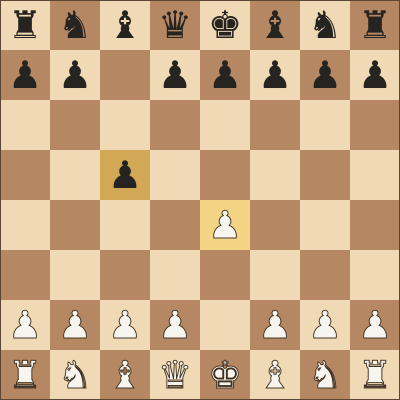
The open games where Steinitz first made his name as an attacker before his positional revolution.
- World Championship 1886 (Steinitz–Zukertort) records.
- Steinitz, W. The Modern Chess Instructor.
- Landsberger, K. William Steinitz, Chess Champion.
- Kasparov, G. My Great Predecessors, Vol. I (Steinitz).
Wilhelm Steinitz — Part 1 of 2
The theory is only half the story. Part 2 shows the method in action — and proves that the great positional scientist could still produce one of the most brilliant attacks of the 19th century.