Luck · Chance · Fate · Reversal
Fortuna, Roman Goddess of Luck and Fate
One of Rome's most pervasive powers — she blesses and she ruins. Behind her turning wheel lies a hard question: is the world governed by providence, or by chance?
 Michael Paycer
One of Rome's most pervasive powers — she blesses and she ruins. Behind her turning wheel lies a hard question: is the world governed by providence, or by chance?
Michael PaycerRole
Luck, chance, fate, prosperity, reversal
Symbols
Wheel, rudder, cornucopia, globe
Cult
Primigenia, Redux, Virilis; oracle at Praeneste
Greek equivalent
Fortuna was one of the most pervasive divine powers in Roman life — goddess of luck, chance, fate, prosperity, and reversal. She was invoked by farmers and generals, travelers and emperors, in circumstances high and low. Under many cult titles — Primigenia, Redux, Virilis, and others — she served different communities and situations, which is why her worship reached into almost every corner of Roman experience.
What makes Fortuna distinctive is her double edge. She can grant abundance and safe return, and she can strip both away without warning. That instability is not a flaw in her worship but its very point: Fortuna is the name Romans gave to the fact that the world does not always reward merit.
Fortuna's cult was ancient and deeply Italian, older than much of the Greek mythology later layered onto her. Her great sanctuary at Praeneste (modern Palestrina), home of the oracle of Fortuna Primigenia, was one of the most important religious sites in central Italy, drawing worshippers who sought to read the future through her lots.
As Rome grew, Fortuna multiplied into a whole family of specialized cults — Fortuna Redux for safe homecoming, Fortuna Virilis in the sphere of women and marriage, and many more. Later she became a genuine philosophical problem: is the universe ruled by providence, by fate, or by unstable luck? Stoics pressed for a rational, providential order, while poets and historians loved the sheer drama of Fortune's reversals.
Fortuna was worshipped both as a public state power and in countless private appeals. At Praeneste her oracle answered petitioners through sortition — the drawing of inscribed lots — a mechanism that made chance itself a channel of the divine. Elsewhere her many titles anchored temples, altars, and festivals across the city and empire. Generals and emperors cultivated her favor, and Fortuna Redux was thanked for the safe return of rulers from campaign. To worship Fortuna was to acknowledge, ritually, that success and safety were never simply earned.
Fortuna was identified with the Greek Tyche, goddess of luck and the fortune of cities, and shares much of her iconography — the wheel, the rudder that steers events, the cornucopia of plenty. But the identification runs only so far. Fortuna's Roman cult was older, larger, and far more embedded in the machinery of the state, from the oracle at Praeneste to the imperial thanksgivings of Fortuna Redux. Reading the two together shows how Rome took a familiar figure and made her a pillar of civic religion.
Fortuna's most famous image is the wheel she turns — the rota Fortunae — lifting the lowly to the heights and casting the mighty down again. It is less a narrative myth than a picture of how she works, and it became the master metaphor for luck and reversal in later Western art and thought.
In On the Fortune of the Romans, Plutarch stages a set-piece contest between Fortune and Virtue over which of them deserves credit for Rome's rise to greatness. The very framing captures the Roman anxiety Fortuna embodies: did Rome earn its empire, or was it handed the winning throw?
At her sanctuary of Fortuna Primigenia, petitioners received answers by drawing lots — letting pure chance speak for the goddess. Here Fortuna is not a character in a story but a working presence, consulted by ordinary people trying to know what the future held.
Fortuna outlived Roman religion by centuries. Boethius, writing in prison, gave her a speech in The Consolation of Philosophy that carried Fortune's wheel into the medieval imagination, where it turns through cathedral windows, manuscripts, and morality plays. The word “fortunate,” the figure of Lady Luck, the Wheel of Fortune in tarot, and every modern discussion of chance versus design descend from her. Whenever we speak of a turn of fortune, we are still speaking her language.
Her attributes spell out her nature. The wheel is ceaseless rise and fall; the rudder is her power to steer the course of lives and events; the cornucopia is the abundance she can pour out; and the globe or ball beneath her foot is instability itself — a footing that can roll away at any moment. Together they say what Rome meant by Fortuna: bounty and ruin held in the same hand.
Famous public-domain depictions — click any image to view it full size.
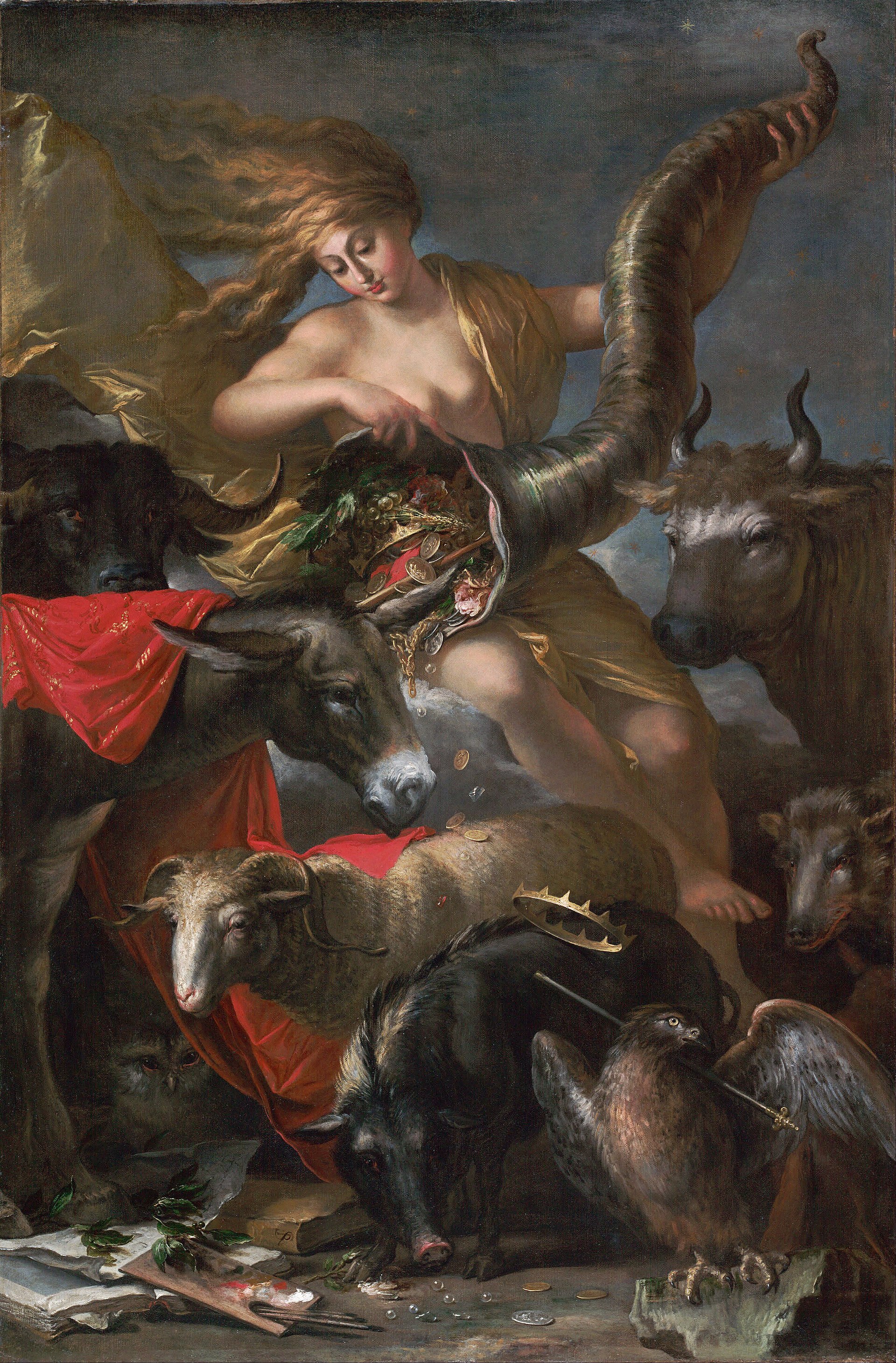
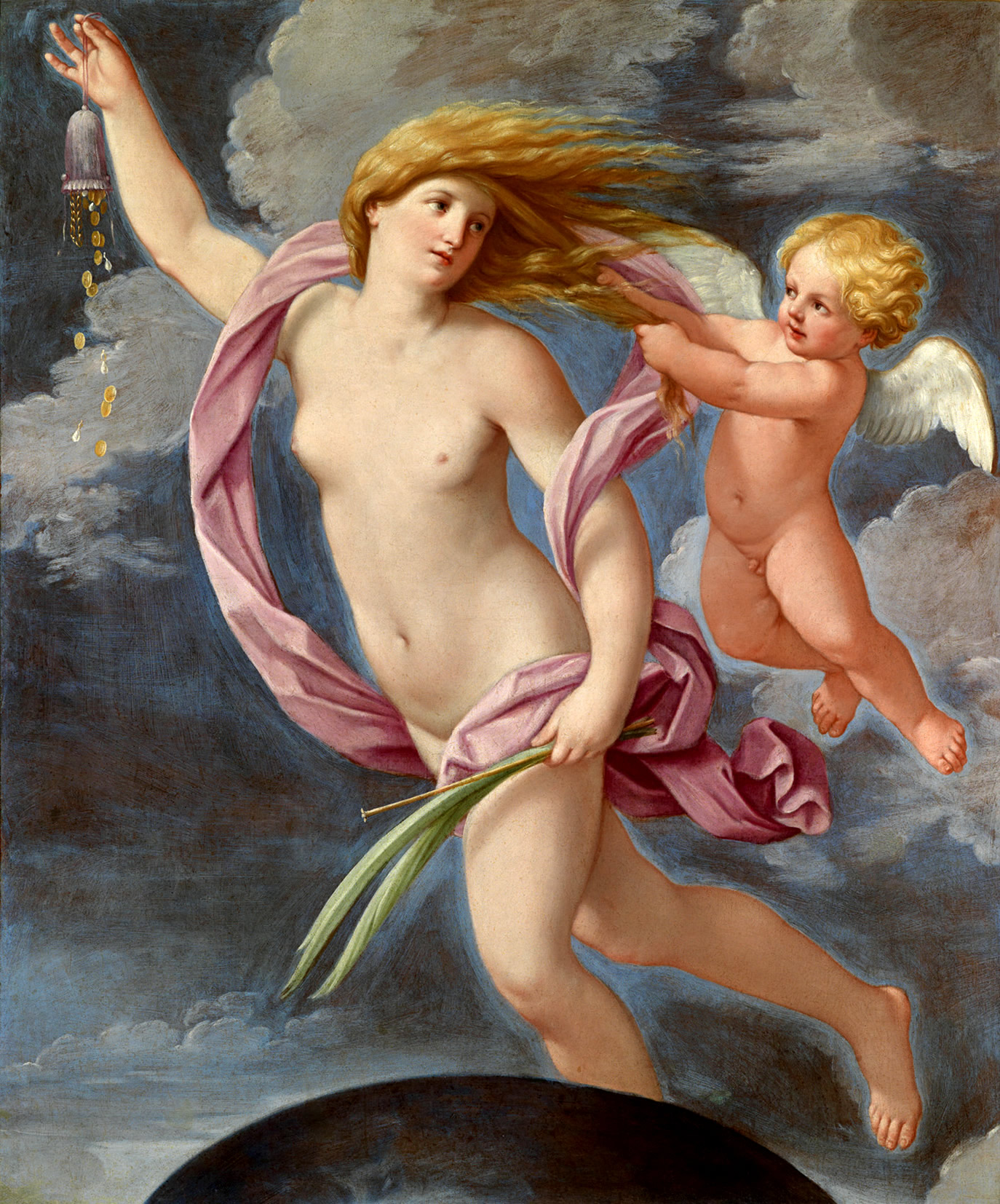
[Paraphrase] In On the Fortune of the Romans, Plutarch stages a debate over whether Fortune or Virtue deserves the credit for Rome's greatness. (Summary of the work's argument; no single line is quoted verbatim here.)
Plutarch, On the Fortune of the Romans (paraphrase)
Fortuna shows Roman religion thinking out loud about chance and meaning: the same goddess could be a working oracle at Praeneste, a symbol of imperial success, and — in the hands of philosophers — the test case for whether the universe is ruled by providence or by luck.
Ancient Italian power of luck and fate, with a vast Roman cult — the oracle at Praeneste, titles like Redux and Primigenia, and a central role in state religion.
Greek goddess of luck and the fortune of cities — the model for Fortuna's imagery, but without her deep roots in Roman civic and oracular cult.
Fortuna was identified with the Greek Tyche, goddess of luck and chance, and shares her imagery of the wheel and rudder. But Fortuna's Roman cult was far larger and older, with many titles — Primigenia, Redux, and others — serving communities and situations across the whole of Roman life.
Luck, chance, fate, prosperity, and sudden reversal. She could grant protection, wealth, safe return from travel, and success — and she was also the power that explained why fortunes turn without warning.
Fortune's wheel — the rota Fortunae — is the image of Fortuna turning a wheel that raises people to the top and casts them down again. Popularized for the Middle Ages through Boethius, it became one of the most enduring symbols of luck and reversal in Western art.
Fortuna made this a central philosophical problem. Stoics argued the universe was governed by rational providence, not blind chance, while literary culture loved the drama of Fortune's wheel and her reversals. Plutarch even staged a debate over whether Fortune or Virtue deserved credit for Rome's greatness.
When I am not reading Virgil or Cicero, I tune databases, design high-availability systems, and run cloud migrations.