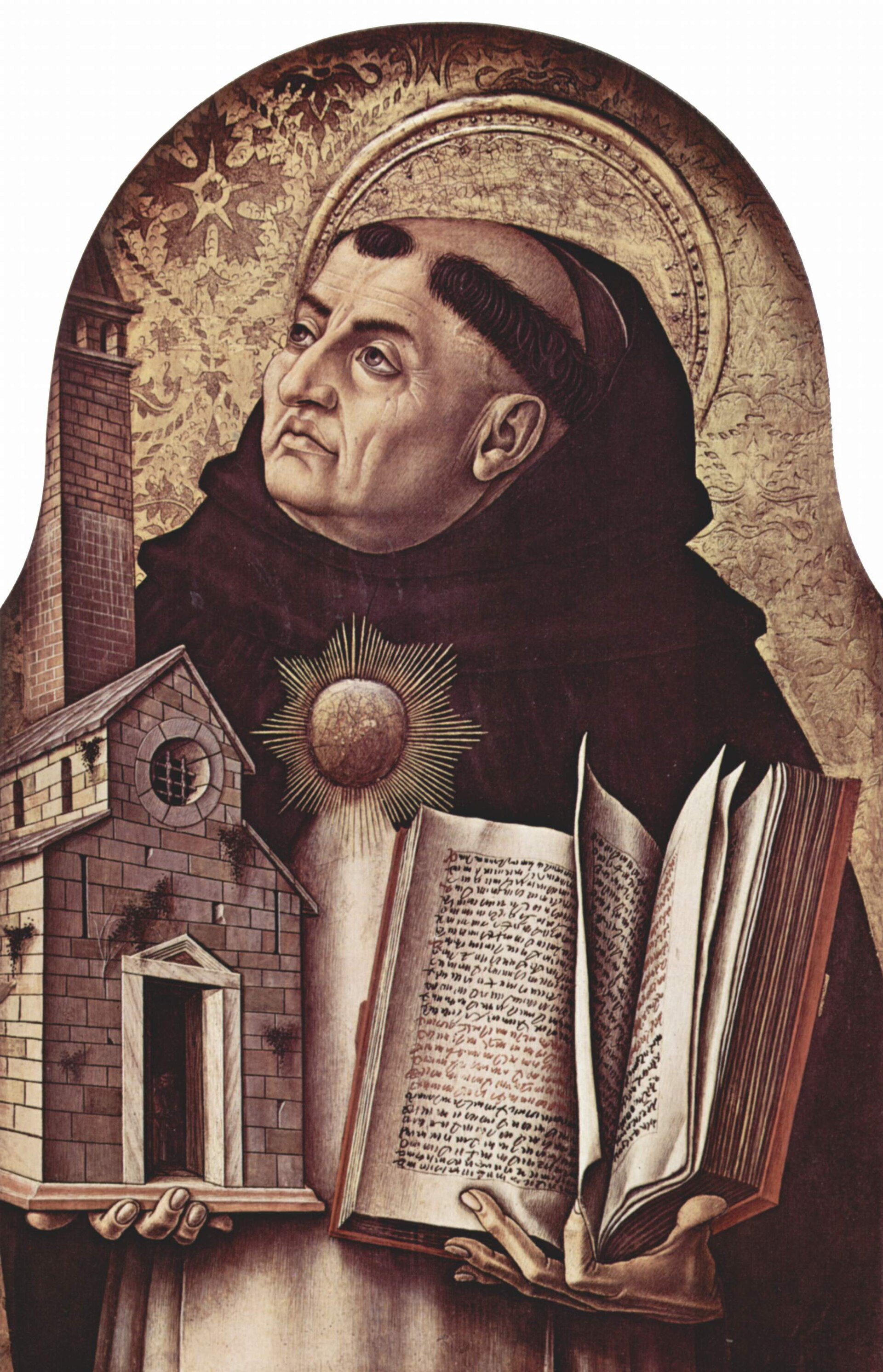
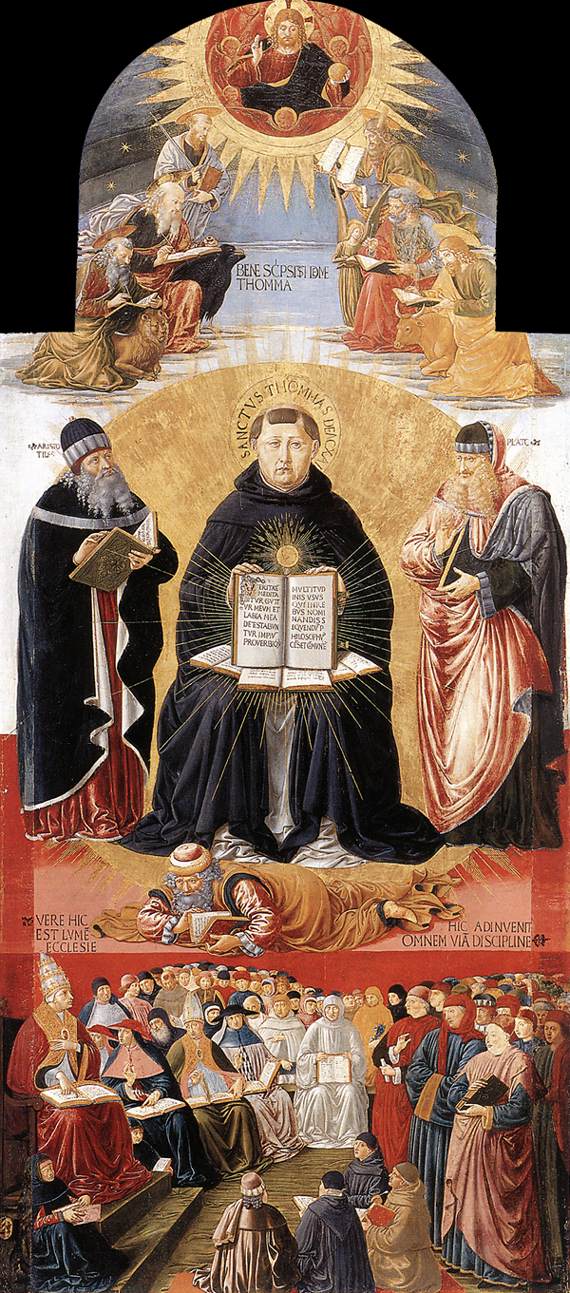
Who was Aquinas?
Thomas Aquinas was the towering thinker of the Middle Ages. At a time when the rediscovered works of Aristotle seemed to threaten Christian belief, Aquinas argued the opposite — that reason and faith are partners, not rivals.
His lens: unite faith and reason. Truth is one; what we learn through careful reasoning and what we learn through faith cannot ultimately conflict, because both come from the same source.
Life & era
Born into an Italian noble family, Aquinas defied them to join the new, mendicant Dominican order. A quiet, heavyset student nicknamed 'the dumb ox,' he became the most influential theologian in the Catholic tradition.
His great unfinished Summa Theologica systematized Christian thought using Aristotle's philosophy, and his synthesis remains foundational to Catholic teaching and natural-law theory today.
Big ideas
Faith and reason in harmony
Aquinas held that reason can establish much on its own — including, he argued, the existence of God — while revelation adds truths reason cannot reach alone. The two are complementary paths to one truth.
Natural law
There is a moral order built into human nature and accessible to reason. By understanding what genuinely fulfills human beings, we can derive moral principles — the basis of natural-law ethics in law and politics to this day.
The Five Ways
Aquinas offered five rational arguments for God's existence — from motion, causation, contingency, degrees of perfection, and the order of nature — among the most discussed arguments in the history of philosophy.
Faith seeking understanding
Aquinas held that grace perfects nature rather than destroying it: reason can carry us a long way toward truth, and revelation completes what reason cannot reach alone. He gave the medieval world its most confident synthesis of the two.
The cardinal and theological virtues
Building on Aristotle, Aquinas mapped the virtues — prudence, justice, courage, temperance — and added the "theological" virtues of faith, hope, and love, integrating Greek ethics with Christian life into a single account of the good person.
Legacy & influence
Aquinas became the central theologian of the Catholic Church; his Summa Theologica shaped Western thought for centuries, and "Thomism" remains a living philosophical school. He was canonized a saint and named a Doctor of the Church.
His natural-law theory still underpins much of Western ethics, law, and debates about human rights, and his rescue of Aristotle for the Christian and Western tradition carried the Greek inheritance a thousand years forward. The question he answered — how reason and faith fit together — has never stopped mattering.
Themes & debates
Where reason ends and faith begins. Aquinas drew a confident line: reason reaches some truths, revelation completes the rest. But every later thinker has redrawn that boundary, and the question of how much religion and reason can or should say to each other remains as open as ever.
Natural law in a plural world. Aquinas held that a moral order is built into human nature and knowable by reason. In modern, pluralistic societies that disagree about human nature itself, can natural-law arguments still command agreement? The debate runs through ethics, law, and politics today.
Public-domain portraits and depictions — click any image to view it full size.
Aquinas rescued Aristotle for the Western and Christian tradition, fusing Greek philosophy with faith. In doing so he extended the Greek inheritance a thousand years forward.
His question — how do reason and faith fit together? — remains one of the most consequential in the history of thought, and his answer still shapes ethics, law, and theology.
What is Aquinas best known for?
Reconciling the philosophy of Aristotle with Christian theology, and arguing that faith and reason lead to the same truth. His Summa Theologica is a foundational work of Western thought.
What is natural law?
Aquinas's idea that a moral order is built into human nature and discoverable by reason. By understanding what truly fulfills human beings, we can derive moral and legal principles.
What are the Five Ways?
Five rational arguments by Aquinas for the existence of God — from motion, cause, contingency, degrees of perfection, and natural order — among the most analyzed arguments in philosophy.
How did Aquinas use Aristotle?
He adopted Aristotle's logic, metaphysics, and ethics and integrated them into Christian theology, arguing that Aristotle's reason and Christian faith were compatible rather than opposed.
 Michael Paycer