Steinitz's Theory in Action
It is tempting to picture the father of positional chess as a dry technician. The truth is richer: Steinitz taught players when to attack, not to stop attacking — and when his principles said the moment had come, he could deliver a combination as brilliant as anything in the romantic era. Nowhere is that clearer than in his masterpiece at Hastings 1895.
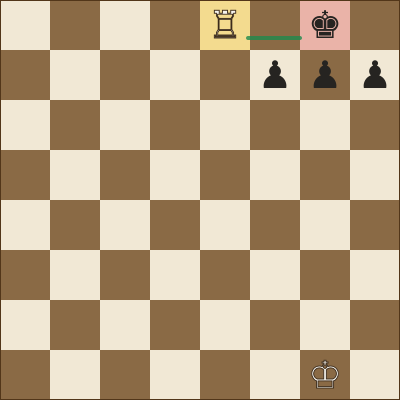
The reward of a justified attack: a forced mate. Steinitz's theory was never anti-attack — it was about earning the right to attack by first accumulating advantages. When the position was ripe, as against von Bardeleben in 1895, the assault was overwhelming and exact.
The timing that ties it together
The most misunderstood part of Steinitz's teaching is that it is not anti-attack. His rule was about timing: attack when your position justifies it, and not before. Lash out against a sound position and the assault rebounds — but once you have accumulated enough small advantages, you are actually obliged to attack, or you risk letting the edge slip away. Positional play and the attack are not rivals; the first earns the right to the second.
That is why a positional theorist could still be a fearsome attacker. Steinitz spent the early game doing the patient work — improving squares, fixing weaknesses, keeping his king safe — and when the balance tipped, he struck with full force.
Steinitz–von Bardeleben, Hastings 1895
At the legendary Hastings 1895 tournament — one of the strongest events of the century — Steinitz produced his immortal game. From a Giuoco Piano he built pressure, then sacrificed material to tear open the black king's shelter and launch a forced combination. The finish involved a cascade of checks that von Bardeleben could not escape.
Faced with the inevitable, Curt von Bardeleben did something extraordinary: rather than resign, he stood up, left the playing hall, and never returned, letting his clock run down. Unbothered, Steinitz reportedly turned to the watching masters and played out the forced mate — roughly ten moves of checks ending in checkmate — to applause. It is one of the most famous endings in chess, and a perfect rebuttal to anyone who thought the positional champion had lost his teeth.
The kind of forced mating net Steinitz wove against von Bardeleben — the king driven into a corner by check after check, every escape covered. The combination was the product of his positional groundwork, not an alternative to it.
Lasker, and a lasting legacy
Steinitz held the world title from 1886 until 1894, when the younger Emanuel Lasker beat him in a match; Lasker won their 1896–97 rematch decisively too. Steinitz's final years were hard — money troubles and failing health — and he died in 1900. But by then the argument was over: the game had become a science, and every champion who followed, from Capablanca to the modern masters, played the positional chess Steinitz had invented. He is where the lineage on this site begins.
Steinitz in Action — FAQ
What is the Steinitz–von Bardeleben game?
Steinitz's most famous attacking game, from Hastings 1895. In a Giuoco Piano he sacrificed to expose Black's king and forced a mating combination. Von Bardeleben, rather than resign, left the hall and let his clock run out — and Steinitz demonstrated the forced mate to the spectators.
Did Steinitz only play positional chess?
No. He founded positional theory but began as a brilliant attacker and never lost the gift. His point was timing: attack when the position justifies it. When his advantages warranted it, he produced combinations as dazzling as any romantic master.
How did Steinitz's reign end?
He held the title from 1886 until 1894, when Emanuel Lasker beat him; Lasker won the 1896–97 rematch too. Steinitz's later years brought hardship and ill health, and he died in 1900 — but his theories had already permanently reshaped chess.
The forced mate — the kind of finish Steinitz earned through patient positional play.
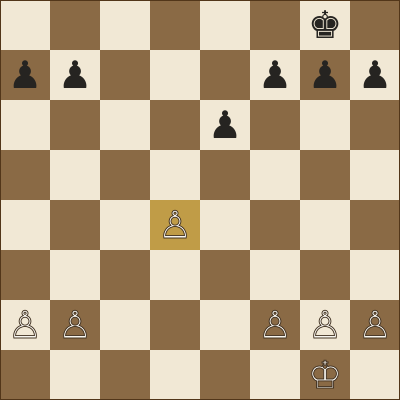
A structural advantage — the raw material of Steinitz's "small advantages" theory.
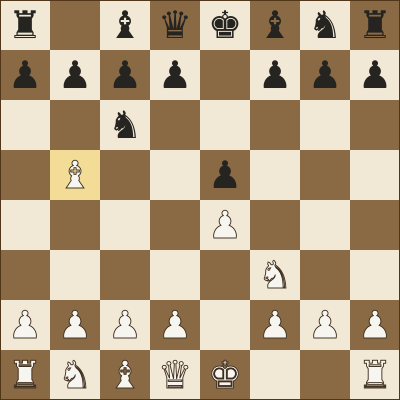
The classical openings (Part 1) where his strategic principles do their quiet work.
- Steinitz–von Bardeleben, Hastings 1895 (game record).
- Steinitz, W. The Modern Chess Instructor.
- World Championship matches 1886, 1894, 1896–97 (records).
- Kasparov, G. My Great Predecessors, Vol. I (Steinitz).
Wilhelm Steinitz — Part 2 of 2
That completes the Steinitz guide — the first champion who turned chess into a science, and proved the scientist could still attack like an artist. From here the lineage runs forward to every champion on this site.