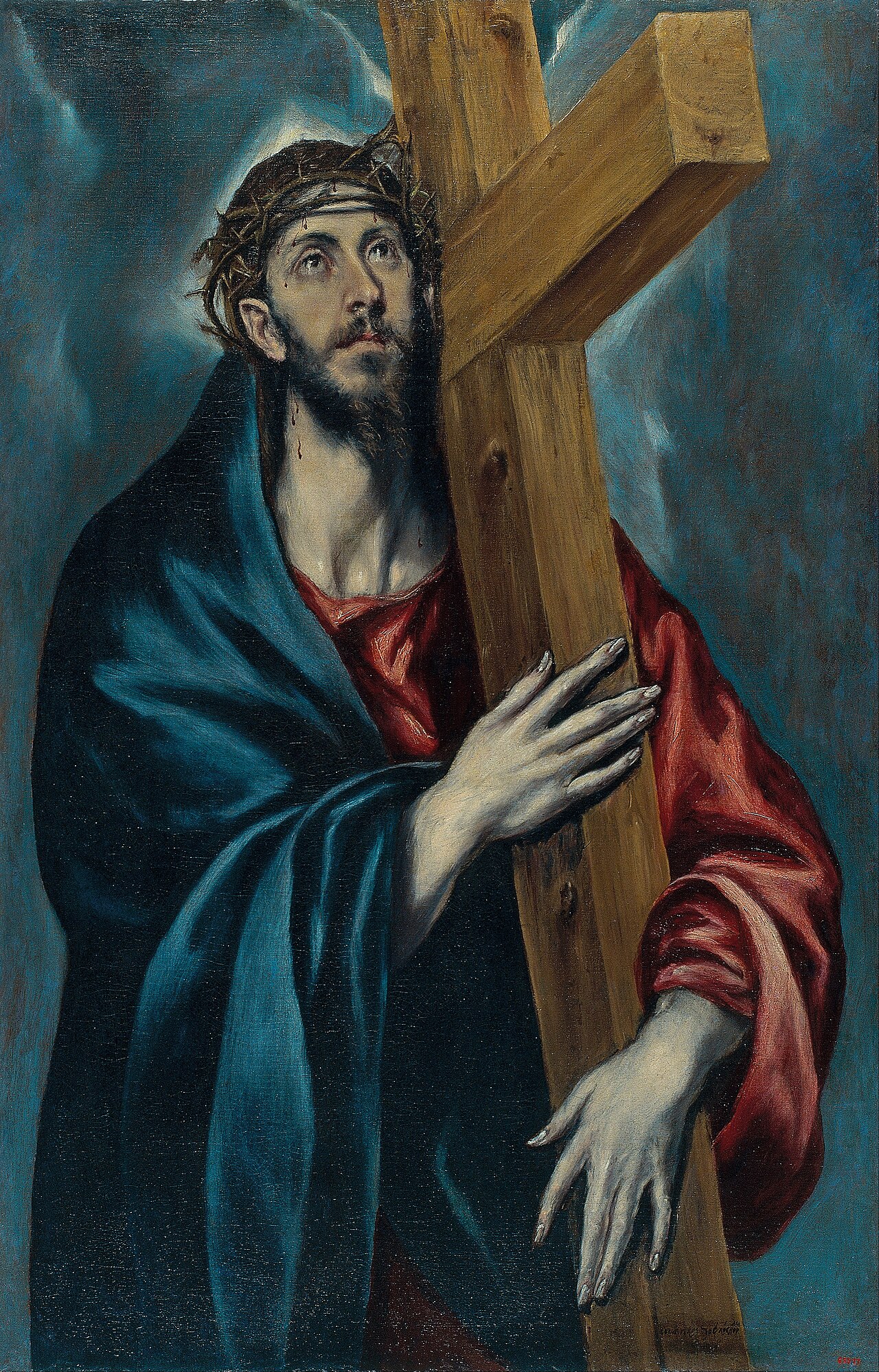
The Stations of the Cross turn the last hours of Jesus into a walk. Moving from image to image around a church, the believer stops at fourteen moments — a condemnation, a stumble, a mother's face, a death — and prays through each one. It is the Passion made slow and physical, so it can't be rushed past. Here is the full set, where it comes from, and what it's for.
Michael Paycer
Fourteen scenes from condemnation to burial
A prayed walk, station to station
Especially Lent and Good Friday
Each station is a pause — look, remember, pray, move on. Together they trace the road from the judgment hall to the sealed tomb.
| # | The station | |
|---|---|---|
| 1 | Jesus is condemned to death | The sentence |
| 2 | Jesus takes up his cross | The burden accepted |
| 3 | Jesus falls the first time | Tradition |
| 4 | Jesus meets his mother | Mary on the road |
| 5 | Simon of Cyrene helps carry the cross | A stranger conscripted |
| 6 | Veronica wipes the face of Jesus | Tradition |
| 7 | Jesus falls the second time | Tradition |
| 8 | Jesus meets the women of Jerusalem | “Weep for yourselves” |
| 9 | Jesus falls the third time | Tradition |
| 10 | Jesus is stripped of his garments | The stripping |
| 11 | Jesus is nailed to the cross | The crucifixion |
| 12 | Jesus dies on the cross | The death |
| 13 | Jesus is taken down from the cross | The deposition |
| 14 | Jesus is laid in the tomb | The burial |
Most of these come straight from the Gospel accounts of the Passion. A few — the three falls, and Veronica wiping his face with a cloth — are from tradition rather than Scripture, which is worth knowing rather than glossing. Because of that, Pope John Paul II introduced a Scriptural Way of the Cross that keeps only events found in the Bible, beginning in Gethsemane. Some versions of the devotion also add a fifteenth station for the Resurrection, so that the walk doesn't end at the tomb.
The devotion began with real footsteps. Early pilgrims to Jerusalem would retrace Jesus' actual route to Golgotha — the road later called the Via Dolorosa, the “Way of Sorrows.” Most Christians, of course, could never make that journey. So the Church brought the road to them: stations were set up in local churches, usually fourteen carvings or paintings spaced around the walls, so that anyone could make the same spiritual pilgrimage without leaving town. The Franciscans, entrusted with the holy sites, did the most to spread the practice, and the number settled at fourteen in the eighteenth century.
Prayed slowly — a station at a time, with a pause at each — it works much like the rosary: a repeated, embodied rhythm that keeps the mind from racing and lets a single scene do its work. One of its most human moments has nothing to do with Jesus directly:
“And as they led him away, they laid hold upon one Simon, a Cyrenian… and on him they laid the cross, that he might bear it after Jesus.”— Luke 23:26 (KJV)
A bystander pulled from the crowd to shoulder another man's burden — the fifth station, and, many have felt, a small picture of the whole thing.

The Stations refuse to let the Passion be a single word — “crucified.” They break it into fourteen slow steps, so the one praying has to walk the whole road rather than skip to the end.
This page lays out the stations and where the devotion comes from. What walking them has meant to me, personally, belongs in its own space, and a reflection will live here soon. — Michael
Fourteen in the traditional set, from Jesus' condemnation to his burial. Some versions add a fifteenth for the Resurrection.
Most are, drawn from the Passion narratives. A few — the three falls and Veronica — are from tradition. A “Scriptural Way of the Cross” keeps only biblical events.
Any time, but especially during Lent and on Good Friday, when many parishes pray them together as a community.
When I'm not walking the fourteen stations, I tune databases, design high-availability systems, and run cloud migrations.