
The Elo Rating System
Sit down across from a stranger at a tournament, glance at the pairing sheet, and you both already know something important about each other — not your name or your country, but your number. That four-digit figure is your Elo rating, and in the chess world it is as close to a universal identity as the game has.
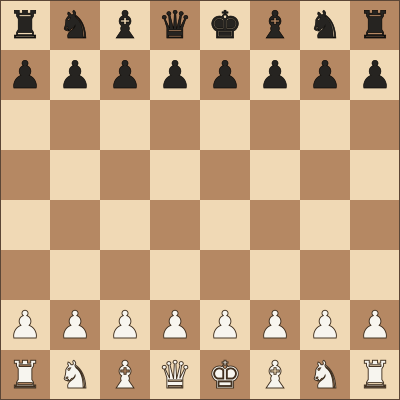
Where every rated game begins: the same 32 pieces, an identical setup — and yet, before a single move, the two players' ratings already predict who is favored. Making that prediction, then correcting it, is exactly what the Elo system is built to do.
Named For
Arpad Elo, a Hungarian-American physics professor who designed the system in the 1960s
Adopted by FIDE
1970 — the global standard for chess ever since
Typical Range
~100 for beginners to 2800+ for the world elite; Magnus Carlsen peaked at 2882
The K-Factor
Controls how fast a rating moves: K=40 for new players, K=10 above 2400
The man behind the math
The Elo system takes its name from Arpad Elo, a Hungarian-American physics professor obsessed with ranking chess players fairly. Before Elo in the 1960s, rating systems were inconsistent and easy to game. His insight was elegant: instead of measuring skill directly, measure it relatively — through outcomes against other rated players. FIDE adopted his system officially in 1970, and it has been the global standard ever since.
Today, Elo ratings run from around 100 for absolute beginners to above 2800 for the world's best. Magnus Carlsen, widely considered the greatest player in history, peaked at a jaw-dropping 2882. Most club players sit between 1200 and 1800; breaking 2000 is a serious milestone; Grandmaster territory starts at 2500.
- Absolute beginner / new to rated play~100–800
- Improving club player1200–1800
- Strong club / tournament regular1800–2000
- Expert & candidate master2000–2300
- International Master / Grandmaster floor2400–2500
- World elite2700+
How you earn a rating
You earn a rating by playing rated games — either over the board in FIDE-sanctioned tournaments, or online through platforms like Chess.com or Lichess, which run their own Elo-style systems that update in real time after every game. Your FIDE rating is recalculated and published on an official list. To get an initial FIDE rating you must play a minimum number of rated games against rated opponents; once you cross that threshold every result moves your number up or down.
Your Chess.com rating and your FIDE rating are not the same thing, and they are not meant to be. Online ratings tend to run significantly higher than FIDE equivalents — partly inflation, partly different player pools. Players new to over-the-board chess are often humbled to discover this firsthand.
The logic under the hood (no calculus required)
Here is the core idea: before any game begins, the system already has an expectation of what will happen based on both ratings. An 1800 against a 1400 is heavily favored; 1600 versus 1600 is a coin flip. What happens to your rating depends entirely on whether the result matched that expectation.
When you are the favorite
Beat the 1400 as an 1800 and you gain a handful of points — 2 or 3 — because it was expected. But if that 1400 beats you, you lose a significant chunk: the system penalizes you in proportion to how surprising the loss was.
When you are the underdog
Flip it: as the 1400, beating the 1800 earns a lot of points — you dramatically outperformed expectations. Lose, and you barely drop anything, because losing to someone 400 points higher was already predicted.
Every point one player gains comes directly from the other. The total number of rating points in the system stays constant — think of it less like a grade and more like a poker-chip economy.
How fast can you rise?
One variable controls how dramatically your rating swings after each game — the K-factor, a sensitivity dial. New players and juniors have a high K-factor (FIDE uses K=40 for new players), so their ratings shift quickly — which makes sense, because their true strength is still unknown and the system should locate them fast. Established players above a threshold drop to a lower K-factor (K=10 above 2400): for a grandmaster with a decade-long track record, one bad tournament should not crater everything. Their rating becomes a slow-moving average rather than a snapshot. When experienced players joke that their rating "doesn't move anymore," that is by design.
What the numbers unlock
The Elo system is the backbone of the entire FIDE title structure. Earning the Grandmaster title requires two things together: reaching a 2500 rating and recording three GM performance norms at qualifying tournaments. A norm means playing at grandmaster level across a qualifying event — it is not enough to grind your rating up slowly; you must prove you can perform at that level under competitive conditions. The same dual requirement — sustained rating plus peak performance — applies to the International Master and FIDE Master titles, preventing a title from being earned purely by playing lots of easy opponents over time.
Why the whole world uses it
The genius of Elo is that it turns something subjective — chess skill — into a portable, comparable number. A 2100 in Brazil, Norway, or Japan is, in theory, playing at roughly the same level, which makes it invaluable for pairing players of similar strength. That is also why the concept spread far beyond chess: League of Legends, Counter-Strike, and dozens of competitive games use Elo-based matchmaking; analysts have adapted it to rate NFL teams and tennis players; and a few dating apps have even used Elo-style algorithms to rank profiles — which says something either flattering or deeply unsettling about competition in modern life.
Elo Rating — FAQ
Why is my Chess.com rating higher than my FIDE rating?
Different player pools and rating inflation. Online platforms run their own self-contained Elo-style systems, so the numbers are not directly interchangeable with FIDE's. A 1600 on Chess.com generally corresponds to a meaningfully lower FIDE figure.
How many points do I gain for an upset win?
It depends on the rating gap and your K-factor, but the bigger the upset, the bigger the swing. Beating someone hundreds of points above you can net a large gain, while beating someone far below you earns only a point or two.
What is a "good" chess rating?
Context matters. Breaking 1000 means you are an established rated player; 1500–1800 is a solid club player; 2000 (Expert) is a real milestone; 2200 is roughly National Master strength; 2500 is the Grandmaster floor.
Can my rating go down even if I play well?
Yes. If you score below your rating-based expectation against a field — even respectably — you can lose points. Elo tracks results relative to expectation, not effort or quality of play.
- Elo, A. The Rating of Chessplayers, Past and Present (1978).
- FIDE Handbook — Rating Regulations and Title Regulations.
- Glickman, M. "A Comprehensive Guide to Chess Ratings."
- Chess.com and Lichess rating-system documentation.
Chess Concepts — Ratings & Variants
If the Elo rating measures skill, Chess960 strips skill back to its essence — removing memorized opening theory entirely. Read the companion explainer next.