The Genius of Chess960
You sit down at the board, your opponent plays 1.e4, and suddenly you are not playing chess anymore — you are reciting it. Twenty-five moves deep into a Ruy Lopez or a Najdorf Sicilian, both players are still on autopilot, burning through memorized lines laid down by grandmasters decades before either was born. Bobby Fischer hated this. In 1996, he decided to do something about it.
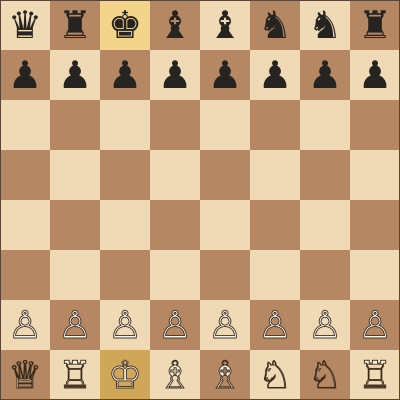
Chess960 shuffles the back rank into one of 960 starting configurations — bishops on opposite colors, king between the rooks. Everything else stays the same, but opening theory goes out the window from move one.
Invented By
Bobby Fischer, announced June 19, 1996 in Buenos Aires as "Fischerandom Chess"
Starting Positions
960 unique back-rank arrangements; the traditional setup is position number 518
What Changes
Only the back-rank pieces are shuffled — pawns, movement, capture, and checkmate are unchanged
FIDE Recognition
Officially recognized in 2019; the first FIDE Chess960 World Championship was held in Oslo that year
What Fischer wanted to solve
By the mid-1990s, Fischer had been away from competitive chess for more than twenty years, yet he remained obsessed with the game — and increasingly disgusted by it. He believed professional chess had devolved into a contest of memory rather than thought. Opening theory had ballooned to the point where top grandmasters employed teams of analysts and computers to prepare ever-deeper novelties; the player who remembered further won before a single original move was made.
Fischer's diagnosis was blunt: "Chess is a dead game." His prescription was equally radical. On June 19, 1996, in Buenos Aires, he introduced Fischerandom Chess — a variant to strip away the preparation arms race and force players to actually think from move one. The concept was elegant: randomize the back-rank pieces, and leave everything else the same. The pawns stand where they always have; the rules of movement, capture, and checkmate are unchanged. But the king, queen, rooks, bishops, and knights are shuffled into one of 960 configurations — hence the name most players use today, Chess960.
Three constraints preserve the geometry
Chess960 is not a free-for-all. The randomization follows three strict constraints that keep the game's fundamental geometry intact.
- The two bishops must sit on opposite-colored squares — one light, one dark — just as in standard chess, keeping both bishops relevant and the diagonals intact.
- The queen and knights can occupy any of the remaining squares in any order.
- Most critically, the king must be placed between the two rooks. This is not aesthetic — it is essential for preserving castling.
Applied together, these constraints yield exactly 960 unique starting positions (four light-bishop squares × four dark-bishop squares × 60 arrangements of the rest = 960). Each is numbered 0 to 959, and the traditional position is number 518.
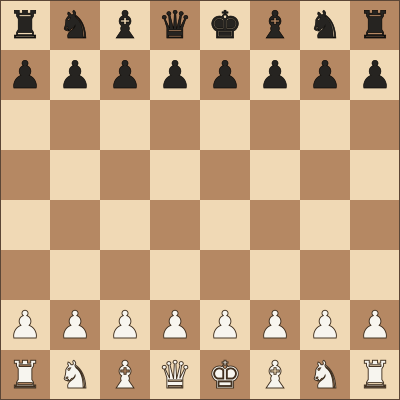
Standard start — position 518. The familiar back rank: R N B Q K B N R. One of the 960, and the only one most players ever see.
A sample Chess960 start. A legal shuffle: bishops on opposite colors, king between the rooks. No opening book applies — both players think from move one.
The same destination, a different journey
Adapting castling to Chess960 required the most creative rule-writing. In standard chess, kingside castling moves the king to g1 and the rook to f1; queenside castling sends the king to c1 with the rook on d1. Those destinations are fixed — and Chess960 preserves them.
No matter where the king and rooks start, the final positions after castling are identical to standard chess: king on g1/g8 with the rook on f1/f8 for kingside, and king on c1/c8 with the rook on d1/d8 for queenside.
The practical consequence is that sometimes a king or rook moves only a single square to castle — or, in positions where the king already sits on g1, castling might not move the king at all. The prerequisites are the same as always: neither king nor rook may have moved, no square the king passes through may be attacked, and the squares between must be clear. It sounds complicated in the abstract, but at the board it becomes intuitive quickly. The destination is always the same; only the journey differs.
From fringe idea to FIDE championship
For years Chess960 lived on the margins — beloved by a passionate minority but largely ignored by the mainstream. That changed as the generation raised on computers and databases began pushing back against the very tools they had been trained on. Magnus Carlsen, the longest-reigning World Champion of the modern era, became the variant's most prominent advocate, arguing that Chess960 produces purer, more entertaining chess that reveals who can actually play rather than who prepared better. Nakamura, Caruana, So, and many other elite players embraced it as a legitimate, demanding test of skill.
The institutional watershed came in 2019, when FIDE officially recognized Chess960 and ratified its rules. In the inaugural FIDE World Fischer Random Championship that year, held in Norway, Wesley So crushed Magnus Carlsen in the final to become the variant's first official world champion. Hikaru Nakamura won the second edition in 2022, edging Ian Nepomniachtchi in an armageddon finish — and in 2026 Carlsen finally claimed the crown himself. Chess.com and Lichess have since made the variant accessible to millions, driving an explosion in grassroots play.
Why players love it — and Fischer's strange legacy
Ask enthusiasts what they love about the format and you hear a consistent theme: it is honest. In standard chess, hundreds of hours memorizing the Grünfeld or the Catalan is a legitimate skill — but one adjacent to chess rather than chess itself. Chess960 erases that advantage. When both players face a novel position on move one, everything has to be earned through calculation, pattern recognition, positional understanding, and creativity — the things that drew people to the game in the first place. It is democratizing, too: the club player who cannot afford a second job in preparation competes on more equal footing.
Bobby Fischer never competed in a Chess960 event. His later years were marked by exile and estrangement from the chess world he had dominated, and he died in Reykjavík in January 2008 — the same city where his 1972 match against Spassky had transfixed the planet. He left two enduring monuments: a chess legacy of surpassing brilliance, and a variant that grows more popular every year. Ironically, the man who declared chess dead may have done more to revitalize it than anyone in the modern era. Chess960 is not a replacement for standard chess — it is a complement, a reminder that beneath all the theory there is still a game of pure, unmediated thought waiting to be played.
Chess960 — FAQ
Why exactly 960 positions?
There are four squares for the light-squared bishop and four for the dark-squared bishop (16 combinations). The queen and two knights then occupy the remaining squares, and with the king forced between the rooks the remaining arrangements total 60. 16 × 60 = 960.
Is the standard chess position one of the 960?
Yes — the normal setup (RNBQKBNR) is position number 518. Standard chess is simply one special case of Chess960.
How does castling work if the king already starts on the g-file?
The king and rook still end on their standard castling squares. If the king already sits on the destination square, only the rook moves; in some positions the king moves just one square. The end position is always the same as in classical chess.
Do opening principles still matter?
Absolutely. Develop pieces, control the center, get the king safe, do not move the same piece twice without reason. What disappears is memorized theory — you must derive a plan from the position in front of you.
Is it called Chess960 or Fischer Random?
Both. Fischer named it "Fischerandom"; "Chess960" (from the 960 positions) is the more common term today, and FIDE uses "Fischer Random / Chess960."
- Fischer's June 19, 1996 Buenos Aires announcement.
- FIDE Handbook — Appendix on Chess960 rules (2019).
- Reports from the 2019 (Wesley So), 2022 (Hikaru Nakamura), and 2026 (Magnus Carlsen) FIDE World Fischer Random Championships.
- Chess.com and Lichess Chess960 documentation.
Chess Concepts — Rules & Variants
Chess960 strips chess back to pure thought; the Elo rating measures how well you think. Read the companion explainer, or dive into the full opening guides.